

Decontaminating Water
[maghub_sidebar]
digital illustration of an hourglass; Quick Tech Tips department heading
Decontaminating Water
digital illustration of an hourglass; Quick Tech Tips department heading
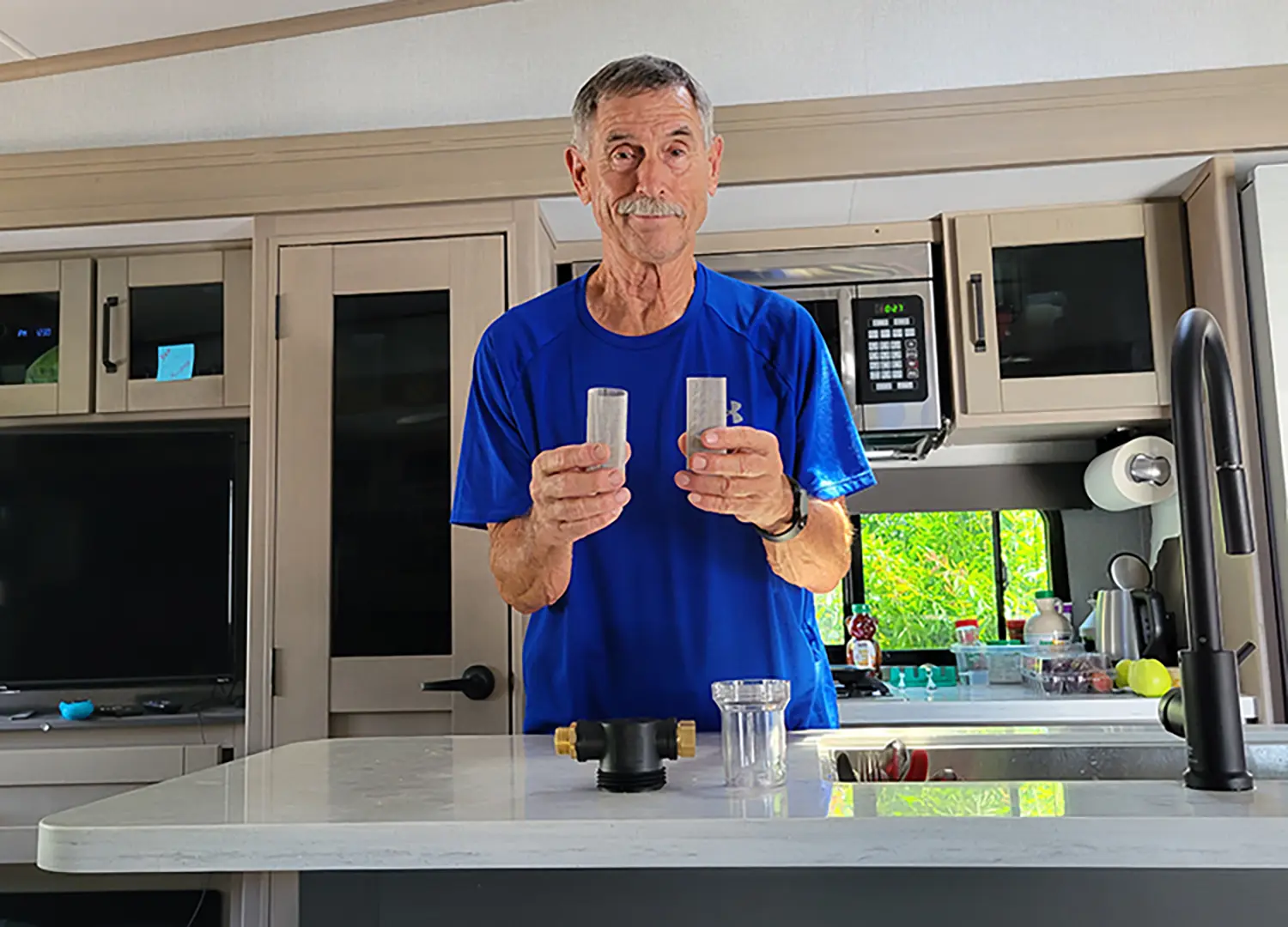
Indoor RV close-up photograph perspective of Bill Gehr in a blue shirt holding small mesh screen filter tubes plus The Twinkle Star Garden Hose Filter Attachment product with the attachment's transparent jar tube are located on the marble countertop as he stands nearby the sink area
Keeping contaminants out of an RV’s water system is an ongoing process. You can’t have too much filtering when dealing with unknown sources, especially water supplied from a well. A mesh screen filter is a good way to pre-strain debris from water.
By Bill Gehr / Photos by author
R

Vers who move from park to park know that water quality can be hit-or-miss in certain places. The water flowing out of the faucet can be full of anything from sand to dirty contaminants. There’s nothing worse than discovering — too late — that the water flow in the system has slowed down considerably or even become plugged with calcium or other materials coming from the campground hookup.

And we haven’t even mentioned the need to clean the aerator screens in the faucets on a frequent basis.

I use a solid carbon block filter between the faucet and the RV. This is effective for taste and odor, but it does nothing to help trap sediments, especially from well water that can be full of sand and other solids. A sediment filter used as part of a good multi-filter set-up, like the one from Clearsource (clearsourcerv.com), does a tremendous job of removing quite a bit of the bad stuff, but I found a garden-hose filter attachment that fits a standard garden hose or city-water hookup gives me another layer of protection by filtering out the bigger particles that have a tendency to prematurely plug the sediment filter used in the whole-house system.

There are numerous mesh filters on the market, and many are designed to filter out particles when connecting a hose to a pressure washer. The one I bought, Twinkle Star Garden Hose Filter Attachment (Amazon, $16.99), comes with 40- and 100-mesh screens, is only 5 x 5.5 x 2.6 inches and can be easily attached to any garden hose or fitting with the ¾-hose-type threads (to include the city-water connection). This particular filter attachment comes with pretty good quality brass fittings that should last quite a while through multiple hookups. The box also comes with a couple of washers. This type of filter is very similar to the mesh screen used at the demand water pump inlet to trap particles that would otherwise enter the pump.

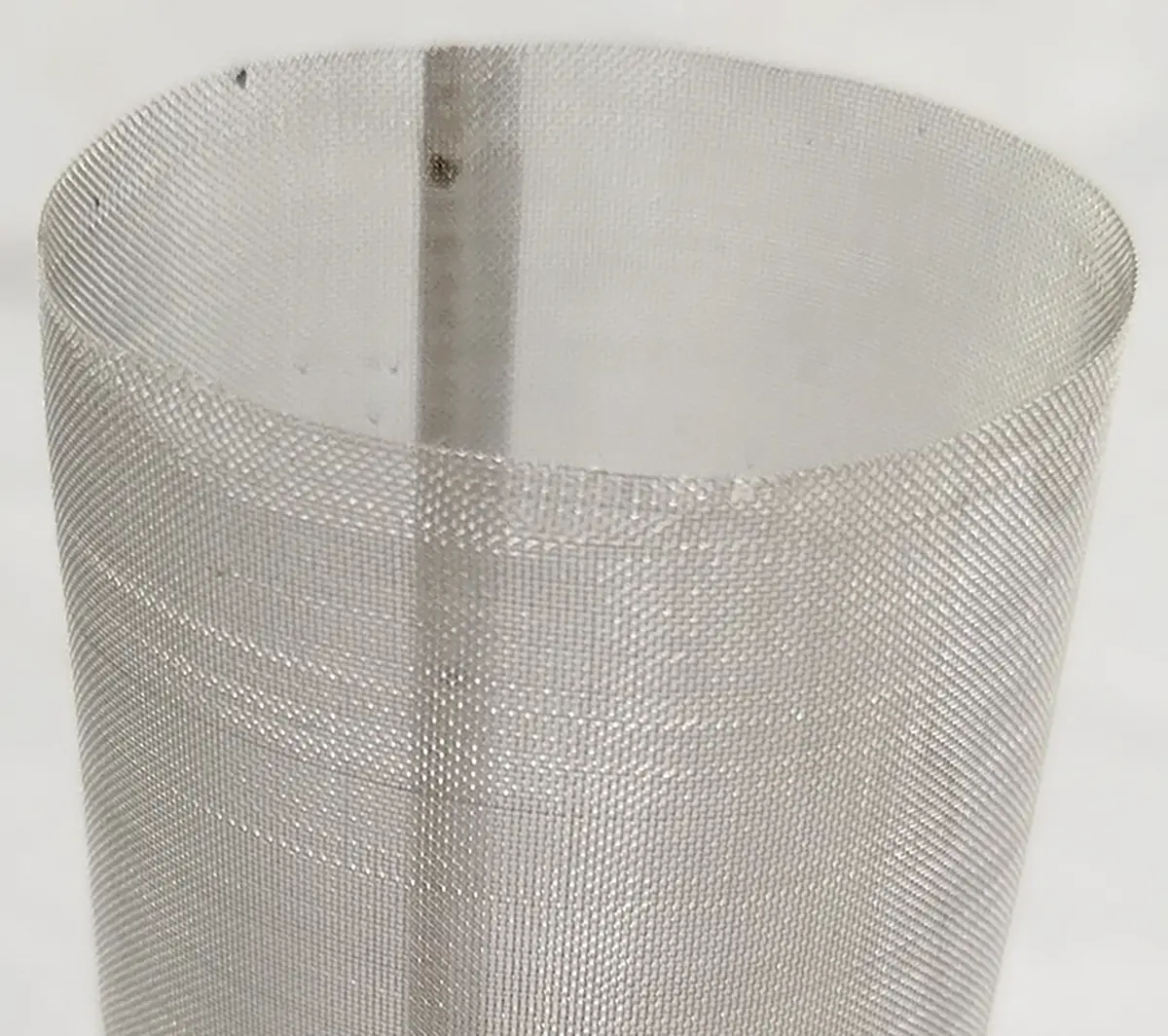
Keep in mind that the mesh filter will not remove smaller particles, since a 100-mesh screen is equivalent to a 149-micron filter. (A mesh rating is the number of openings measured across one linear inch of screen.) Most sediment filters targeted for RV filter systems are rated at 0.5 microns. You could also use this filter on your hose to restrict larger contaminants when filling the water tank via a gravity fill opening.

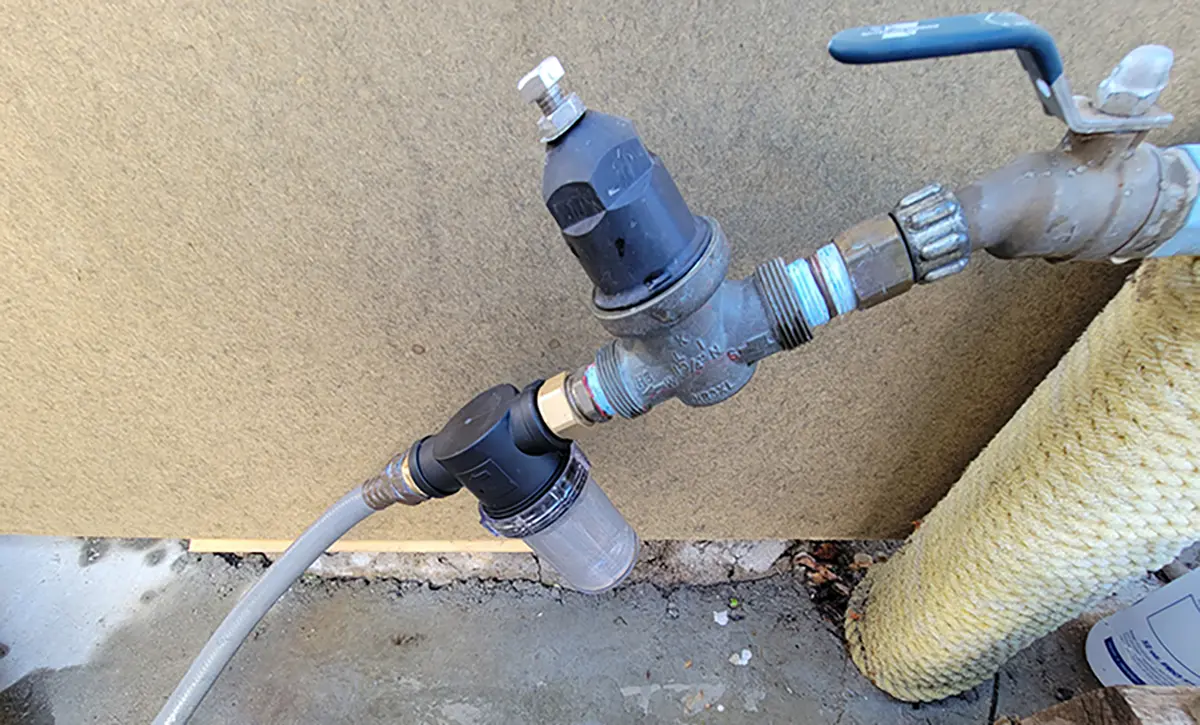
A friend installed his mesh filter in the utility bay, at the city water inlet, but I found a better location was at the pressure regulator outlet. I was tempted to place this filter in front of the regulator, but it is only rated up to 80 psi. If the RV park water pressure is higher, it might damage the filter; my pressure regulator is set at 50 psi. The Twinkle Star filter is made of plastic and metal.

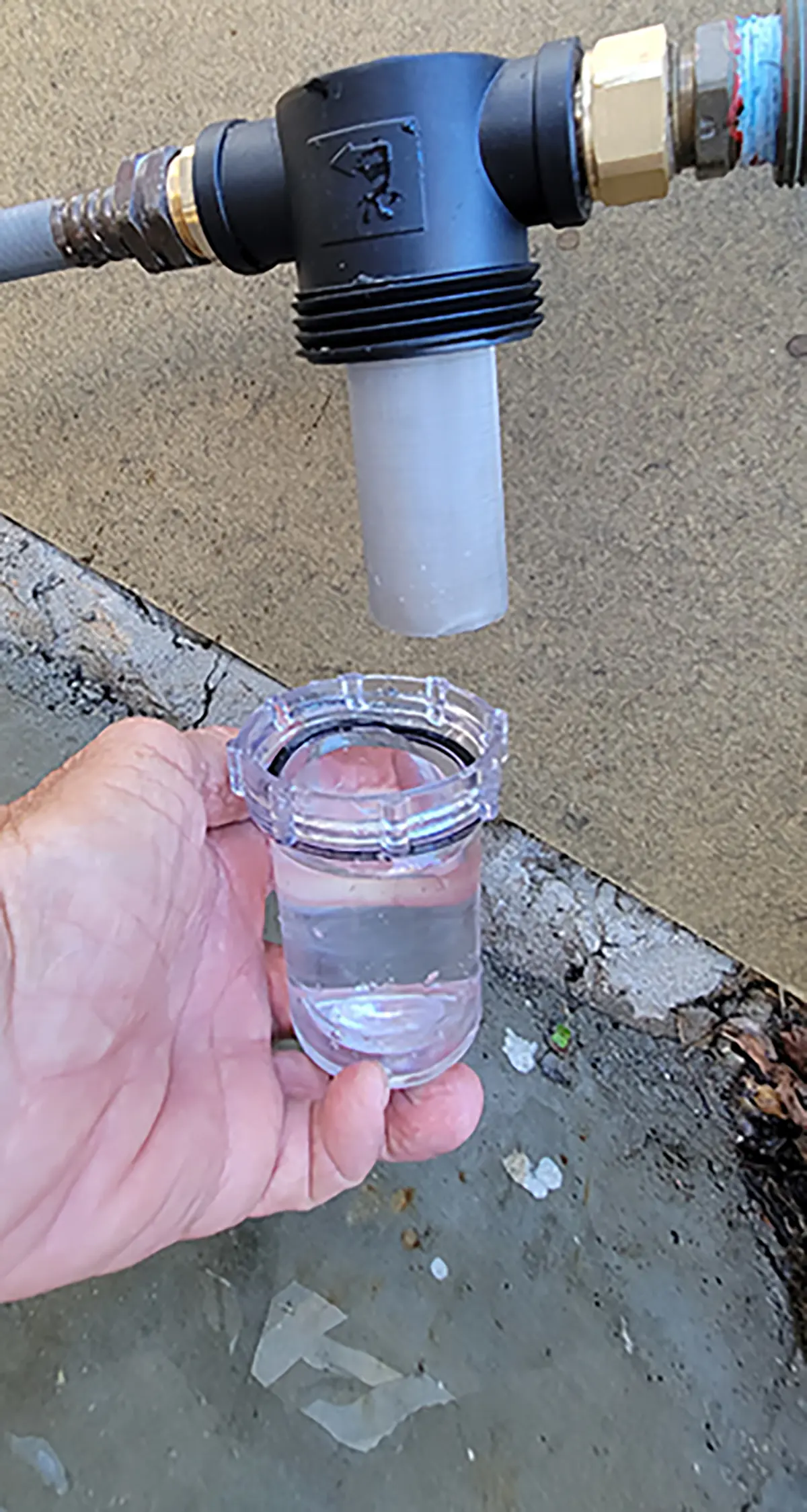
The fine mesh screen inside the filter housing is very easy to clean: Just unscrew the clear jar attached to the bottom of the head assembly and rinse it clean. Some of the stubborn stuff may stick to the screen, so you may need a toothbrush or a small soft bristle brush to break up the particles.

If the calcium from a water heater is excessive, it might send larger particles of built-up calcium and mineral created by the combustion process down the line. These particles normally find their way into your aerators. Therefore, another use for a mesh filter is to install one downline from the water heater hot tube, which may play a role in dissipating some of the particles before reaching the faucets and showerhead(s) due to the high water temperature.

When it comes to dealing with unknown water sources, you can’t have too much filtering. Your water system and appliances will thank you.
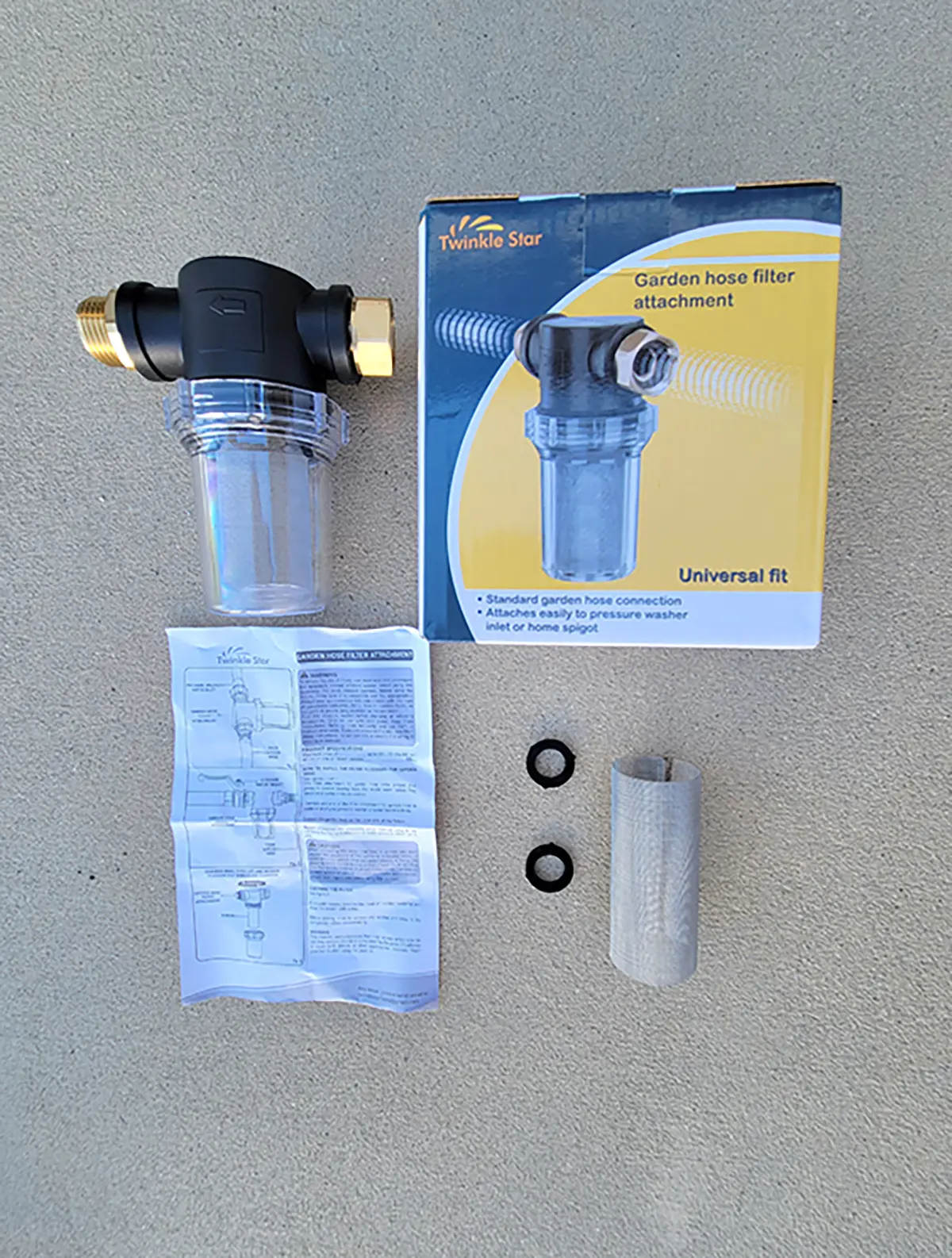
Close-up photograph perspective of The Twinkle Star Garden Hose Filter Attachment product with a tiny manual document, product box, and other accessories; While found on Amazon for $16.99, it was originally targeted as a filter for pressure washers that are attached to a water hose. It was adapted for use as a prefilter for RV water sources.
The Twinkle Star Garden Hose Filter Attachment, found on Amazon for $16.99, was originally targeted as a filter for pressure washers that are attached to a water hose. It was adapted for use as a prefilter for RV water sources.
Close-up photograph perspective of the installation site of the mesh filter at the hose bib area; It was the best place right after the water pressure regulator. That way water pressure can be maintained at 50 psi; the mesh attachment is rated for 80 psi; some RV park water can exceed that pressure without a regulator.
I found the best place to install the mesh filter was right after the water pressure regulator at the hose bib. That way water pressure can be maintained at 50 psi; the mesh attachment is rated for 80 psi; some RV park water can exceed that pressure without a regulator.
Close-up photograph perspective of Bill Gehr's hand holding a small transparent see through jar tube with water filled inside it and the mesh filter is attached to the head assembly located up above; 100 and 40 mesh filters are provided with the kit. The 100-mesh screen is equivalent to 149 microns. Cleaning the filter is simple; just remove the jar to access the mesh screen; it might require the use of a toothbrush or similar “tool” to removed stuck-on contaminants.
The mesh filter is attached to the head assembly; 100 and 40 mesh filters are provided with the kit. The 100-mesh screen is equivalent to 149 microns. Cleaning the filter is simple; just remove the jar to access the mesh screen; it might require the use of a toothbrush or similar “tool” to removed stuck-on contaminants.
Close-up photograph perspective of a mesh filter; They are rated by the number of openings in one linear inch. The 100-mesh screen is the finer of the two provided with the garden hose attachment kit.
Mesh filters are rated by the number of openings in one linear inch. The 100-mesh screen is the finer of the two provided with the garden hose attachment kit.
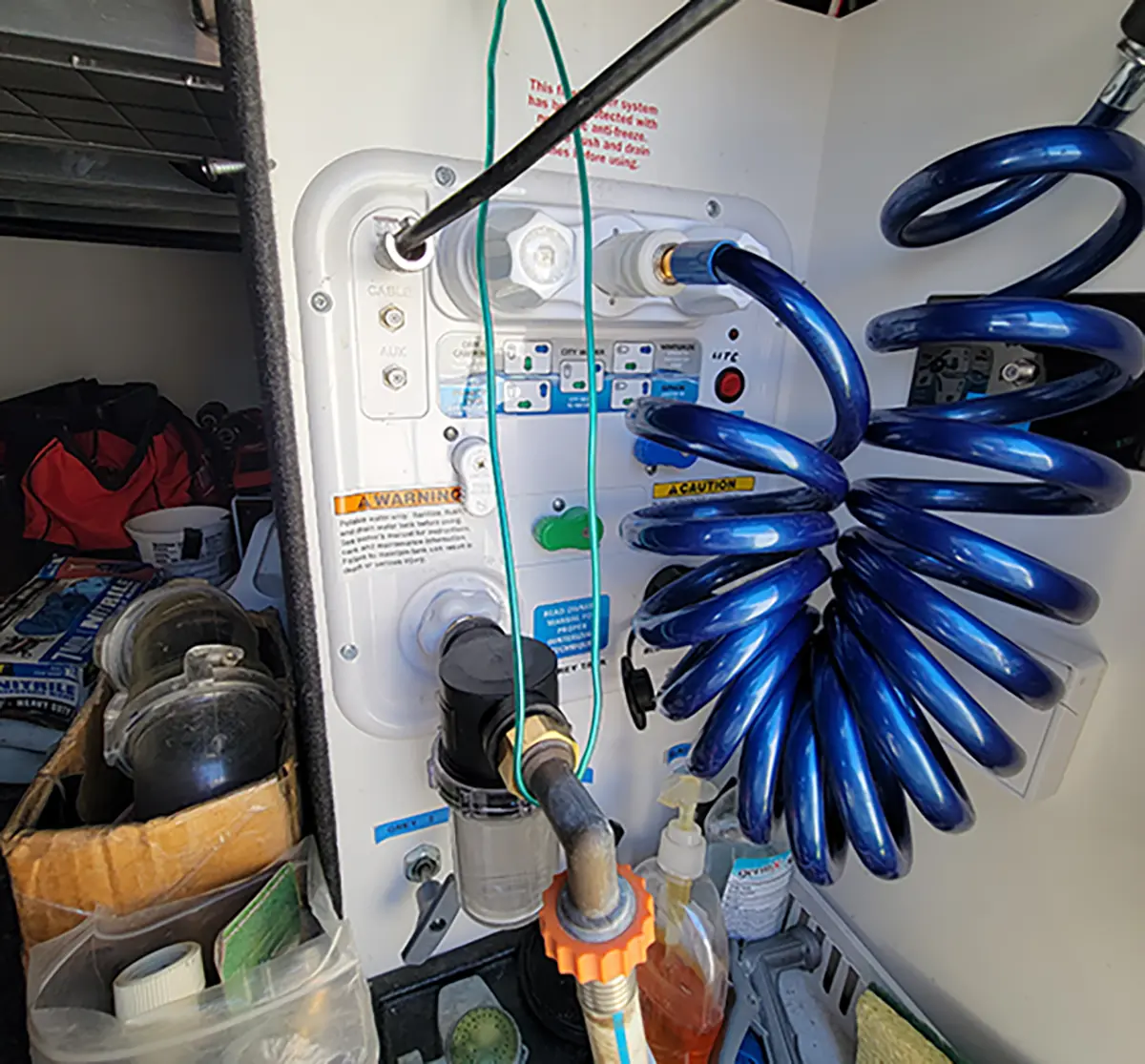
Close-up photograph perspective of a mounted mesh filter attachment directly to the water inlet built into the wall inside the utility bay; A friend worked on this process (his other filters were under the kitchen sink). If you plan on doing that, make sure the filter housing is restrained to prevent undue weight pulling on the inlet fitting in the city-water plate. Here, a piece of wire worked, although it is not beautiful.
Close-up foreground photograph perspective of a mounted mesh filter attachment directly to the water inlet built into the wall inside the utility bay plus other storage stuff in the background area; A friend worked on this process (his other filters were under the kitchen sink). If you plan on doing that, make sure the filter housing is restrained to prevent undue weight pulling on the inlet fitting in the city-water plate. Here, a piece of wire worked, although it is not beautiful.
A friend mounted the same mesh filter attachment directly to the water inlet built into the wall inside the utility bay (his other filters were under the kitchen sink). If you plan on doing that, make sure the filter housing is restrained to prevent undue weight pulling on the inlet fitting in the city-water plate. Here, a piece of wire worked, although it is not beautiful.