



wning an RV can be overwhelming at times. Aside from the necessary upkeep of a mobile home on wheels and the frustration of not always being able to camp where you want/when you want due to the popularity of certain locations, simply moving the new-to-you rig can be alarming. Let’s face it: Until retrieving the “fun funds” from a bank account and driving away with an oversize motorhome or towing a travel trailer of fifth wheel, most RVers have never piloted anything bigger and heavier than a pickup truck or a full-size SUV.
Not surprisingly, the thought of now being responsible for negotiating suspect roads and off-camber curves behind the wheel of a package that might weigh upwards of 10 tons or more and stretch out for, in many cases, 60 or more feet is a bit mind-boggling, to say the least. And it certainly doesn’t help matters when the RV handles or rides like a buckboard.
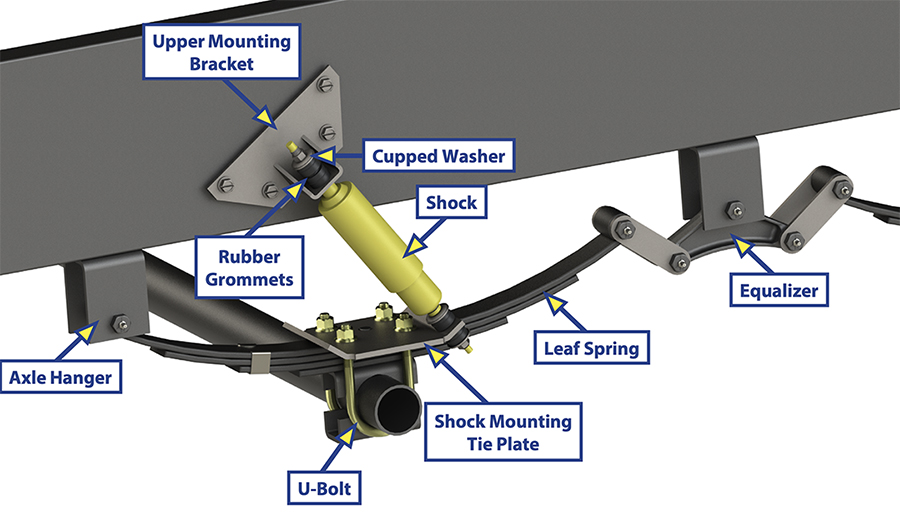
There’s a reason for that — three, actually. For starters, while leaf-spring suspensions have been around for many decades, their longevity is due to the simple acknowledgement that not only does the system work, but it can be easily adapted to virtually any vehicle design. And, such a system is simplicity personified: mounted fore-and aft to the RV chassis with the axles bolted either below or above the spring pack, leaf-spring suspensions are comprised of a very few easily repaired and/or replaceable components.
Lastly, it’s a relatively inexpensive system. That’s probably less a fault of the manufacturers as it is a buying public that constantly clamors for ever-more-luxuriant, residential-quality RVs…until they have to come to grips with how much such additions add to the bottom line. We want it all — but, for the most part, we don’t want to pay more for it.
Fortunately, the reliance on leaf-spring suspensions has created a cottage industry of companies offering upgrades. Most work in conjunction with the existing suspension to reduce the impact of road hazards on the vehicle, while one or two completely replace it. In all cases, though, the net result is an RV that rides smoother and handles better than its stock counterpart. That translates into less driver fatigue and less anxiety when behind the wheel. Suspension upgrades can also improve brake efficiency and life, protect not only the trailer but its cargo — and save money by reducing the possibility of damage to the trailer caused by rough roads.
The following pages outline many of the suspension upgrades available to improve the performance of a leaf-spring suspension on a trailer or motorhome. This is by no means an exhaustive guide to what’s available — it’s just intended to illustrate the various options available. In some instances, we’ve also provided overviews of the step-by-step process for installing certain systems in travel trailers, fifth wheels and even a Ford F-53-based Class A motorhome. These systems range from mild to wild, so there’s bound to be one that fits your lifestyle and your wallet.
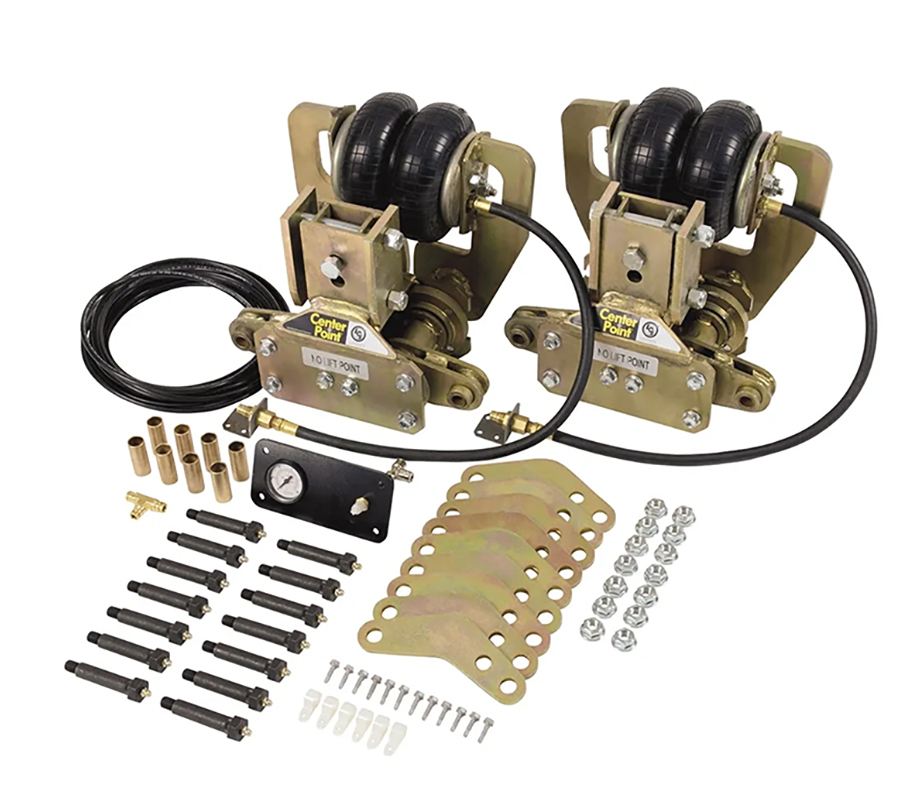
Lippert Center Point Air-Ride RV Suspension
Air-Lift Air Bag Systems

airliftcompany.com
Super Springs International SuperSprings

You can, for example, jettison the stock suspension for torsion suspension axles. Dexter is one of several companies that can help make this happen; its TORFLEX system is a torsion arm suspension that’s completely self-contained within the axle tube and attaches directly to the trailer frame using brackets which are an integral part of the assembly. The TORFLEX axle provides improved suspension relative to leaf-spring axles through the arrangement of a steel torsion bar surrounded by four rubber cords encased in the axle beam — there is no metal-to-metal contact between moving parts. Dexter offers the system in progressively higher capacities, from 600-1,100-pounds to 8,000 pounds capacity. All include precision-machined steel spindles and integral cast-iron hub/drums, with different braking options available.


MORryde X-Factor Crossmember

Lippert Heavy-Duty Shock Mount Kit
