


A Sunshine State of Mind
[maghub_sidebar]
A Sunshine State of Mind typography
Fun from the Sun logo
190-watt Go Power! Weekender ISW kit being installed
Fun from the Sun logo
Installing a 190-watt Go Power! Weekender ISW kit in RV Enthusiast magazine’s 2005 Lance Lite 1025 rebuild project
By Chris Dougherty / Photos by Michael Gordon and the author
S

olar energy systems are all the rage for RVers. While solar systems are nothing new, battery technology and an overwhelming desire to RV “off the grid” have pushed the segment into the mainstream in a significant way. Components are lighter, more efficient and more budget-friendly than ever, making it possible for just about anyone to camp off-grid without the benefit of a generator or power hookup.

Perhaps the single biggest factor that has allowed the technology to filter down into the smallest RVs is the lithium iron phosphate battery, or LiFePO4. These batteries are the current “gold standard” for a number of reasons:

  • Half the weight of flooded lead-acid batteries (FLA);
  • 98% usable capacity as rated (compared to FLA, which have 50% usable capacity as rated);
  • Lasts much longer, making it less expensive over time even considering a higher initial purchase price;
  • Up to 10 times the lifetime cycles of FLA and AGM batteries (3,000-5,000).
  • LiFePO4 batteries can be mounted anywhere and in any orientation, as they are non-venting and have no liquid;
  • LiFePO4 batteries will not freeze unless exposed to -4F for one month or more (LiFePO4 will not charge below freezing. Heated battery packs are available, as are add-on pack heaters).

What all those advantages add up to is a battery that allows more usable energy in a lighter package that smaller RVs can handle. With a wide array of solar charging options on the market, it’s much easier to stay off the grid for more extended periods of time.

Another factor that’s making solar more accessible is the availability of complete solutions from individual companies, instead of owners finding and building a system piecemeal. While ala-carte systems will always be the best way to create a custom system (see “Solar Flair” in this issue), it’s not always practical or necessary — especially when your needs are basic and you’re not trying to live 24/7/365 off the system.

We opted to use the “Weekender ISW” kit from Go Power!, a division of Valterra Products, for our 2005 Lance Lite 1025 rebuild project. What is neat about this system is that it’s pretty much complete, save for a few little odds and ends we decided to change during the install process. The most significant hardware changes we made were an inline MC-4 solar panel fuse on the roof and a battery switch, both of which we sourced from Amazon.com. Romex wiring is, of course, not included because the amount and gauge needed will vary with every install.

The Weekender ISW system with everything except the battery switch
The Weekender ISW system comes with everything you see here except the battery switch, converter/charger and Battle Born LiFePO4 battery.
Go Power! sells three complete kits. The 190-watt Weekender ISW kit is designed for 30-amp service and can easily be wired to provide power to the entire RV. According to the company, if the RV has 50-amp service, the Solar Elite system (with 380 watts of solar panels) is a better choice. The company’s largest package, its Solar Extreme kit, has 570 watts of solar panel included. All are complete kits with inverters, but only the Weekender ISW has an external transfer switch included.

Included in the Weekender ISW System:

  • Overlander 190-watt solar charging kit (OVERLANDER)
  • 1500-watt pure sine wave inverter for AC power (GP-ISW1500-12)
  • 30-amp dual-bank, Bluetooth PWM Solar Controller (GP-PWM-30-UL)**
  • 30 amp pre-wired transfer switch (GP-TS-30)
  • Inverter on/off remote (GP-ISW-R-12)
  • DC Inverter Install Kit (GP-DC-KIT3)
  • 1 x 2 feet of MC4 output cable (#10) red and 1 x 25 feet of MC4 output cable (#10) black and all mounting hardware (1 x GP-MH-4-KB)

The Weekender ISW was the perfect system for this project. First, consider that this is a small truck camper with 30-amp service, really only has room for a single battery as designed, and weight is a significant consideration. Second, it’s the easiest to wire in, providing a complete power solution for the entire RV. Third, the Weekender solar system is expandable to 570 watts should our needs increase. Fourth, the Lance has a new Cummins Onan QG 2500i LP inverter/generator on board, which will easily, quietly and efficiently handle occasions when more power is needed than the 1500-watt pure sine inverter can supply. Finally, almost everything is included in one palletized box. We added the MC-4 fuse, a master shut-off switch, and resized and re-terminated some battery cables. The Go Power! kit’s inverter cables are neatly terminated already, so if you can’t crimp your own, you’ll have to source pre-made battery cables of an appropriate size and length online. We’ve opted to create new ones, and we had everything needed to make new battery cables with heat-shrink-covered ends. Thanks, Harbor Freight!

As you might have guessed, we also decided to change the RV over to LiFePO4. There is more to this than just buying a battery, as the RV’s converter/charger must be lithium-compatible. So, we also purchased the Go Power! GPC smart battery converter/charger for this project, which was a direct (sort of) replacement for the 45-amp original-equipment converter. The GPC allows adjustment of the output with a multimeter to the exact specs provided by Battle Born. As it turned out, the replacement converter was physically larger than the OE converter, requiring the front bulkhead in the camper to be removed and the converter shelf “re-imagined” to fit the GPC.

While Go Power! identifies the 1500-watt inverter as an “industrial” model, it’s a relatively simple pure-sine inverter in its line, ranging from 700-3,000-watts. The kit also includes a dedicated remote control with a power switch, LED indicators for battery and output levels and indicators for troubleshooting. A confusing indicator on the panel, intended to show when the RV is hooked up to the “grid,” didn’t function, which caused some brief confusion while testing. As we learned, it doesn’t work with this model inverter but does with versions that have an integrated transfer switch instead of our external model.

installation chart and diagram
Planning your installation well ahead of time is essential and should include finding locations for the components, wiring, switches, remotes and so on. We made this schematic to indicate where runs of AC and DC wiring would go, placement of circuit protection and integration into the existing system. We used the ElectricDesign app for MacOS to draw this, but even a hand drawing is okay as long as everything is included.
Speaking of transfer switches, this system comes with a partially pre-wired transfer switch, the 30-amp GP-TS. As seen in many motorhome generator setups (and our camper has one for its genset), the GP-TS senses when the inverter provides power and disconnects the shore power input in favor of the inverter’s output. What’s clever about this setup is the converter/charger runs through this transfer switch and is automatically isolated when the inverter output is on. You don’t want the battery charger active when your AC power source comes from the batteries. It’s literally plug-and-play for the deck-mount GPC converter/charger in our installation. Since the GPC was mounted in the front bulkhead and the rest of the system in the closet, we simply sourced a heavy-duty 10-foot extension cord sized for the GPC’s amp draw and length and ran that to the front bulkhead from the transfer switch in the closet. We abandoned the OE converter/charger receptacle on the back of the power center altogether.
opening up the cabinetry inside and planning out the wiring runs
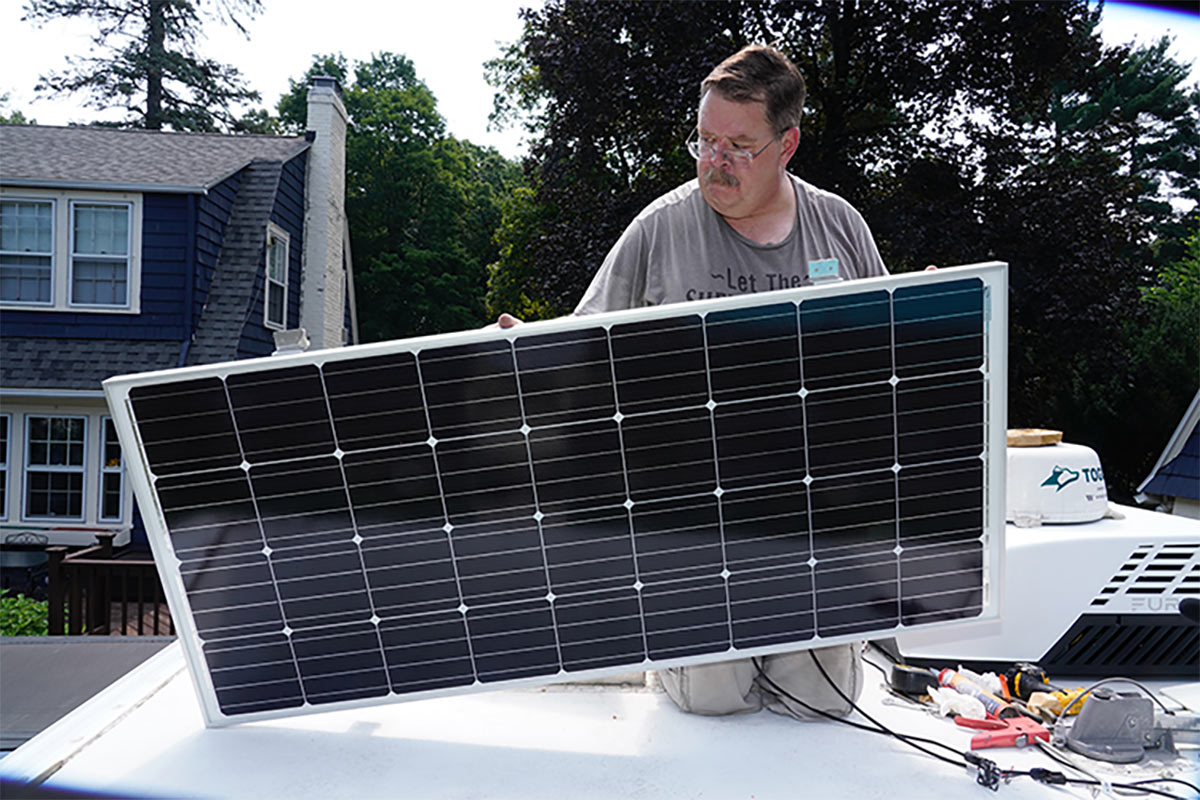
After opening up the cabinetry inside and planning out the wiring runs, we installed the 190-watt solar panel on the roof. The kit comes with all hardware. We carefully laid out where the panel would be set and attached it to the roof.
Ensuring a good seal on every roof penetration is key
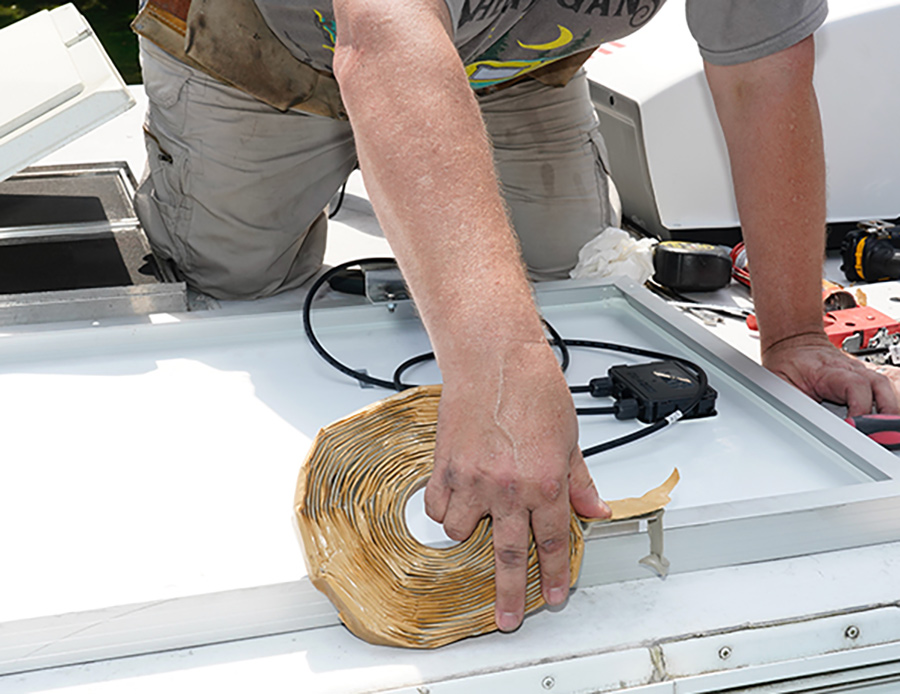
Ensuring a good seal on every roof penetration is key. We started with putty tape on the bottom of the bracket.
flipped panel lined up
brackets down and screwed
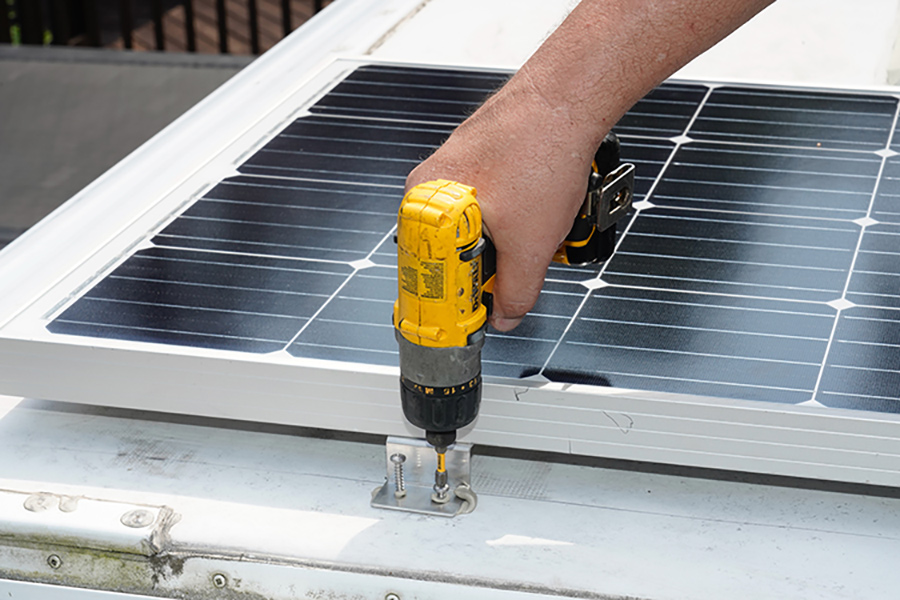
Next we flipped the panel, lined it up with our marks, and screwed the brackets down. Then we sealed the brackets with a TPO-safe self-leveling sealant. Be sure to only use sealant that is compatible with your RV’s roof.
early solar prep with 12-gauge wire
The Lance came with an early solar prep with 12-gauge wire, which would not work for our needs. We removed it and ran the included 10-gauge solar wire with MC-4 connectors already installed.
It took a little investigating and planning to figure out how to wire this system with the existing transfer switch. Understanding how the transfer switches work and drawing a diagram were essential. We used the OE genset transfer switch as a junction box. We ran 12/2 Romex from the output of the genset transfer switch to the input of the inverter transfer switch and another run from the output of the inverter transfer switch back to the power center feed in the genset transfer switch. This way, both shore power and the generator would power the converter/charger, and the inverter could still power the rest of the camper. Getting to the OE genset transfer switch was a challenge, as it was tucked in under the sink and behind the LP-gas cylinder box but was still reachable. Removing the range allowed us to run the cables we needed with the main wiring harness.

The solar system, which includes pre-attached MC-4 connectors, was a blazingly simple installation — even a caveman could do it. Of course, because of our tight confines in the truck camper and trying to use resources and holes that already existed, we ended up having to do a little fabrication on the roof. But that worked out extraordinarily well.

a Winegard two-cable roof cap being used during installation
combining the solar with a Winegard Connect 2.0 power cable
We used a Winegard two-cable roof cap for this installation, combining the solar with a Winegard Connect 2.0 power cable. There also are solar-specific cable passthroughs available. To avoid cutting more holes, we carefully cut the cap in the shop to match the base of the radio antenna. We made sure there was adequate putty tape on the cap before pressing it into place.
The 2005 Lance was prewired for a small solar panel, as was accepted practice at the time. Solar has been around RVs for decades; in fact, older Fleetwood motorhomes had small solar panels attached to the air-conditioners going back to the early 1990s at least. This 12-gauge pre-wire ran from a small plug on the roof next to the radio antenna down to the space under the bathroom sink by the battery box. For our system, we cut out the OE pre-wire and ran the 10-gauge counterpart. The solar wire is included in the kit. The access behind the systems monitor panel was excellent, and we pushed the cable through the wire chase behind the galley cabinets to the closet and the solar charger. The antenna and the plug were tightly mounted together, however, which created a problem. We opted not to cut another hole in the roof and instead used a Winegard multi-wire roof cap and modified it to fit around the circular base of the radio antenna. We also ran the power wire for our Winegard Connect 2.0 through the same cap. The result was a nice, tight installation with easy access to the MC-4 connectors.

The closet became the only spot in this camper we could install the inverter and transfer switch, which also became the best spot to install the wall-mount remote and solar charger. We determined there was space for wire behind the back wall of the closet, so we removed the paneling, which made the rest of the install much easier — we now had access from the upper control center area, the harness to the batteries and the harnesses to the genset transfer switch, and the main power center and bulkhead.

cap screwed down and healed
Once the cap is screwed down and sealed, it’s good to go. We left enough cable to reach the panel’s cables. Do not connect until everything else is done, or the wiring will be hot.
The original plan was to mount the inverter to the back wall of the closet with the transfer switch. That plan quickly dissolved. As we designed how the items would go on the 1 x 6-inch pine we were using as a new backer, we discovered the caps for the inverter’s battery terminals made the unit too wide to fit. Some folks might leave the covers off or cut them, but we instead decided to mount the inverter flat on the closet floor and build a shelf above it. It’s important to note that the inverter can only be mounted on a wall horizontally, per the manufacturer, for cooling reasons. Otherwise, it needs to be on a flat surface like the floor.

The outer wall of the closet made the best sense for the remote and solar charger, although the thinness of the wall required us to make further changes. We carefully removed the paneling inside the closet to install the remote and controller, only to find they were too thick for the wall. The decision was made to continue to install these components in this location and rip down more pine to double-frame the closet cabinet wall, so we could hide the wiring and reattach the paneling.

The result is a slightly smaller closet but designed to still function for clothes hangars and a shelf on the bottom to hold items out of harm’s way to the inverter. We installed a ventilation grate on the closet door, and there are openings in the back of the closet to aid in ventilation. We’ll monitor this closely and add more ventilation to the space as needed.

a convenient wire chase behind the closet
We luckily found a convenient wire chase behind the closet. We removed the paneling in the back, and ripped 1-inch pine down to make a new weight-bearing wall to mount components to. The open space gave us wiring runs to everywhere we needed, which was excellent.
side of the closet becoming the ideal spot
The side of the closet became the ideal spot to locate the remote for the inverter and the solar charger — however, the wall wasn’t thick enough. We ripped down 1 x 2-inch pine and furred out the wall with wire passages. We reinstalled the original paneling and cut down the closet bar after everything else was done.
The last thing to tackle was the battery. The Lance came with a box with access in the sidewall for a single Group 32 battery. The previous owner installed an absorbed glass mat (AGM), battery, which worked OK, but we wanted the lithium. We had two Battle Born 100-amp batteries at our disposal and were hopeful we could squeeze them both into this space. Measurements were clear, but the install was a little complicated.

We looked at several options, including removing the battery box altogether and creating another cabinet, but it would have made little difference and added a lot of expense and fabrication — and the space for the batteries was not guaranteed (and we would have lost the under-sink storage). So, we opted to install only one, with the option of adding the second in the truck’s bed using a 6-gauge Battery Quick Connect Disconnect Wire Harness Plug Kit, cable, and a battery box.

We completely removed the wiring, switch and OE breaker from the battery box and installed the 250-amp fuse included with the Go Power! kit and a new battery master switch. These were fed inside, where we installed 5/16-inch terminal studs and brought all the inside wiring, including the RV feed, generator start cables and inverter cables, to a single point. The stock 40-amp self-resetting circuit breaker was re-used for the RV feed.

generator or transfer switch installed in the motorhome
Most towables won’t have a generator or transfer switch installed, but some truck campers — like this one — and motorhomes will. This factored into how we could integrate with the switch. Hidden under the galley sink next to the LP-gas compartment, it was a challenge running two new cables through this box, but we did it.
We really couldn’t be happier with the result. We have enough inverter power to run electronics and the microwave, and the 190-watts of solar is ample for our current needs but is ready to be expanded if necessary. Again, considering that we have a built-in generator, the combination should take care of all our needs for brief excursions to the Cape Cod seashore or the mountains of Vermont and New Hampshire.

The inverter handles the 900-watt microwave adequately, but be prepared for what sounds like a jet engine winding up as it takes on the load. This is, of course, the inverter’s cooling system and shuts down soon after the load is removed. The air-conditioner’s fan-only setting runs well on the inverter but, of course, the compressor won’t start using this size system. It’s essential to keep in mind that, with any inverter system that feeds an entire camper, the “automatic” loads are turned off, like an RV refrigerator or 120-volt AC water heater. For example, on the fridge, keep it on manual and set for LP-gas, unless you want it on 110-volt AC or, in the case of a 3-way unit, 12-volt DC. If you leave these loads on your inverter, you’ll deplete your batteries in no time.

As far as cost is concerned, each Battle Born GC2 battery retails for around $1,200, the Go Power! Weekender ISW kit is about $1,700 online, the converter/charger is $170 online and we had about $300 in miscellaneous parts and components for the whole project. Copper wire is super expensive, and what we used in addition to the Go Power kit was worth about $75.

Being able to camp where we want, when we want? Priceless.

closed up walls and mounted inverter
Once all the wiring was run, we closed up the walls and mounted the inverter on the floor of the closet (not our first choice, but there was no other option) and attached the inverter transfer switch to the wall and wired it.
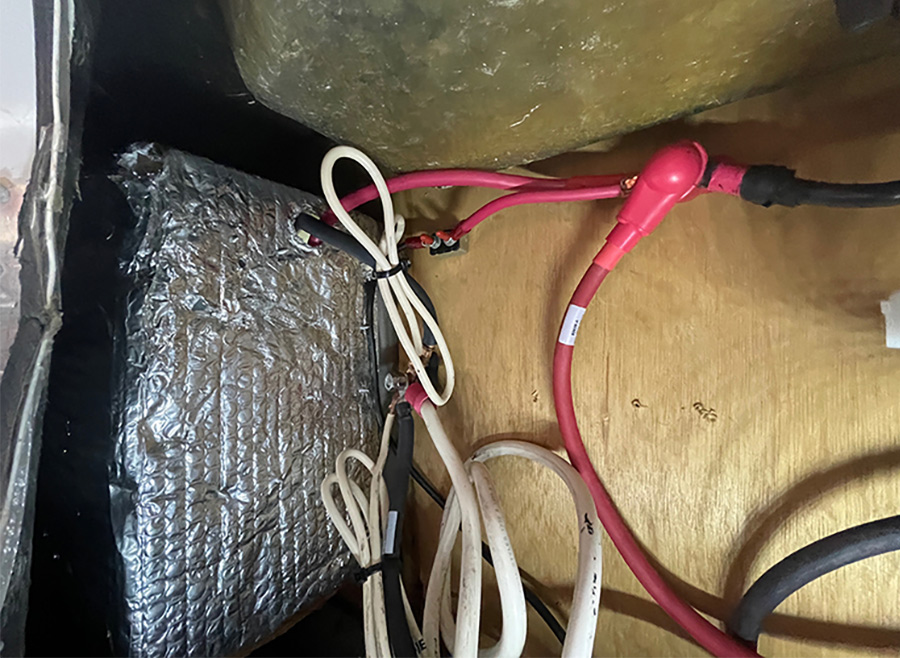
wiring for the small battery box
Because of the generator, the small battery box was already a mess of wiring and had a small pull-out power switch. We removed all of it and moved the junctions inside. The one wire left was a ground for the aluminum siding.
the original wiring visible inside
From behind, the original wiring is visible, and worked OK, but we added a bunch of conductors, circuit protection and a master switch, so rewiring was necessary.
new 250-amp system fuse installed
battery box connected to the master switch
We installed the new 250-amp system fuse inside the battery box, which is connected to the master switch and the battery. Once that was done, the battery switch, fuse and battery were connected. The single 100-amp battery pack barely fit. In the future, we’ll connect another remote battery that will be located in the bed of the truck using a battery harness plug.
mounted junction posts for the conductors
Inside the fiberglass wet bath, beneath the sink, we mounted junction posts for the conductors to attach to and the 40-amp circuit breaker for the camper’s 12-volt DC loads.
new inverter transfer switch installed
The new inverter transfer switch has a simple corded receptacle to plug the deck-mounted converter into. Because of tight spaces, we opted to run an appropriately sized heavy-duty extension cord from the new transfer switch box to the converter/charger. The bulkhead was completely removed to allow us to rebuild the converter shelf from Lance, which was too small for the new unit. We simply wired the 12-volt DC connection exactly like the previous unit.
bulkhead being removed
a new shelf for the converter/charger
The bulkhead was removed to build a new shelf for the converter/charger that allowed access to the fuses, wiring and the side adjustment ports. The charger needs to be adjusted to properly charge LiFePO4 batteries. Here, a microswitch is flipped to make the converter’s output fixed voltage instead of 3-stage charging, and the pot switch in the next hole is turned until the output is properly adjusted. A multimeter is required for this step, and the battery and all loads should be turned off while adjusting the GPC-45’s output. The switch is turned back to three-stage after the adjustments are completed.
completed closet slightly smaller
The completed closet turned out to be slightly smaller, but not by much. We’ll install a shelf atop the inverter using leftover paneling and paint the rear wall to match. We also installed a return air grate on the closet door (not shown) to allow airflow. The back of the closet has an opening to allow air into the back of the inverter and it will blow out the front.
Codes Notes!
Being that this is a truck camper that has no metal chassis frame, the converter/charger has no 8-gauge chassis ground. However, the negative wire in the 12V DC system does bond to the aluminum skin. The camper is in compliance with the codes in place as built in 2005. MC-4 connectors meet the requirements of NEC690 for means of disconnecting systems of less than 30 volts. The MC-4 inline fuse provides added protection, and an ATC fuse is installed on the charge line from the solar controller at the inverter post inside the RV and is marked.
Image by Michal Jarmoluk from Pixabay
multi-colored wires
the solar panel connected
Once all other wiring is complete, the solar panel can be connected. We purchased an add-on MC-4 solar fuse for the panel and plugged it in — it’s not required but is a good idea to prevent the panel from shorting out.
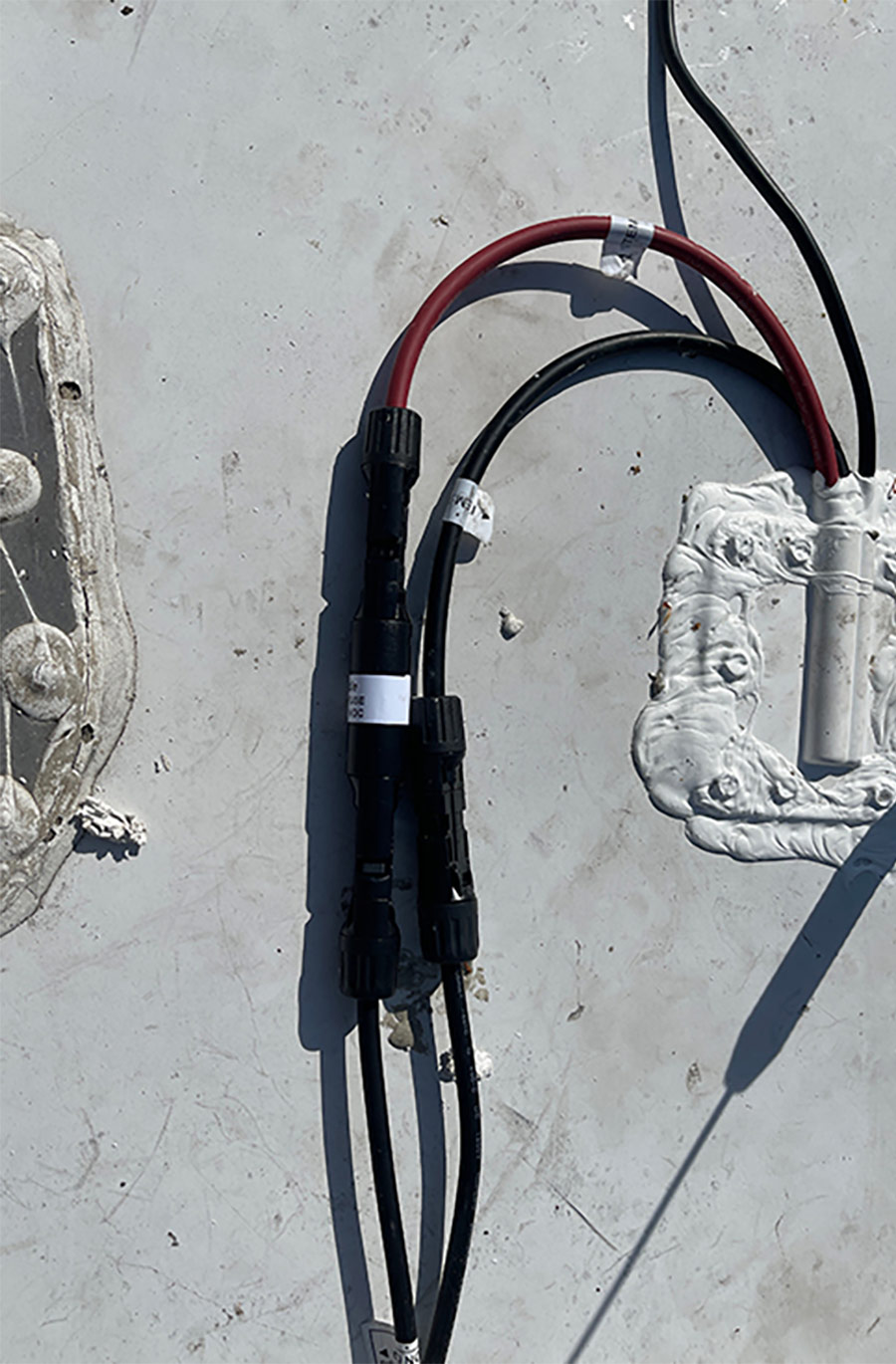
MC-4 connectors joined together
The MC-4 connectors join together easily and are secured to the roof using cable tie-downs, which are sealed with roof sealant.
bluetooth-enabled Go Power! solar charge controller
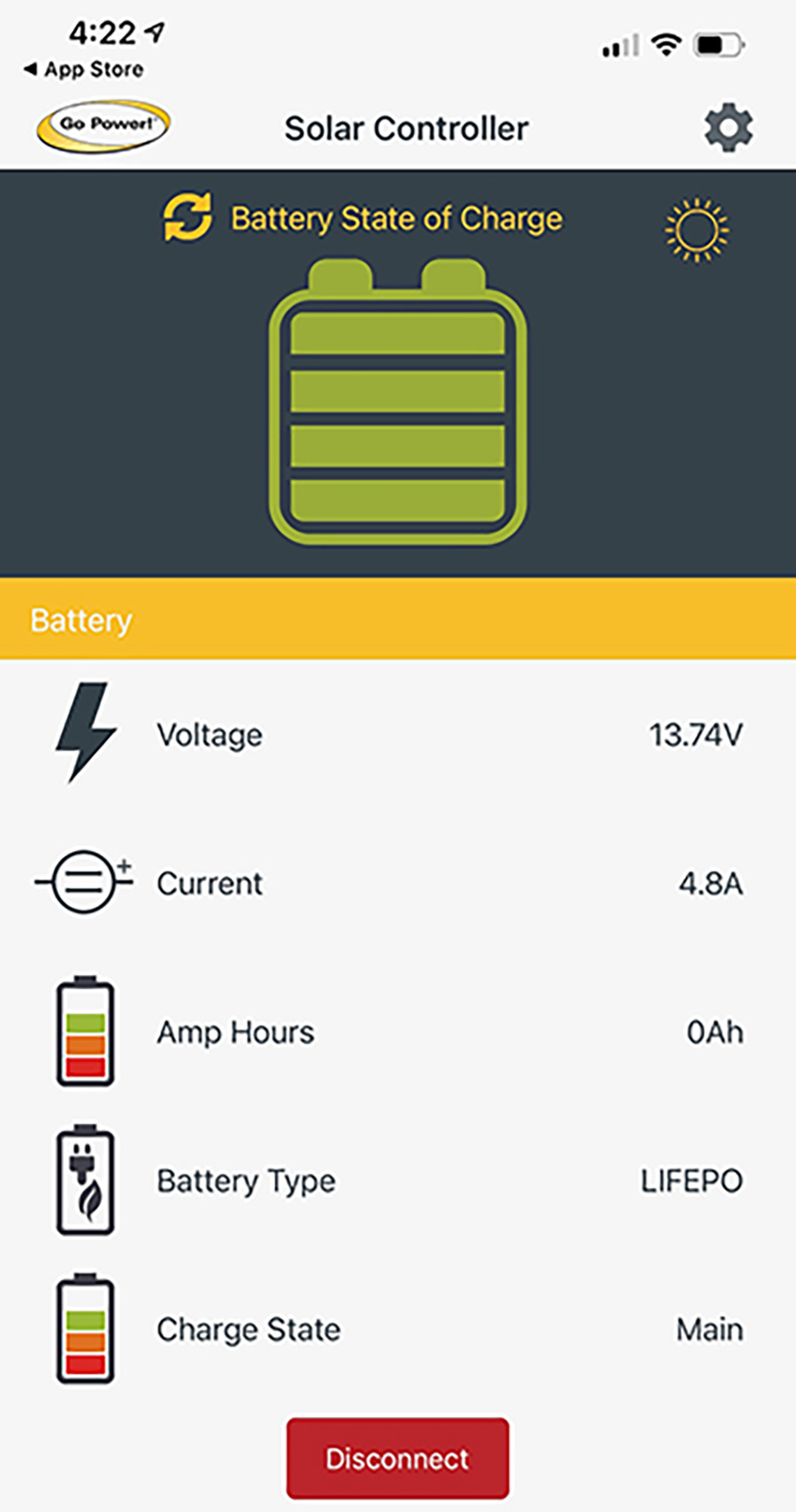
The Go Power! solar charge controller is Bluetooth-enabled and runs the company’s app for IOS and Android devices, and allows complete control.
tests being performed on microwave
One of the tests performed on the new system was to run the microwave on the inverter, which pretty much maxed out the inverter. Even though voltage did drop to 12.1-volts DC while running it didn’t make a blip in the battery from what we could see. LiFePO4 batteries retain a relatively constant voltage output through the discharge cycle and the solar was working nicely.
Sources:
Go Power
https://gpelectric.com
(866) 247-6527

Battle Born Batteries
https://battlebornbatteries.com/
(855) 292-2831