
o discussion of RV suppliers is ever complete without heavy mention of Lippert. From axles and coatings to electronics, furniture and mattresses, glass, lamination, metal fabrication, plastic molding and power and motion systems, Lippert has a hand in an amazing number of supply channels feeding the RV industry. Most RVers, in fact, are unaware of the depth of Lippert’s involvement. That HappiJac bed lift in your toy hauler? That CURT fifth-wheel hitch? The Thomas Payne furniture you sit on? These — and more than two dozen others — are all Lippert companies.
But while acquisitions have contributed greatly to Lippert’s growth, much of the company’s success is fueled by its continual dedication to product development.
“We’re really focused on turbocharging our innovation as a company,” said Andy Murray, chief sales officer for Lippert. “We’re looking for areas that may have been stagnant and trying to find ways that we can bring value, innovate and change the game in some of those areas.”
Underscoring that statement, RV Enthusiast joined RVBusiness Executive Editor Rick Kessler recently to meet with several key Lippert executives showcasing a number of new products the company is introducing through RV manufacturers for 2022 model year recreational vehicles. And while Vice President of Marketing Jarod Lippert noted that the company’s initial focus with the new products will be on the OEM side, he also pointed out that all would find their way to the aftermarket. In fact, one — the On-The-Go Ladder system — may be making its way there well before the upcoming holidays.
Along with the ladder, the products unveiled included a new entry step design and, said Jarod Lippert, “a new electric tongue jack that’s never been seen before in the market.” And unless you read the RV trade publications, you’re seeing them here first.
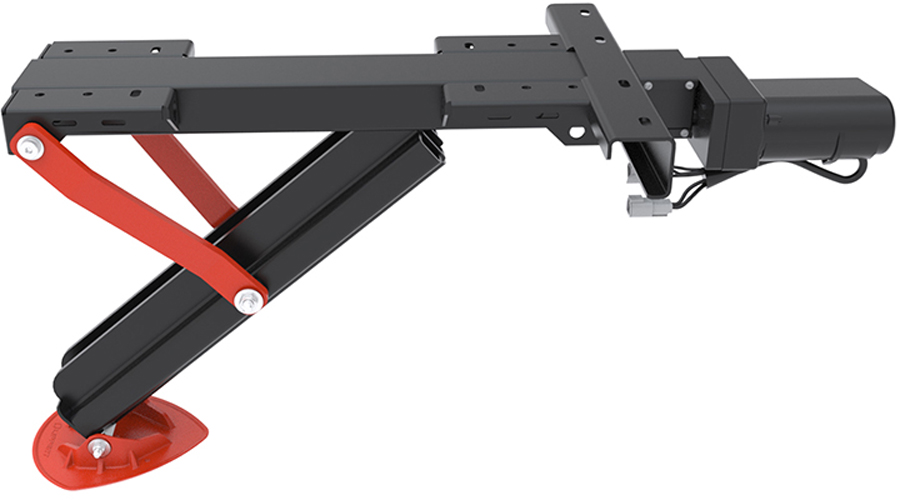
“Tongue jacks have been pretty much the same for a long time,” said Mason Ogle, vice president of sales. “They stick up in the back and get in the way of lowering a truck’s tailgate when hitched up. We wanted to create a jack that is at the bottom of the A-frame, not protruding out the top.”
To accomplish this, Lippert engineers modified one of the jacks used in the company’s travel trailer leveling system. Mounted to the bottom of the A-frame, when not in use the jack collapses into its housing, flush against the A-frame; when activated, it drops down at an angle to provide the required support. Aided by triangulation bars to either side — new technology developed by Lippert — the jack is rated for 3,500 pounds. An easily accessible switch and lighted bezel will be added to the front of the A-frame where the cylinder jack previously resided.
In addition to saving wear-and-tear on a tailgate, additional benefits of the Gate Defender include freeing up otherwise unused real estate on the top of the A-frame for additional batteries, bike racks or other equipment. And, because it tucks up flat against the underside of the A-frame when not in use, there’s no chance of it catching and bending on a steep driveway.

“Our current Solid Step is used extensively in the market, but it’s similar in
Solid Step Levitate, on the other hand, is an entirely new concept.
“Our current Solid Step is used extensively in the market, but it’s similar in design to our competition,” said Ogle. “We wanted to make something with more of a residential ‘feel.’ This step has one rail going down the center and has a ‘floating stair’ look to it.”
By removing the somewhat bulky side rails, the new step also allows users to approach the unit from the side as well as from the front for faster access. And, added Ogle, tests have shown the Solid Step Levitate’s stability to be comparable to the company’s current Solid Step; it also will carry a similar 350-pound weight rating.
Easily adjustable to whatever terrain is below it, the new step uses an adjustable pull pin on the center leg to set the unit and features a larger foot pad for increased stability. The Solid Step Levitate will be available in configurations of two to four steps and is manufactured with an eye toward aesthetics: the steps are black steel treads while the main center rail sports an aluminum finish. The new steps also will incorporate an optional lighting system.
“Another benefit we’ve addressed is, the Levitate latches to itself using cables that prevent it from going into the unit,” Ogle said. “Other steps latch to the doorframe and can damage the unit. And it’s just chest-high when you are unlatching it; current latching systems used today are 18 to 20 inches higher, which can make them difficult to deal with at times.”

“Ladders had been a mainstay in the industry for decades, but they aren’t a very secure method to access the roof,” said Jarod Lippert. “OEMs feel the need to supply them due to maintenance requirements on the roof and that’s why most RV owners feel like they need it. But what triggered the idea here was noting how many times an RV was seen rolling down the road with a real ladder strapped to the back. That told us the end user wants a better solution.”
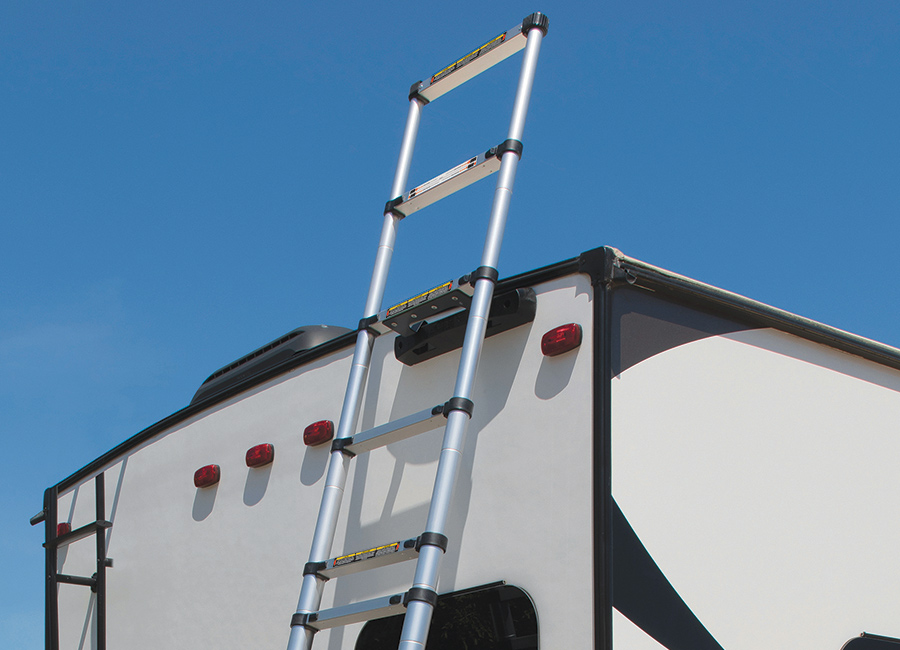
Lippert’s On-The-Go Ladder is built around the use of a telescoping ladder and bracket. The lightweight aluminum ladder collapses into itself for easy storage in an outside compartment while the bracket can be mounted on the rear or side of the RV — a big benefit for toy haulers where ladders cannot be mounted on the rear ramp door. During use, special arms at the top of the ladder fit into the bracket to establish a solid connection while the ladder legs are secured on the ground rather than the RV.
Just as importantly, said Lippert, is the fact that the ladder when used is set against the RV at an angle rather than the typical vertical ladder mounted to the rear of a unit.
“That makes a huge difference in terms of ease of use and security when you’re going up the ladder,” he added.
The On-The-Go system also was designed to overrun the rooftop when in use by 24 to 36 inches. This provides the user with a secure area to grab onto when accessing or leaving the roof. And, by limiting mounting points to just the bracket, the Lippert ladder system also eliminates upwards of a dozen screws sunk into the rear cap of the RV for a traditional RV ladder — all of which are potential water incursion points.
Beyond the obvious benefits, having access to a portable ladder while camping also opens up other uses, from being able to access the roof of a cargo trailer or cleaning the windshield on a motorhome to retrieving kids’ toys from tree branches. The ladder, by the way, has a weight capacity of 250 pounds.

Arguably the first control system widely used in the RV market, Lippert has made continual upgrades to the product and the newest version – it’s fourth iteration – has been updated with a new interface for mobile devices and its own monitor panel.
As explained by Andrew Mock, vice president of sales/interiors, the new interface allows end-users to access OneControl’s various tasks with fewer inputs — “it’s going to be less button pushes to get to the things you want to be able to use,” he said. The interface also is designed to be programmed by the user to create “favorites” and make required access buttons more readily available.
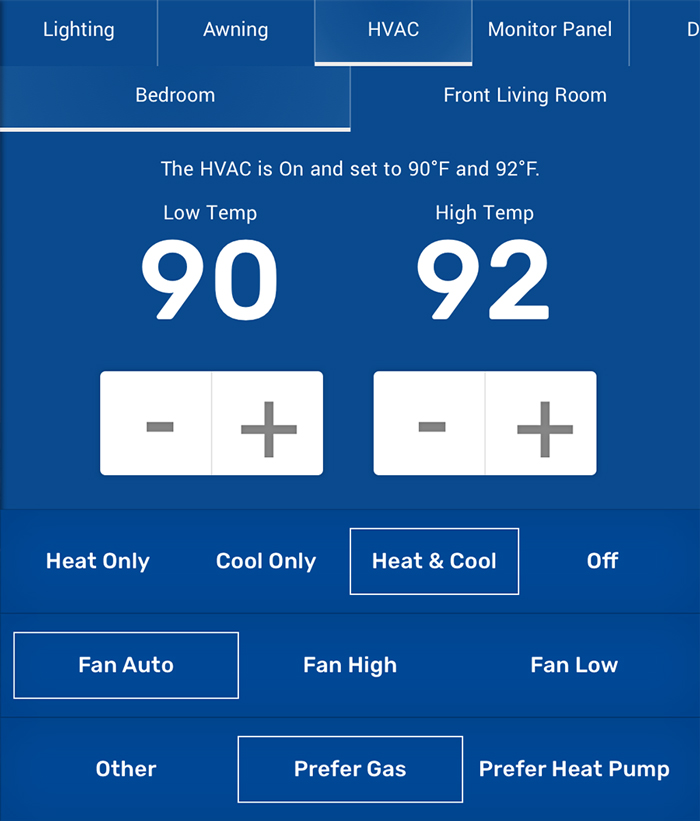
Along with the interface, OneCon- trol also will have its own proprietary monitor panel for the first time and will feature Bluetooth connectivity allowing users to automatically link to their smartphone.
“You will just hit the button at the top of the monitor panel and then find your phone just as you might find any other Bluetooth-connected device,” said Mock. “It then automatically links up.” The high-tech Laser Etch panel also uses a single cable, he added, “which gives OEMs the option of placing it just about anywhere in the unit they want.”