

Motorhome Makeover
[maghub_sidebar]
Motorhome Makeover typography
When using a foam gun and a high-quality foam like Chemical Guys Honeydew Snow Foam, a blanket of foam is produced on the paint that helps clean and prevent scratching the paint during the washing process.
Using professional products — and a lot of elbow grease — will give any RV a long-lasting and beautiful protective finish
By E. Don Smith
I

f you want to maintain a nice-looking motorhome you have two options: Learn to do it yourself, or pay someone on a regular basis to detail it for you. Some of us love detailing in general and look forward to washing and waxing our coach. It’s not much different from the care you may have put into the cars of your youth, except there’s a lot more real estate to cover. Nobody ever said motorhome ownership was easy — and a full detail job on a motorhome is a lot of work.

For a professional detailer and a small crew, it’s a task that can be easily finished in a day. However, for an individual person doing a full paint correction plus wax/sealant on the paint and polishing the wheels, it can take multiple days.

One aspect about detailing that is constantly changing is the type of products that are available. In the past, detailers mostly used “old school” waxes such as carnauba or longer-lasting synthetic/polymer sealants. For most professionals today, however, it makes little sense to spend hours waxing a large motorhome with a carnauba wax that lasts weeks when it is actually easier to use a modern synthetic polymer sealant that lasts months. Also, during the last five years a new class of products called “paint coatings” have come on the market — usually ceramic or graphene-based chemicals that are applied in a different manner than a normal wax or sealant. They literally can last for a few years instead of a few months (see sidebar for more on ceramic paint coatings).
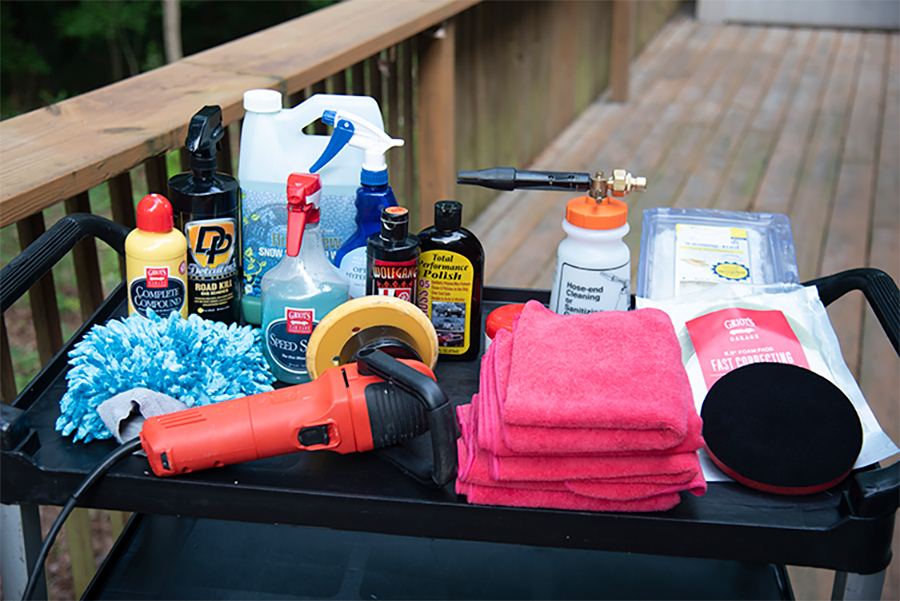
products and tools ready to use for detailing
Detailing a motorhome not only requires a lot of time, but it also requires a lot of products and tools as shown here. This photo doesn’t even include the ceramic coating products and applicators.
Obviously, you have a lot of choices when it comes to detailing your ride — and they hold true whether your RV is a 44-foot motorhome or a 20-foot single-axle travel trailer.

Throughout this article we will reference brand names and products you may not be familiar with; unlike the cleaners and waxes found on the shelves of the big-box retail store, these are very specific products mostly used by serious detailing enthusiasts and professional detailers. Most of these are available online at specialty detailing product dealers (and, in most cases, Amazon); very few of them will be found at normal retailers or, in some cases, even auto parts stores. There are usually good alternative products stocked at such locations — but I’ve found the best results are achieved by products used by the pros.

Cleaning: Front to Back
Before starting on the rest of the coach, we prefer to clean the front end to remove bugs as this takes a bit more time than the sides and back. There are many good bug and tar removers on the market, but currently our favorites are Griot’s Bug and Smudge Remover, Poorboy’s World Bug Squash and Duragloss Bug Remover 471.

Start by first completely wetting the front end of the coach and allowing the water to soften the bugs and to rinse off as much dirt as possible. Each brand of bug remover has its own directions, so refer to each before using. Spray the bug remover on and allow it to remain for 30-60 seconds, then use a specialty bug-removing cleaner pad to scrub away the bugs before rinsing everything off. Sometimes two or more applications may be necessary for caked-on bugs. (Know, too, that if you notice that the paint is not beading water anymore, you may need to re-wax/seal the paint.) If your motorhome has a clear bra on the front, it may have special cleaning instructions. Diamond Shield (clear bra), for example, suggests not using any bug and tar removers and to only use its own brand of soap and a soft cotton or lamb’s wool wash mitts. Next, apply 303 Aerospace protectant to the clear bra after each washing.

large 5-gallon bucket with a grit guard in the bottom
When washing any painted vehicle always use a large 5-gallon bucket (filled with soapy water) with a grit guard in the bottom. This keeps your washing bonnet from touching the bottom of the bucket where the dirt will accumulate and keeps the grit off the paint.
After the bugs are gone, the next step is a good wash for the paint. Some detailers use an electric pressure washer; it does help, but it is not required. A water hose with a nozzle-mounted foam gun filled with “snow foam” will produce a blanket of foam that will greatly speed up the process and help prevent scratches in the paint. Most paint swirls that you see on motorhome paint jobs are caused by improper washing or drying, so it’s important to use a good soap and a soft pad. On the bottom of the coach, we prefer using a hand mitt made for washing cars along with a Swobbit Sheepskin washing tool on an extension pole for the higher areas. In our experience, the Swobbit tool has shown to be the softest and least likely to scratch the paint of any we have ever used.

Generally, we wet the entire side of the coach we are working on, and then spray soap on a smaller section at a time. It helps to split each side of the coach into several equal sections and work on each area in succession to prevent the soap from drying before rinsing it. If possible, work when the sun is not directly shining on the paint to help prevent water spots; using deionized water for the final rinse will also help. After spraying the soap, give it a minute or so to loosen the dirt then use the Swobbit to remove the dirt — and make sure you have a clean bucket of soapy water with a “grit guard” in the bottom to rinse the Swobbit after each section. Continue until the coach is completely washed and rinsed. If you have a leaf blower, you can speed up the drying process and reduce water spots by using it.

If you have awnings or slide covers and want to clean those, it may require opening them up and getting on the roof or a ladder. You can usually use the same soap on them, but there are special soap and cleaners for awnings and vinyl should you have a particularly dirty one.
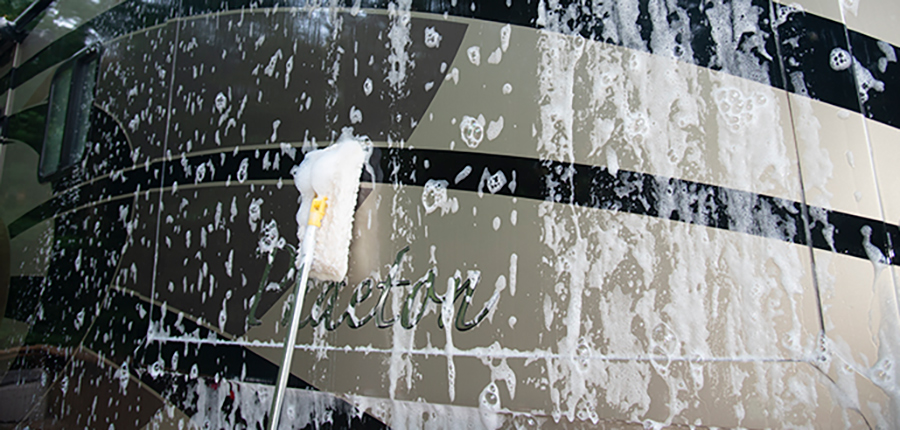
the surface being sprayed with foam
After spraying the surface with a foam gun and snow foam we used a Swobbit wash mitt on an extension pole to help remove all the dirt and road grime off the coach.
polishing and ceramic coating stages
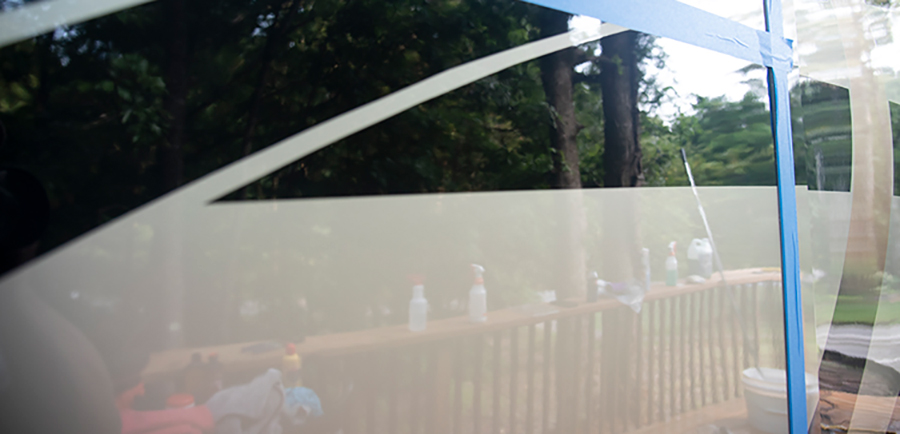
During the polishing and ceramic coating stages, we used painters’ tape to divide the coach into easy to manage sections. There is a lot of surface area on a motorhome; if you are working alone plan on spending multiple days to do an entire detailing job.
the “clay bar” process
To make the “clay bar” process easier we used a clay bar pad from Griot’s Garage on a Griot’s buffer. This buffer mounted pad, along with their Speed Shine spray as a lubricant, speeds up the process greatly. This stage is done after washing and before polishing to remove all bonded debris off the paint.
smooth, glossy paint ready for a wax
After the clay bar and polishing steps, the paint will be smooth, glossy and ready for a wax, polymer sealant or continuing to the next step of the ceramic coating process.
Next on the basic detail list are the wheels and tires. There are two major types of wheels used on most motorhomes: Coated and uncoated aluminum. Make sure you know which wheels you have, as you never want to “polish” a coated wheel. You can often tell the difference by closely inspecting where the lug nuts meet the wheel; clearcoated wheels will oftentimes show a little flaking where the wheels meet up with the lug nuts due to the metal-on-metal contact. Or, you can apply a small amount of polish to an inconspicuous part of the wheel and buff it; if the wheels are uncoated, this will create a black smudge on your towel due to the aluminum oxide.

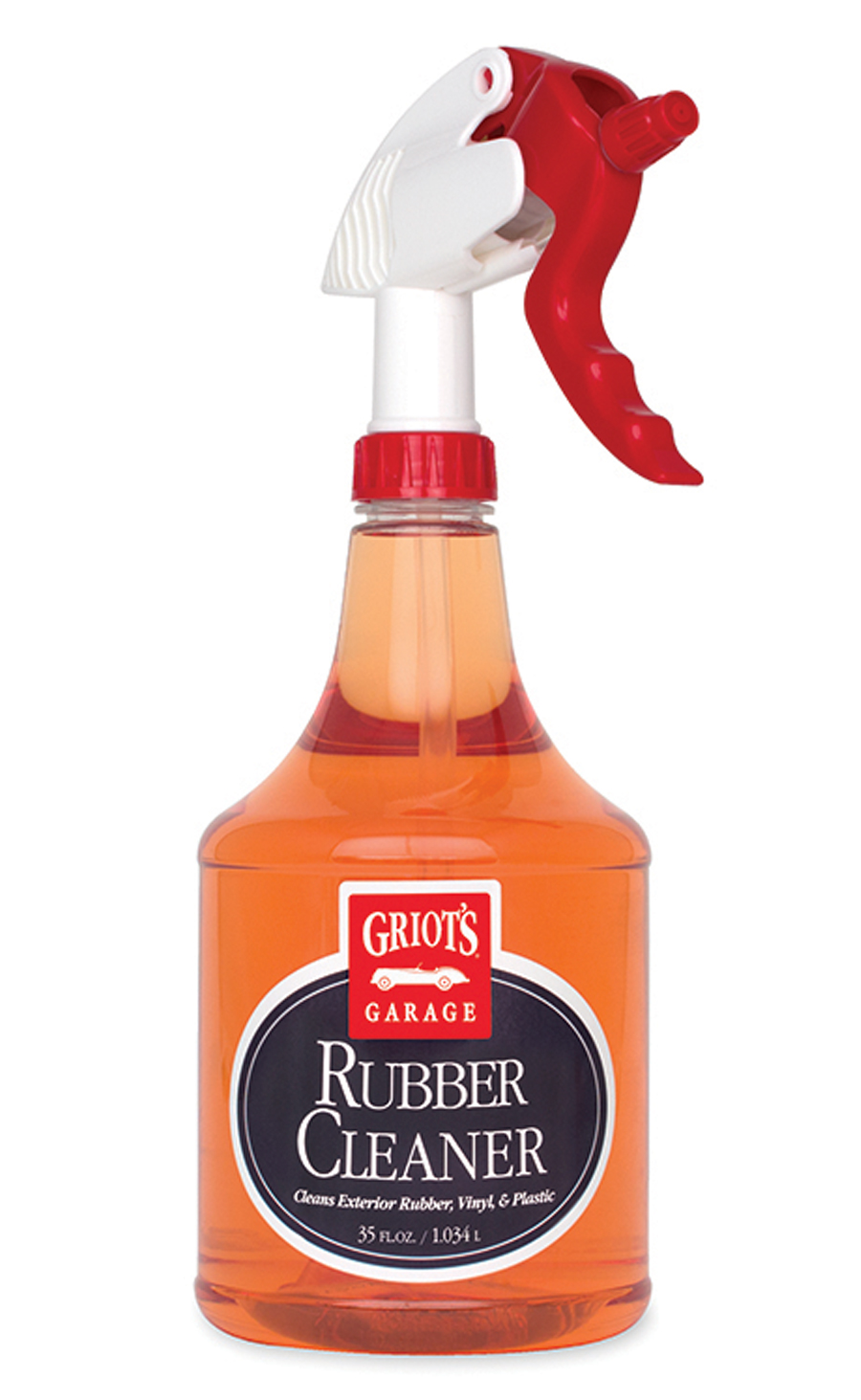
Most (but not all) motorhomes have plain uncoated wheels, so we will cover that process here. First, use an all-purpose wheel cleaner and a wash mitt to completely clean the wheels. Simply spray it on, then agitate it completely — making sure you clean around all the lug nuts and center cap — then rinse fully. Follow that up by using a soft brush and a dedicated rubber cleaner to scrub the sidewalls of the tires. We really like the Griot’s Garage product called “Rubber Cleaner” — it’s made just for rubber and will not accelerate or dry out the rubber on your expensive tires. After cleaning the tires, dry and treat them with 303 Aerospace Protectant; this is one of the best protectants on the market today and with regular use will help extend the life of rubber and vinyl.
Ceramic Coating Primer
When looking on the shelf at retailers, you will see many detailing products using the word “ceramic” on everything from car wash soap to spray detailers. When a professional detailer uses the term “ceramic coating” or “ceramic paint coating,” that is not the same thing as a soap or spray on detailer spray with the word ceramic on the label. A true ceramic paint coating is a rather lengthy (and very expensive) process that requires several preparation steps to the entire vehicle to ensure it is ready for coating. The product is a chemical that is applied to the paint (and other surfaces) that helps protect it from damage and keep it looking great and repelling dirt and water for far longer than traditional automotive wax and sealants. A small bottle of ceramic detailer large enough to coat one car will cost between $40-$100, not counting all the preparation chemicals and toppers that go on afterwards. The total product cost of coating a car with a professional-grade coating can easily cost $200-$300 — and a large motorhome will be several times that. Remember, that is product cost only; you still need to pay for the labor.
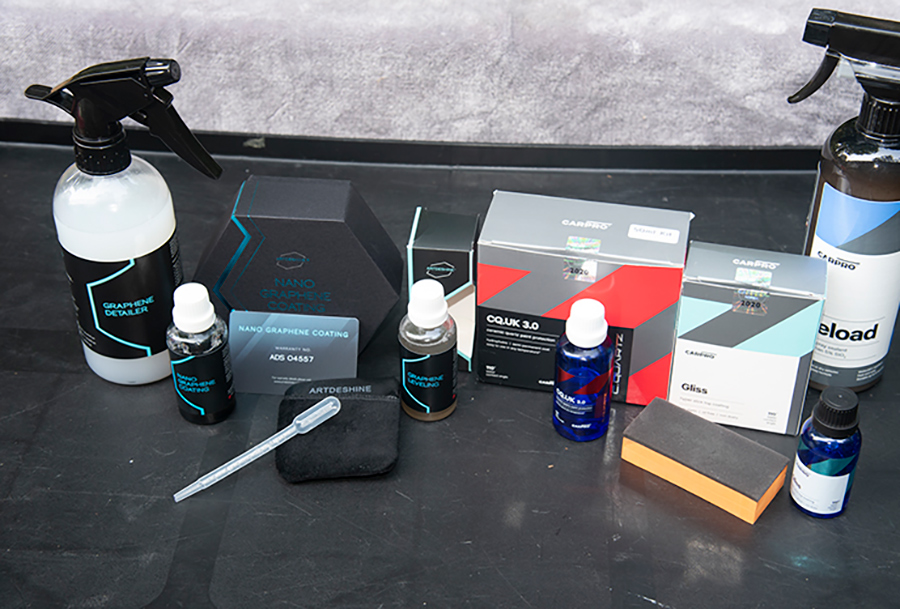
two popular ceramic coating systems
Shown here are two popular ceramic coating systems. The Artdeshine Nano Graphene system on the left is a professional grade product only available through licensed detailers. The CarPro system on the right is a good product that is available to consumers but doesn’t include a warranty.
Is it worth it? In my experience, yes. I believe that paint coatings are perhaps the most important product development in the industry in more than 20 years. I use ceramic paint coatings on every vehicle in my garage, including the motorhome, and typically they last a minimum of two years. However, I have seen them last up to five years, depending on exposure level and maintenance.

The process starts with a decontamination wash, the iron and/or mineral deposit removal, and the prepping of the entire painted surface with a clay bar. The entire painted surface must then be paint-corrected (polished) to remove scratches, swirls and micro marring. This can take one, two or sometimes even three entire polishing steps with a powered buffer to leave the paint glossy and free of surface defects. Finally, the last step before application of the paint coating is an IPA (Isopropyl Alcohol) wipe-down to remove any traces of oil or fillers left from the previous work. Only then is the paint clean and smooth and ready to accept the ceramic coating.

Depending on the brand and type of paint coating used, it may require as little as one layer to as many as three layers of ceramic coating to achieve the desired results. Each layer is hand-applied with special application tools and pads and then allowed to slightly “flash” before wiping down (leveling) with a clean microfiber towel. Once a microfiber towel has been used to wipe off a ceramic coating it should never touch paint again as the coating residue dries in the fibers and can lead to scratches. (This is, as you might have surmised, a very strict regimen and not usually attempted by do-it-yourselfers at home without considerable experience.)

Leveling the ceramic after it cures is tricky and if not done correctly can lead to the forming of streaks or “high spots.” After the coating has cured, the only way to remove a high spot is to mechanically polish the paint again with a polishing media — the coating is that hard and durable. Most coating companies also suggest the use of a topping spray after the coating is applied to protect it during the curing process. Typically, the paint needs to cure from 1-7 days where it is not exposed to water or wash soaps, etc., after the coating is applied. In some cases, IR lights are used to accelerate the curing process.

With all the added cost and complexity of application, you may be wondering why even bother with a ceramic coating. The benefits are many, but most noticeable as an owner is the ease of keeping a coated motor-home clean and looking great. Because of the incredible hydrophobicity — the finish’s little or no affinity for water — after coating, the paint is presenting a surface to water and dirt that they do not want to be on. The water stands up on the surface of a coated surface in a way that has to be seen to be appreciated. This surface makes the paint much easier to wash, dry and to clean, as well.
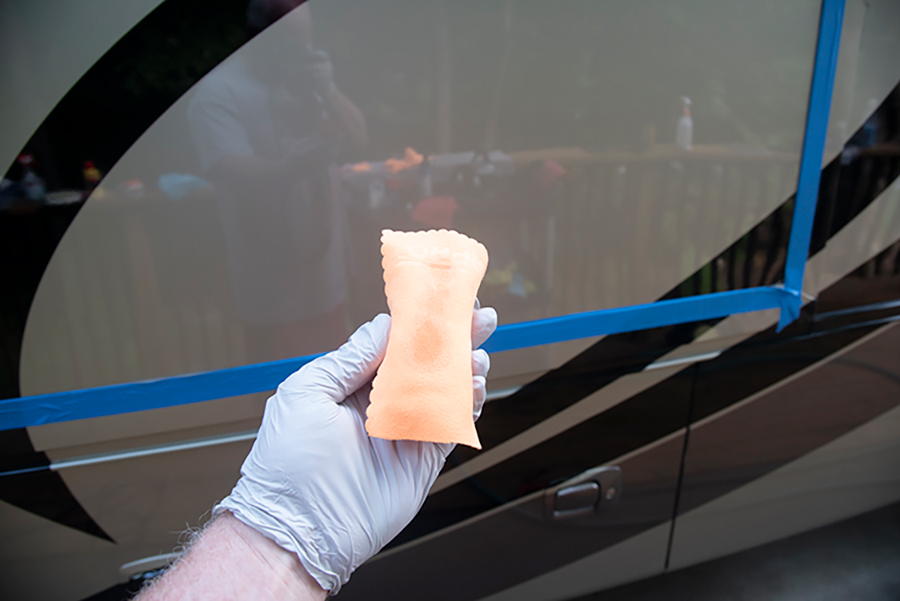
hand with glove getting wax process started with sponge
The application of a ceramic coating is very different than wax. First you must wear gloves, then apply a few drops of the coating on a special applicator. The applicator pad is wiped back and forth, then up and down over a two- or three-foot square and allowed to flash. A clean microfiber towel is then used to level the product on the surface.
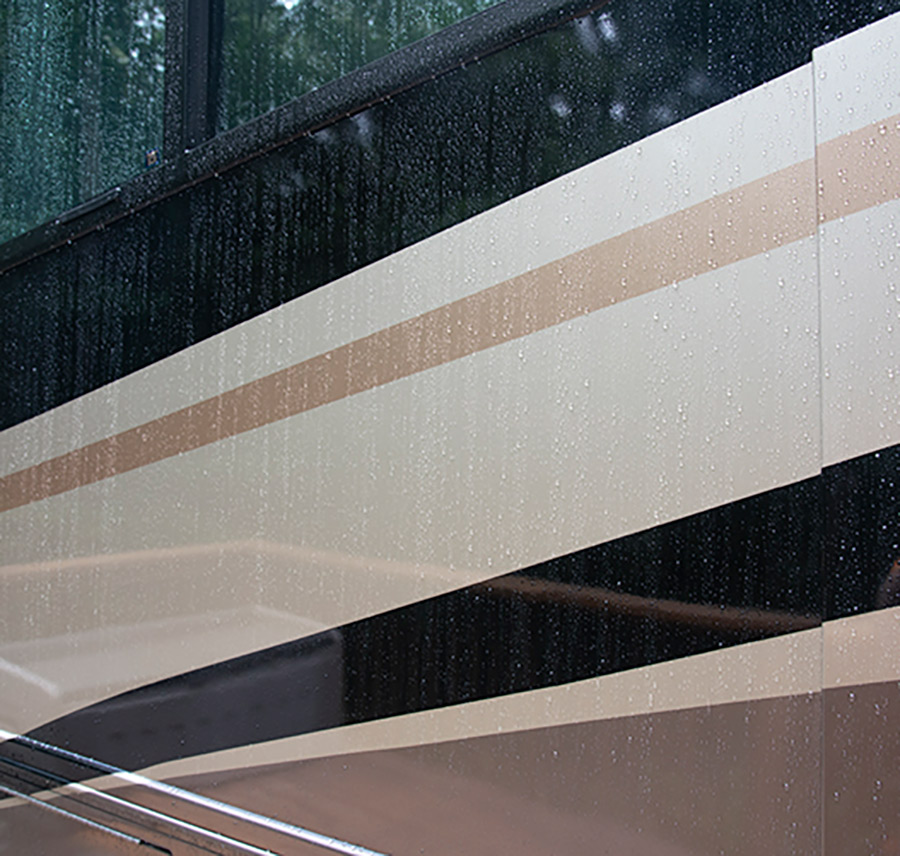
water beading of a ceramic coated paint job
The water beading of a ceramic coated paint job is just amazing. Plus, it lasts for years.
A coated motorhome also looks much better because the gloss is so deep. It is also more resistant against UV damage and oxidation than traditional wax or sealants. One thing that ceramic coatings can’t prevent, however, is water spotting. If hard water gets on the surface and allowed to dry, the minerals in that water will be left on the surface. It will make removing those deposits a lot easier. Understand, too, that although a coated motorhome is resistant to many things, it is not a hard, impervious shell that prevents scratches or nicks from rocks and road debris. It still needs to be washed properly without the use of harsh scrub brushes on the surface. After a paint coating is applied it is important to follow the suggestions of the coating manufacturer for washing and maintenance to ensure the coating lasts as long as possible. If you use the wrong products it can lead to “clogging” of the coating and reducing the benefits.

The process of coating a large motorhome is expensive even if you do it yourself. Expect to spend several thousand dollars to have it done by a professional (and manufacturer accredited) installer. There are many brands of coatings, and each has their own network of installers across the country. Popular brands include Optimum, CarPro, Gyeon, GTechniq, Adams and our current favorite, Artdeshine. On our coach we had the Artdeshine Nano Graphene Coating applied — which is a true professional-grade coating with a multi-year warranty when applied by certified installers — topped with the Artdeshine Graphene Detailer Sealant. This is a true one-coat ceramic coating and after application the surface was incredibly slick and hydrophobic. The water beading is insane compared to a regular wax job and it lasts for years.

In addition to paint coatings, there are specific ceramic coatings for other parts of a vehicle such as glass, plastic trim, rubber, leather and more. In general, the glass and trim products tend to be the most beneficial to motor-home owners. We have used many of them and found they do last significantly longer than their traditional counterparts.

Once you determine you have uncoated aluminum wheels, you can proceed to polishing. We like Zephyr PRO-40 wheel polish and White Diamond polish; both are very good and easy-to-use products. To polish a wheel fast, you really need a drill motor and a polishing tool. We prefer a cordless drill and the Mothers PowerCone and/or the Mothers PowerBall. It also helps to have Viva brand paper towels, which are 100% lint free and are amazing on aluminum wheels (again, based upon our experiences). You don’t really want to use microfiber towels to remove the black polishing residue because the towel will be ruined after this step.

Start by applying polish to the PowerBall and then use the drill to spin it, moving it over the entire wheel. The black slurry that is formed is a sign that it’s working. Some areas of the wheel, such as around the lug nuts and center cap, may not be accessible with the power tool; you will have to do those by hand. After you think it is polished, use the Viva towels and wipe away the residue — the shine should be revealed along with any missed spots. If you did miss some places or don’t think its shiny enough, make another pass. Each wheel can take from 15 to 45 minutes or more, depending on how neglected they are.
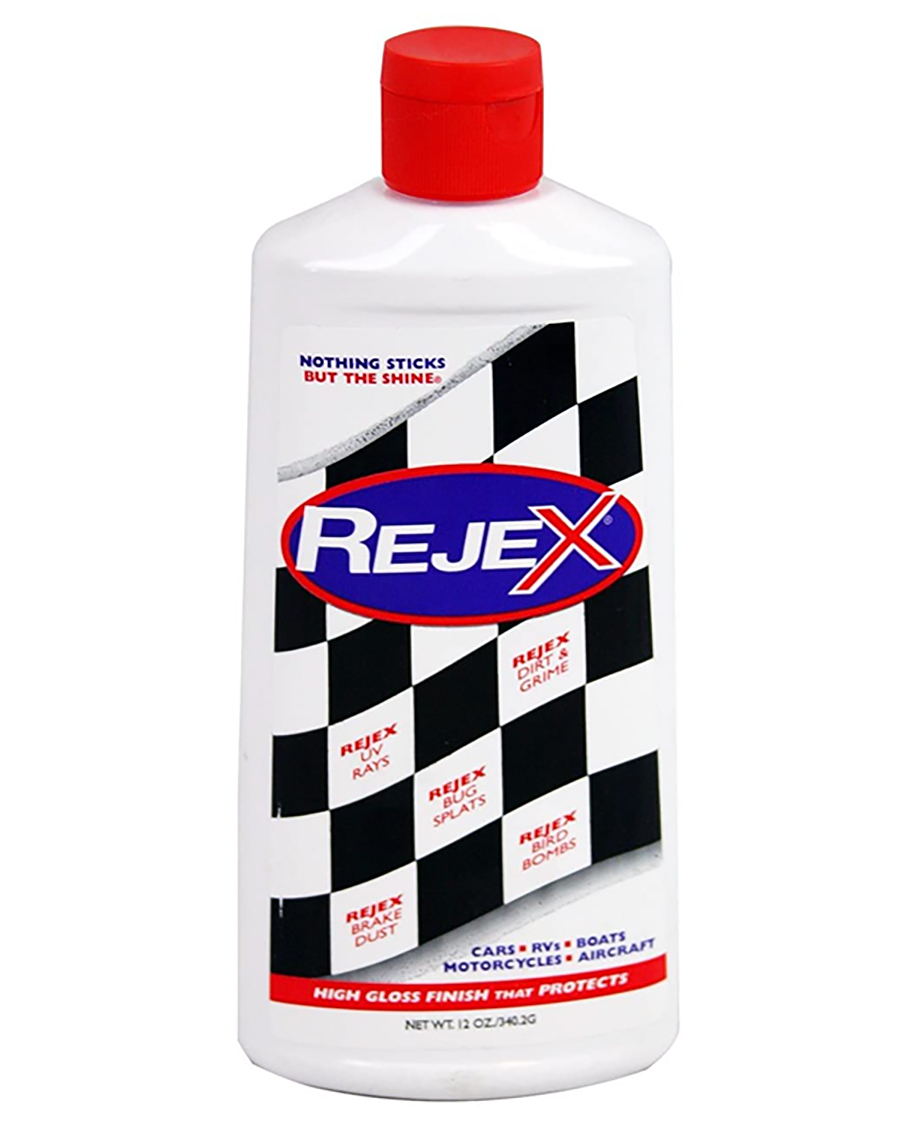
a long-lasting paint sealant
If you decide to use a long-lasting paint sealant instead of a more involved paint coating, there are several good products on the market including Wolfgang Deep Gloss Paint Sealant, Duragloss 105 Total Performance Polish as well as Rejex. All of these are readily available online at most detailing suppliers and Amazon.
good alternative to exterior paste or liquid wax
Another good alternative to exterior paste or liquid wax is a good quality spray on wax/sealant. This one from Griot’s Garage is easy enough to apply so you may not mind doing it every few months.
Treating the Finish
Now that your motorhome is clean, it’s time to do the real work.

Although it’s not required, a clay bar step improves the whole job by removing bonded contaminants on the surface of the paint. You can use either an actual clay bar (available at most auto parts stores) or a clay bar mitt (by hand) or a pad that can be attached to the buffer. Make no mistake: This is an arduous process when done by hand — but after finishing the clay bar step, the paint will be smooth like glass.

Mothers PowerBall system
polish wheels
For polishing the uncoated aluminum wheels, we like the Mothers PowerBall system with the extension rod and both sizes of the polish wheels. This, along with a cordless drill and good aluminum polish like Zephyr Pro-40, will yield fantastic results. After polishing the wheels and protecting the rubber with 303 Aerospace Protectant, they should look like this.
If your paint is more oxidized and requires additional polishing (and you are comfortable performing this operation) you can really take the paint to a new level of clarity and shine with enough time and the correct products. Using a power buffer and a cutting pad along with a good polish such as Optimum Hyper Polish, buff a small area at a time, then remove the polish with a clean microfiber towel. Repeat this step until the entire coach is polished. If the paint is really scratched, it may require two stages of polishing to restore the proper gloss.

For most of us, however, a simple one step sealant with a mild polish will do fine. Paint protection (some call this “step waxing” or sealing) is usually the final step of the process. Using a Dual Action Orbital buffer with the correct pad will make a huge difference in the time of a project like this. There is a lot of surface area involved and, depending on what type of paint protection and polishing you are trying for, it could take anywhere from a few hours to a day or more if you are working alone. Products such as Griot’s Garage Finishing Sealant, DuraGloss 105 Total Performance Polish or Rejex can be used; all are available online and in some stores. They will all do a good job and last many months.
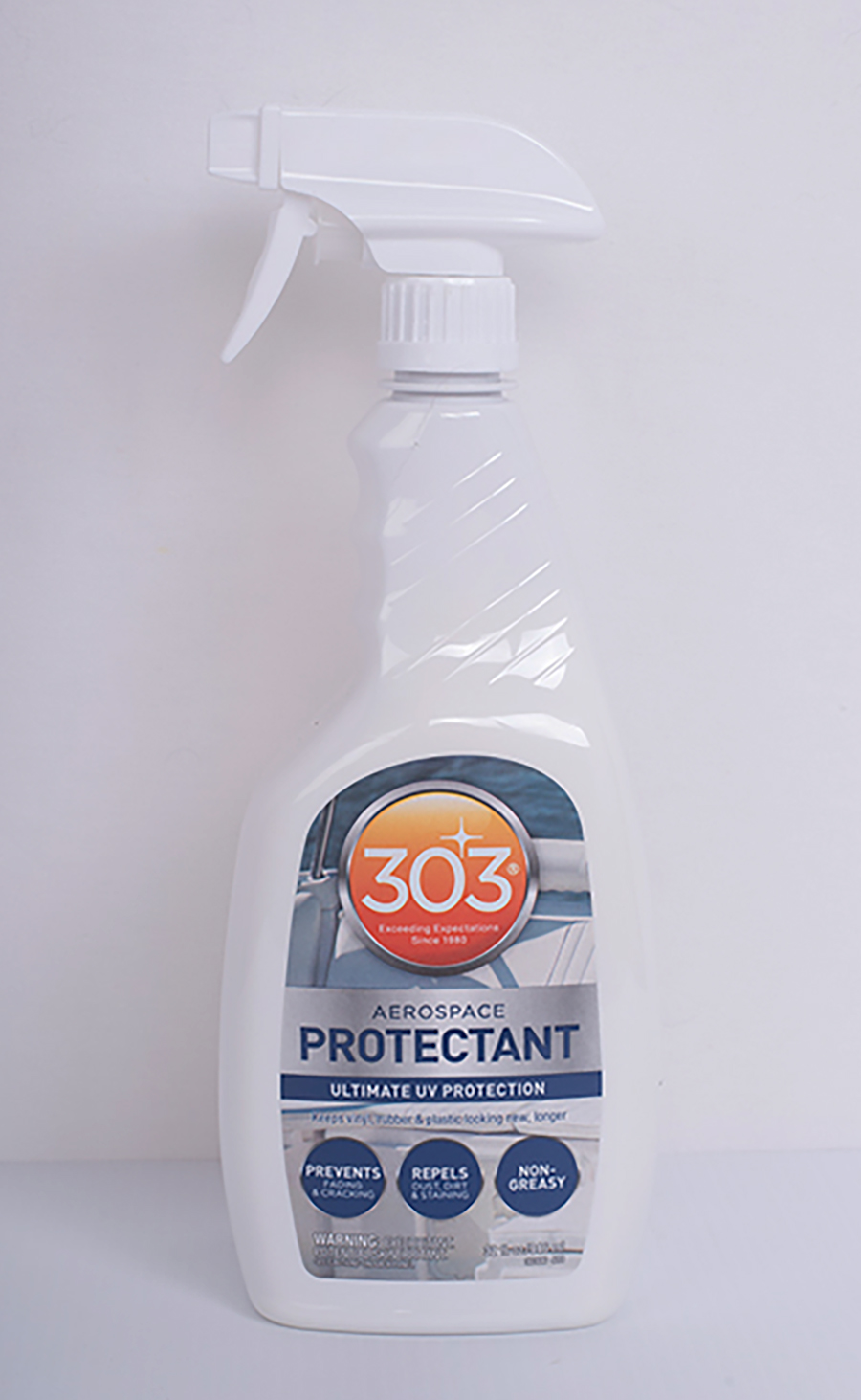
303 Aerospace Protectant
303 Aerospace Protectant is one of the best rubber and vinyl protectants on the market today and it is completely safe for use on tires (unlike some protectants on the market with petroleum distillates).
Griot’s Garage Rubber cleaner
Griot’s Garage Rubber cleaner is a great product for cleaning tires as well as other exterior vinyl and plastic parts.
a fully detailed motorhome with glossy paint, wheels and rich dark black rubber tires
There is nothing that looks better than a fully detailed motorhome with glossy paint, wheels and rich dark black rubber tires properly protected.
As noted earlier, this is not a fast or easy project — which is why many owners hire detailers to do it for them. When shopping for a detailer make sure you know what type of products they plan on using and exactly what steps are involved. If one company is offering a multi-stage paint correction and sealing with a high-end product, expect to pay more than someone simply washing and waxing it with a short-life carnauba wax — the quoted $250 job that sounds good usually isn’t. Over the life of the coach, cleaning and polishing it will pay off both in enjoyment as well as resell value — so don’t overlook the importance of taking care of your coach.