


Sidestepping Shambles
[maghub_sidebar]
Quick Tech
Sidestepping Shambles
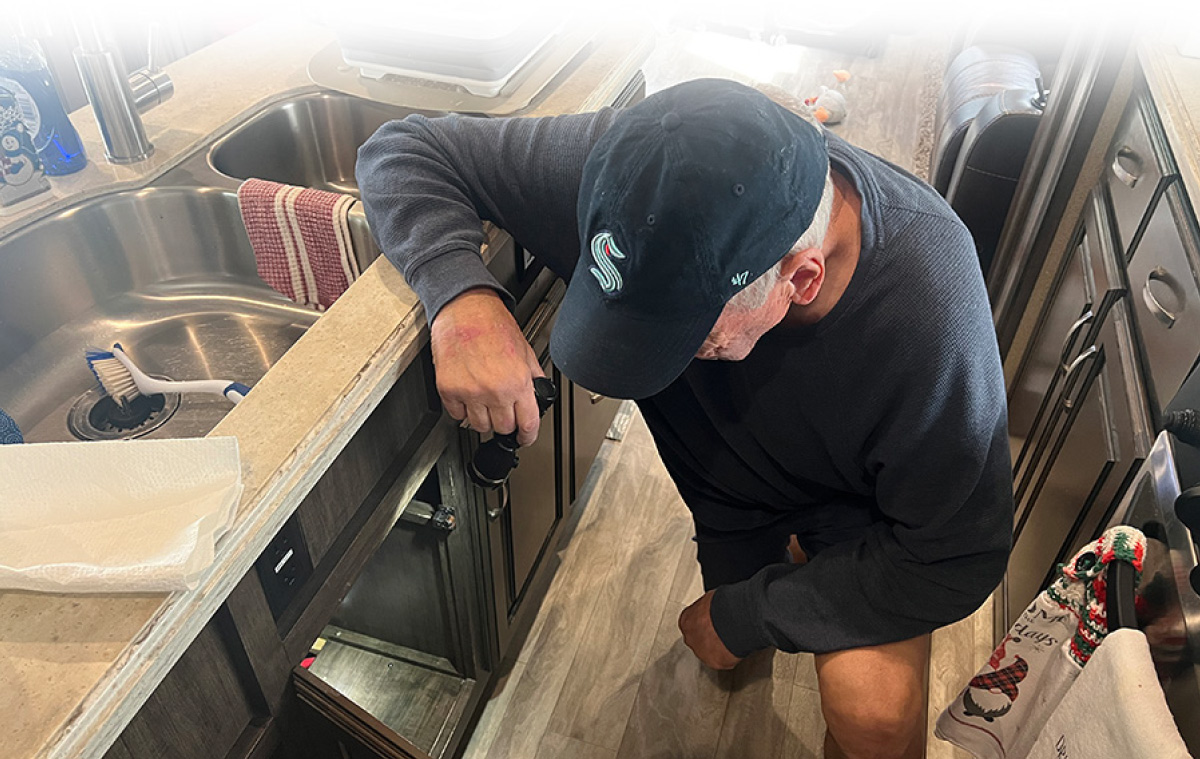
man taking a look under the cabinets in his RV
Detecting moisture in cabinets, under sinks, in storage compartments, behind the toilet and in other places that shouldn’t be wet can prevent costly, unexpected damage. Inexpensive and easy-to-install sensors provide advance warning.
By Bob Livingston / photos by author
W

ater may sustain life — but when allowed to leak in an RV it does just the opposite. When leaking water goes unchecked in an RV, the results can be disastrous — many RVs have been damaged beyond repair from water that was allowed to flood the interior. If you don’t find out about a leak until water drips on the ground — or pours out the entry door — it’s likely too late. Last month, neighbors who left their motorhome vacant in an RV park got a rude awakening when the interior flooded due to a leaking faucet. The damage would have been much worse if friends didn’t notice the wet ground under the motorhome and shut off the water.

You can prevent an expensive clean-up by taking a proactive stance and installing inexpensive leak detectors that can give you advance warning before things get out of control. Not only is this easy to do, but the cost is peanuts when compared to potential repair bills.
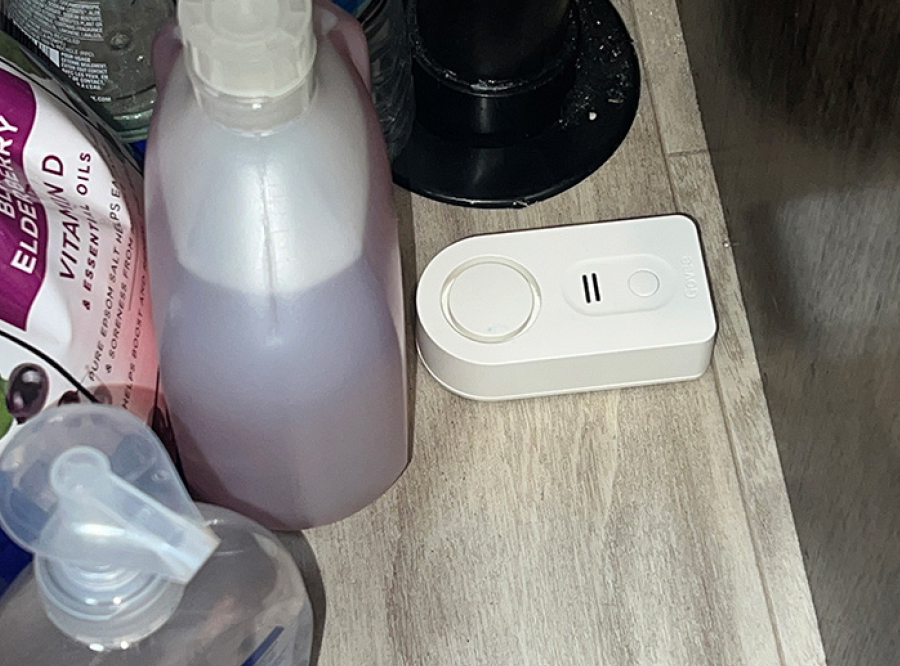
Govee (H5054) water alarm sensor located under the bathroom sink
A Govee (H5054) water alarm sensor is located under the bathroom sink. It’s just a matter of placing the sensor where water is likely to be should a pipe spring a leak.
There’s a proliferation of such devices on the market — they’re well-known among folks who have owned a brick-and-mortar house with a basement prone to flooding — and if you search the Internet, the choices are extensive. My guess is that most will do the job, but when a friend praised the performance of the Govee water sensors he’s used for some time, that’s all I needed to make a good choice. It’s all about experience with products and reviews these days.

The Govee H5054 sensors can be purchased on Amazon ($12.99 each or in packs of five for $49.99). For protecting an RV, five is a minimum number. These sensors are small and inconspicuous — just 1.77 x 1.04 x 3.46 inches in size — and are self-contained. Running on two AAA batteries, they are capable of sensing water on flat surfaces via two groups of built-in probes on the backside or will alert to dripping water when the moisture hits one group of probes on the front of the device. A low battery alert is also provided.

When water is detected, a loud (100 db) alarm can be heard from anywhere inside the RV and on an RV site. A red light also signifies the leak. For those who would like to be informed offsite, there’s a Wi-Fi component that will send messages via email to your phone or tablet. It works on 2.4G Wi-Fi and not on 5.0G versions, so check your system to make sure it’s compatible.

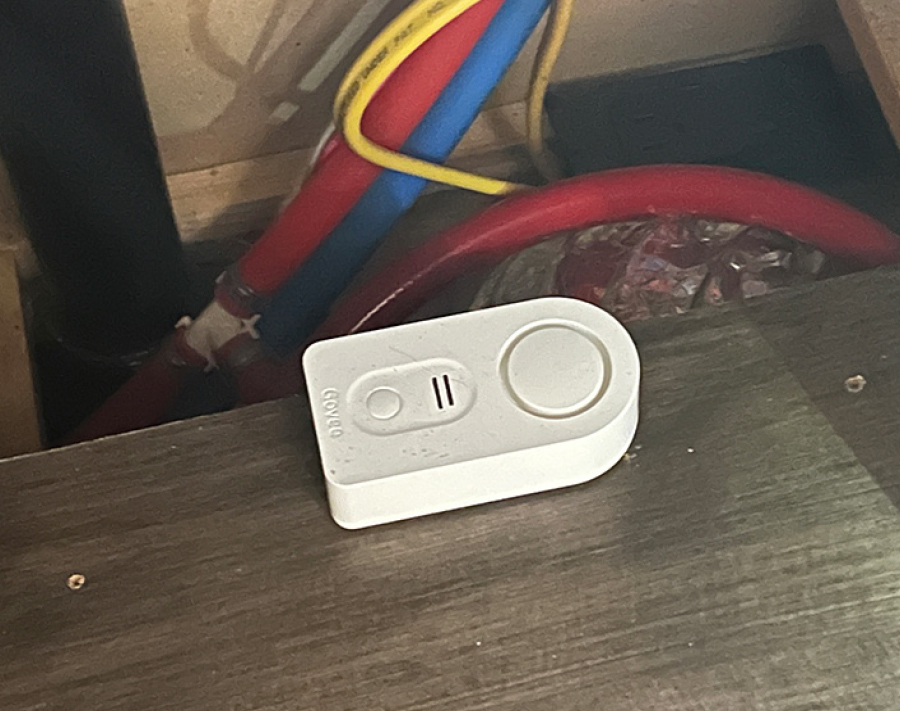
the Govee sensor near toilet
After the water pipe to the toilet let go a few months ago, the owner who recommended the Govee sensors repaired the cracked pipe fitting and added a sensor to detect the future presence of water behind the “throne” before it hits “flood” stage.
the Govee sensor under the kitchen sink
Another logical place to position a sensor is under the kitchen sink. Drainpipes have been known to leak at the P-trap and the hot- and cold-water lines to the faucet.
two groups of probes on the backside of the Govee sensor
The Govee water alarm sensors have two groups of probes on the backside that detect leaks on flat surfaces. Probes on the front side detect dripping water (not shown).
These sensors can be placed anywhere there’s a potential for moisture. For example, logical locations to monitor are under the bathroom and kitchen sinks, behind the toilet, next to the demand water pump, inside storage compartments and in a utility bay. And the sensors are very sensitive — one even went off when the floor was washed a few minutes before returning the sensor to its previous location. If it does sound an alarm, dry the sensors with a towel and press the mute button and you’re ready to be protected again.

Most RV owners have experienced some type of leak. If unwanted moisture is detected in time, the leak can be repaired quickly, clean-up time is reduced to almost nothing — and a potential disaster can be averted. That’s asking a lot of a small investment in simple components, but it works.

sensor with red LED illuminated
When moisture is detected, the sensor sends a 100-db audible alarm and the red LED is illuminated. The sound is loud enough to be heard throughout the RV and almost anywhere on an RV site. The device runs on two AAA batteries and an audible alarm reminds the owner when they need replacing.
sensor next to smartphone and wall plugin
Alerts can be sent via e-mail with the Govee kits that have Wi-Fi 2.4G provisions. This kit sells for $54.99 on Amazon and includes five sensors. An app can be downloaded on a phone or tablet.