


electing a single vehicle as the year’s best is never an easy proposition no matter what the industry. Within the RV arena, with its multitude of manufacturers, it’s even tougher. That’s a big reason why RVBusiness magazine, the nation’s premier RV trade journal, expanded the finalists for its prestigious “RV of the Year” award from four to nine for the 2023 model year. Following two years when the industry’s foremost trade show, the Elkhart RV Open House, was cancelled due to lingering pandemic concerns, most RV builders pulled out all the stops for this September’s event, which is typically “the place” for new debuts.
“We could have expanded the overall list even further — there were that many 2023 model year units worthy of such consideration,” said RVBusiness Executive Editor Rick Kessler.
To be as transparent as possible, there is no set criteria to RV of the Year — although innovation, differentiation, marketability and a genuine “Wow, that’s something we haven’t seen before!” impression also come into play. Of course, the look and feel, as well as function and performance, also are part of the equation.
And, yes, the RVB staff (along with a host of others with respected opinions, including RV Enthusiast editors) do see virtually every new model for the coming season, fanning out to visit myriad locations across northern Indiana during the week-long Open House program. (Those manufacturers that couldn’t make it were either seen at “America’s Best RV Show” in Hershey, Pennsylvania, two weeks earlier, or invited to submit photos and details of 2023 rigs.) Models are identified for consideration, then a robust debate ensues among the staff. And, while the discussion invokes the merits of each unit based on the above parameters, rarely, if ever, has there been a clear-cut winner.
But eventually a consensus is achieved as the merits of one particular model outweigh all others.
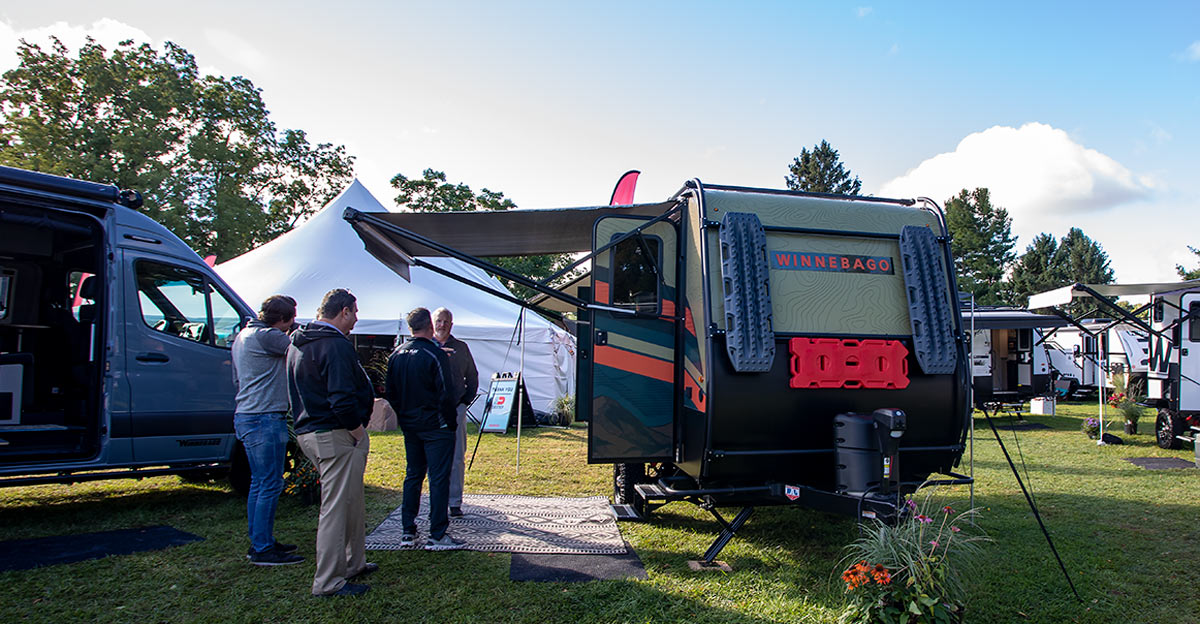
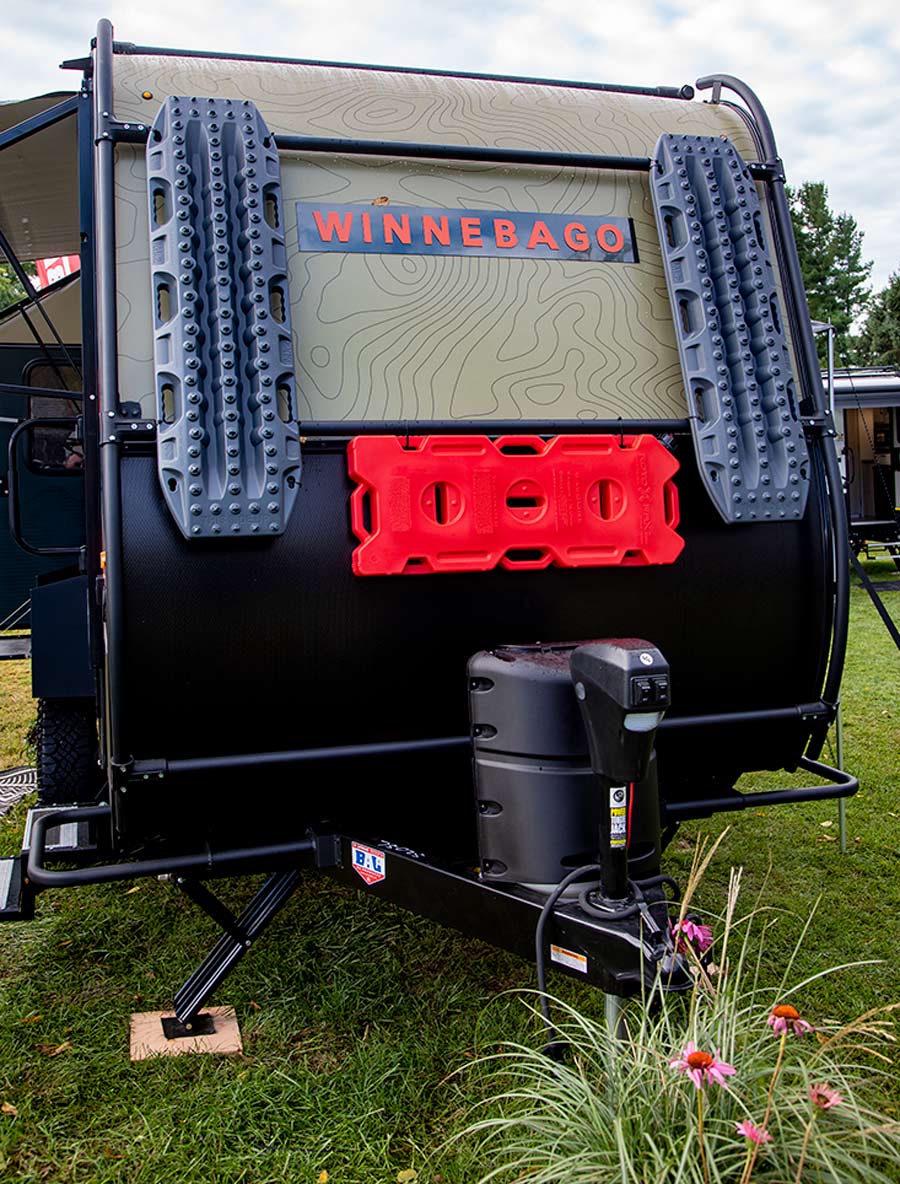
Led by its 131SB Overland Concept, the 2023 RVBusiness RV of the Year goes to the Winnebago HIKE 100 FLX, a line of micro trailers that’s equally at home in the campground or well off the beaten path … or up a mountain … or down a ravine … or wherever outdoor adventures await.
The HIKE 100 FLX includes five floorplans, all under 16 feet and weighing in at about 3,000 pounds unloaded vehicle weight (UVW) with 1,000 pounds of cargo carrying capacity — easily within reach of most SUVs and trucks. The lineup starts in the mid $40,000-range (MSRP), making them within reach of most budgets.
More notably, for 2023 the HIKE 100 has added the FLX package, first introduced a year ago in the (relatively) bigger Micro Minnie line, which includes a suite of components and appliances that combine to form a robust system for comfort and performance.
Also, the HIKE’s other featured addition for 2023 is the all-new Independent Suspension Bridge Axle Mounting System by BAL RV Products, which incorporates Dexter TORFLEX Stub Axles.
In fact, it’s because of the FLX package and independent suspension that the HIKE 100 successfully bridges the gap between a mainstream RV and extreme overlander.
To be fair, there have been a handful of other RVs, both in prior years and for 2023, that are worthy emissaries of this niche segment — among them being the Beast Mode models in the Forest River No Boundaries and IBEX lines, Ember RV’s Overlander ROK and ROL, Lance Camper’s Enduro and dozens of rugged teardrops and so-called “adventure trailers” from specialty manufacturers. But, in the estimation of RVB editors, the HIKE 100 FLX represents the 2023 model year’s best execution of an overland-capable unit with crossover appeal.
In fact, if you’re looking for a product trend for 2023, the overland segment might be the one. Certainly, there are other trends — several OEMs expanded their Class B offerings, and many introduced all-new entry-level lines — but the overland niche has seemingly captured the fancy of would-be outdoor enthusiasts looking to escape into the great outdoors.

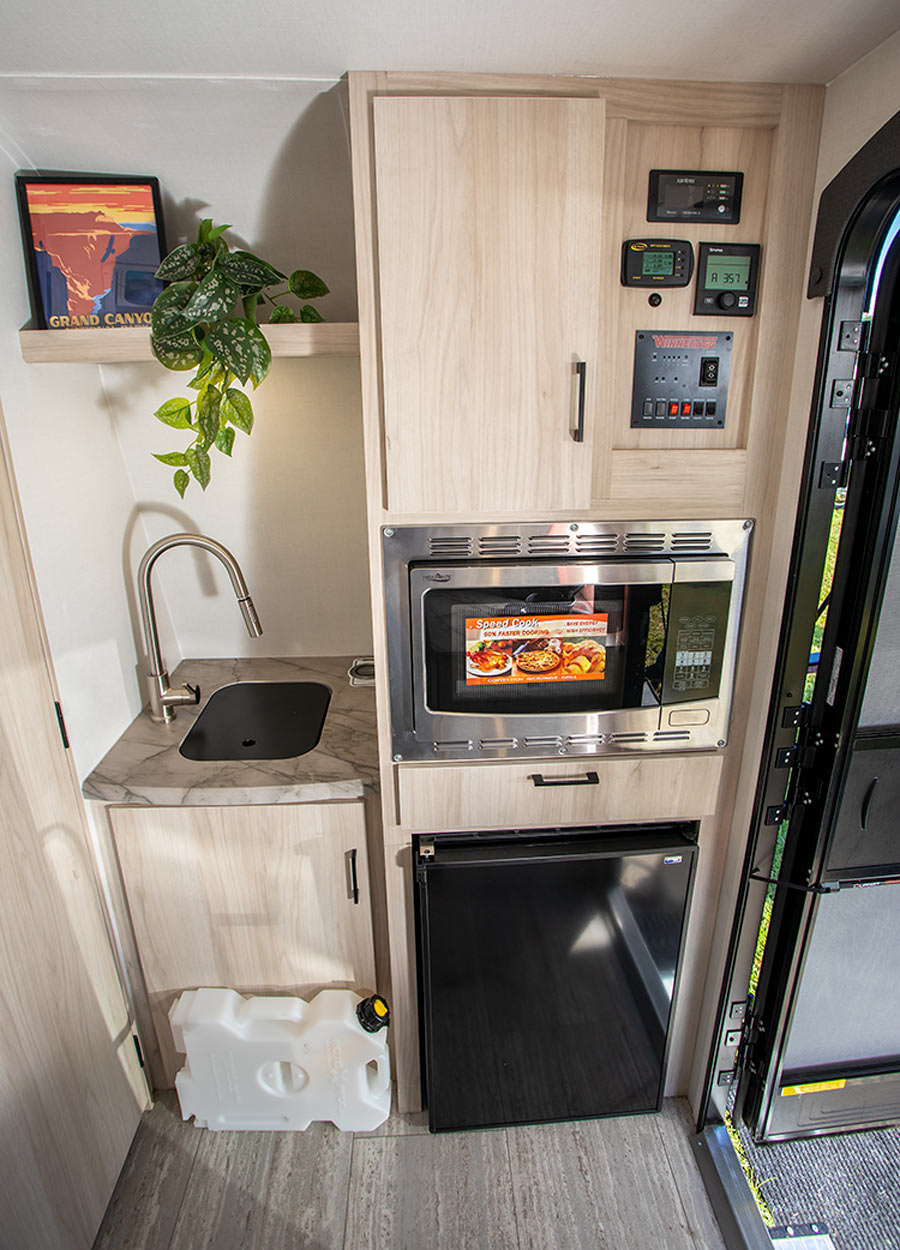
As mentioned, the HIKE 100 FLX can take you off-grid, thanks to its FLX package which expertly combines electric power technologies mated with efficient appliances and components. In fact, according to Winnebago sources, the HIKE 100 FLX can go off-grid for up to five days.
Digging deeper, the FLX package includes: 320-amp hour lithium battery with an internal battery management system and Bluetooth monitoring capability; 3,000-watt pure sine wave inverter; 200-watt solar roof-mounted panel; 30-amp MPPT charge controller; and side-mount solar prep for additional solar panels.
“And then we didn’t stop with just electrification initiatives,” added Adam Christoffersen, senior product manager for Winnebago Towables. “It’s a suite of more efficient appliances with the Truma AquaGo water heater, the Truma VarioHeat furnace and the Truma Aventa air-conditioner.”
And that, added Joel Eberlein, vice president of Winnebago Towables, is where the company differentiates from a lot of trailer manufacturers.
“Right now, everyone’s leaning into lithium and solar, but they’re keeping the base packages the same,” Eberlein said. “You’re not getting any more efficiency in terms of how your heater and your A/C and your furnace are working. The Truma suite of packages gives us more versatility and better optimizes the electrification of the trailer. So, for that person that’s going to be off the grid, they can do it for longer periods of time.”
Add to that BAL’s all-new independent suspension. According to Joe Hosinski, vice president of sales and service for BAL RV Products, the key to the suspension is how BAL’s innovative bridge stub axle mounting system seamlessly integrates with Dexter’s TORFLEX stub axles to offer a smooth and quiet ride on paved and non-paved roads.
“The BAL Independent Suspension Bridge Axle Mounting System allows each wheel to travel independently while allowing for additional ground clearance,” he said. “The system features custom-designed coil-over shock absorbers that dampen wheel oscillation to keep the trailer level, as well as protect it from travel-related damage. “Torsion stub axles feature four rubber cords with a heat-treated solid-steel inner bar that cushions the ride and absorbs road shock, reducing transmission into the chassis and RV,” he continued. “Additional strength and durability is provided by forged heavy-duty hubs, integrated with precision machined steel spindles and cast-iron hub-drums. TORFLEX axles are equipped with electric brakes and E-Z Lube axle bearings.”
BAL’s suspension system, Hosinski added, is the industry’s first truly independent suspension bridge axle mounting system featuring torsion axles. Additionally, the heavy-duty steel stub axle mount is protected and coated with an automotive grade PPG Powder over E-Coat finish and is available in multiple colors.
There are additional aspects of the 131SB, to be sure, including: Showermiser water reclamation system; a patented exoskeleton compatible with Thule and Yakima accessories for gear hauling; lower nerf bars for accessibility when loading and unloading gear; fender gear storage boxes; a toy hauler-style side-mounted ladder; back- and off-camp side batwing awning with drop-down panels for exterior shower; dual rear doors with molle panel and flip down table; opposing couches that flip down to create a bed, with a drop-down bunk above; wet bath with designated gear drying racks; portable induction cooktop for inside and outside cooking; and Winnebago’s “Red Thread” features such as power stabilizing jacks, 2-inch hitch receiver, tank pad heaters, Wi-Fi prep, wireless cell phone charger and fully composite flooring.
Perhaps the best thing about the 131SB concept model is that, as Eberlein and Christoffersen noted, it was born from feedback from actual overland enthusiasts. Fortunately, Winnebago listened — and the overlander niche is now the better for it.