

Ice Breaker
[maghub_sidebar]
Ice Breaker
Winterizing your RV plumbing system correctly is essential to preventing some very costly damage
By Chris Dougherty
W

inter. If you enjoy traveling, it sucks — at least, in the northern part of the country.

I’m probably not alone in that sentiment. There’s no denying that traveling in an RV during winter where very cold weather (think snow) prevails — especially for New Englanders like myself — can be difficult. The popularity of “four-season” RVs has led more folks to take their RVs out in the snow, but for most of us, plummeting temperatures are Mother Nature’s reminder that it’s time to put the toys — and the toy haulers, including those without garages — away.

Whether you store the RV all winter or use it for snowbirding or skiing trips, it still needs to be protected from the elements — and understanding the limitations of its water system and pushing back against the freezing cold is essential.

The primary problem doesn’t lie with the PEX, or crosslinked polybutylene, pipe that is used in all new RVs since the new millennium. PEX can withstand freeze damage and high pressure very well. The problem stems from the plumbing connections, water-fed appliances/hardware (faucets, valves, ice makers, shower heads, etc.) and holding tanks.

Many RVs utilize lighter-weight components, which are not as heavy-duty as their residential or commercial counterparts — and when they freeze, they are much more susceptible to fracture. These components include various plumbing unions, connectors, faucet parts, pump bodies and valves.

It’s not the cold that damages these parts, though — it’s the water left in them, which expands when it freezes.
Master technician Bernie Roy
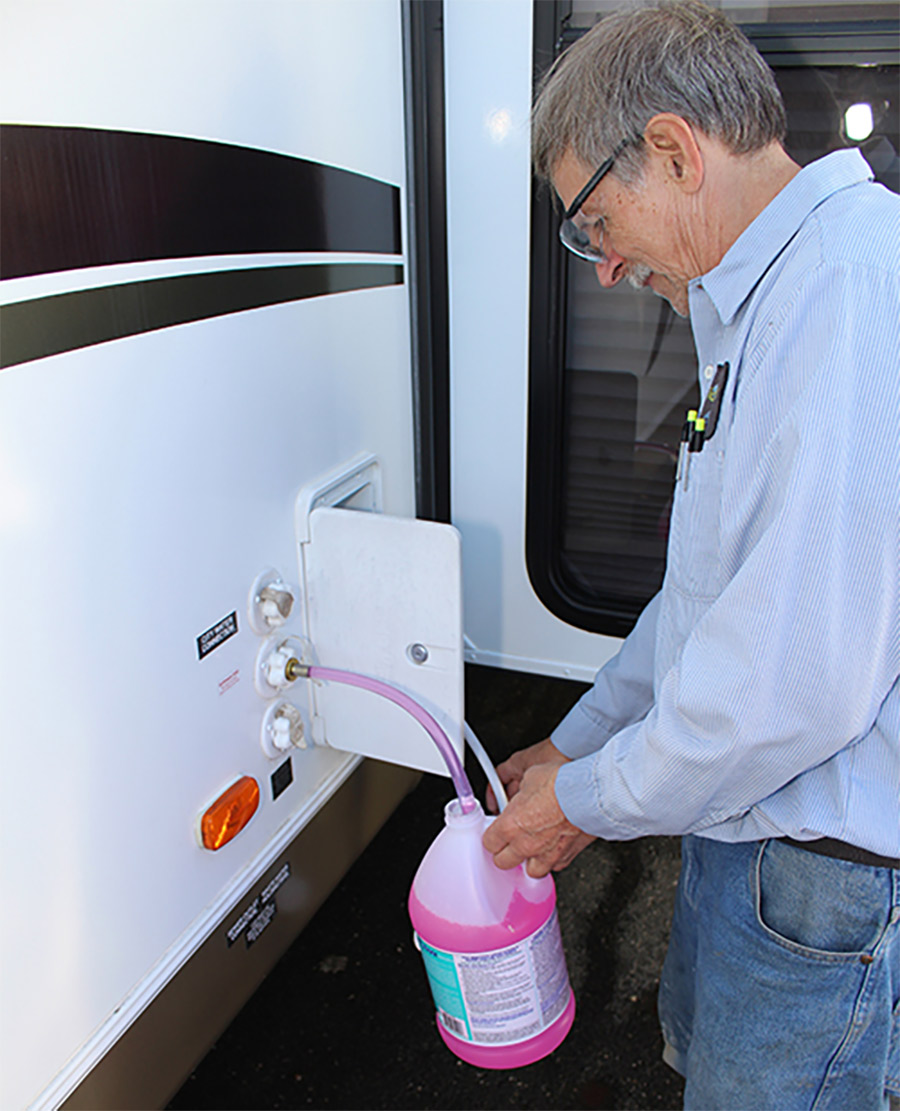
Master technician Bernie Roy winterizes an RV at Diamond RV Center (now Camping World) in West Hatfield, Massachusetts.
The key, then, is to make certain that no water is left in any of the plumbing or appliances/accessories in the RV when it will be exposed to below freezing temperatures. This is especially important when the RV will be cold-soaked below freezing for an extended period of time. For example, when traveling in winter and the heating system fails, there is only a brief amount of time to winterize the plumbing before it freezes.

Yes, RVs come with drains to empty the system. Unfortunately, there are a number of places where simply draining the water system using the low-point drains will not be completely effective in evacuating enough water to prevent damage. Components like water heaters, the toilet and ice maker valves can hold excess water, as can some bends and low points in plumbing are just as susceptible.
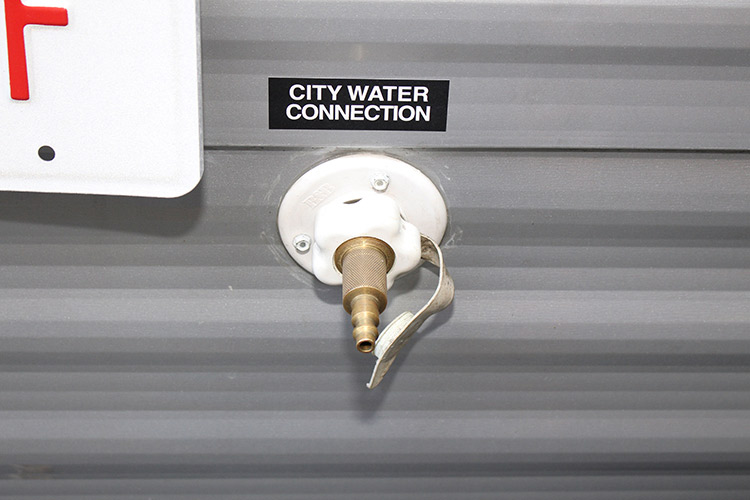
City Water Connector
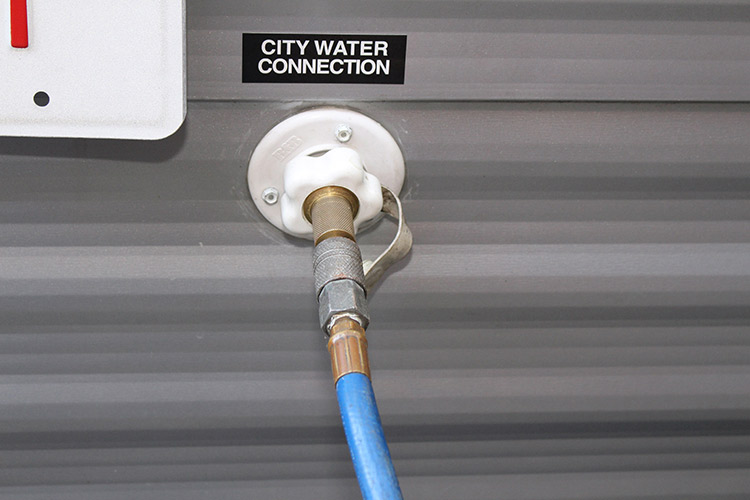
City Water Connector with hose
Blowing out the plumbing system will require an adaptor for the city water inlet, a hose and air compressor. This adaptor allows direct, hands-free connection of a standard air fitting, freeing up the service person (owner) to move around and bleed down the system.
At a minimum, the plumbing should be evacuated with compressed air, at no more than 40 psi. Special adaptors are commercially available to connect a compressor hose to the city water inlet to blow air through the freshwater system. It is essential that every part of the system is cleared of as much water as possible, including the city inlet and low point drains. Drain the freshwater tank and let the water pump run dry for a short duration. The pre-filter on the pump may hold some water, and should be cleared by opening the housing and dumping, or it can be blown out.
Water heater bypass kits
Water heater bypass kit tag
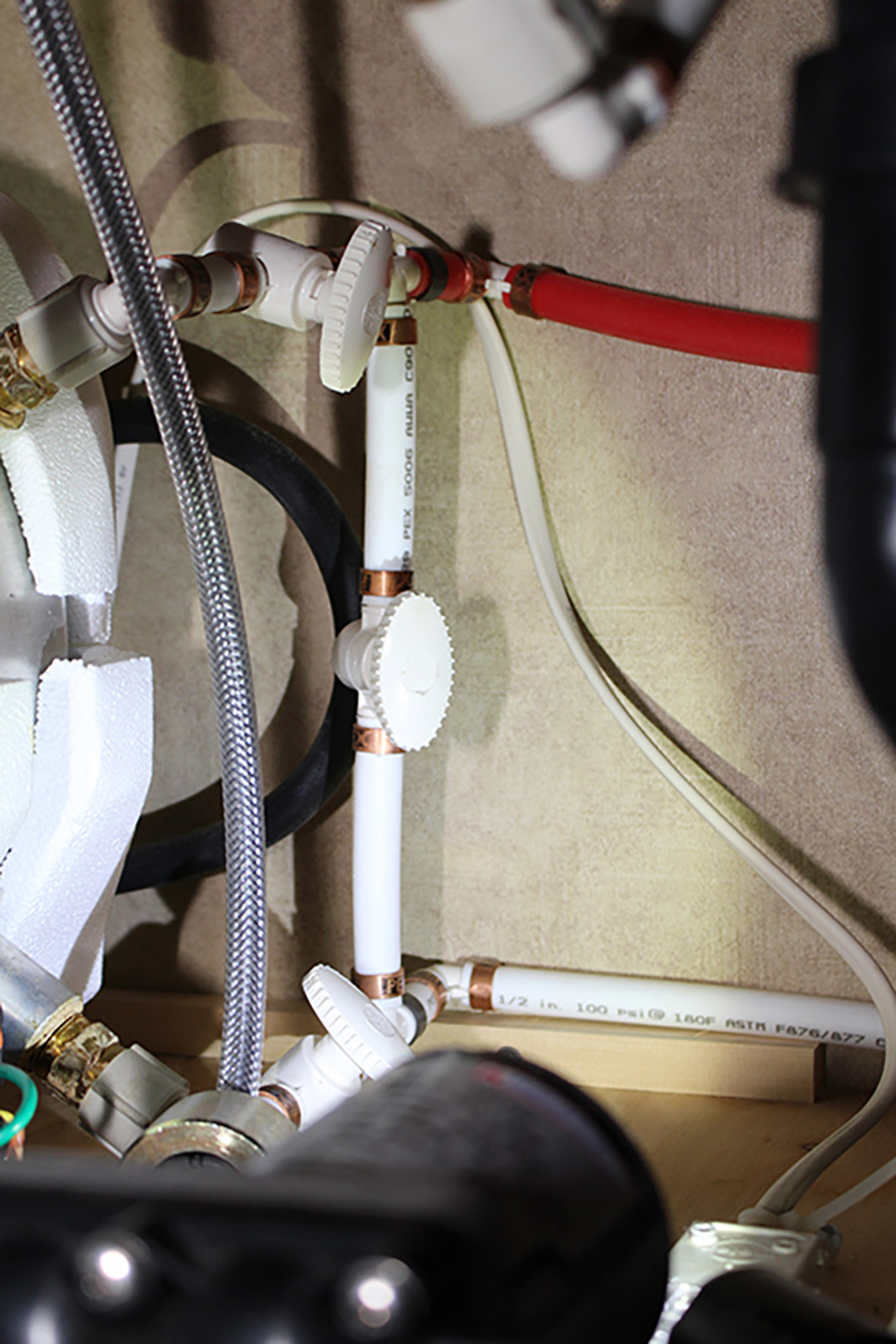
Water heater bypass kits come in a number of variations, with one, two or three valves on the back of the water heater or at a remote valve control panel. The idea, of course, is to isolate the water heater so you don’t have to fill it with antifreeze. Demand heaters must not be cleared with compressed air. They should be allowed to gravity drain.
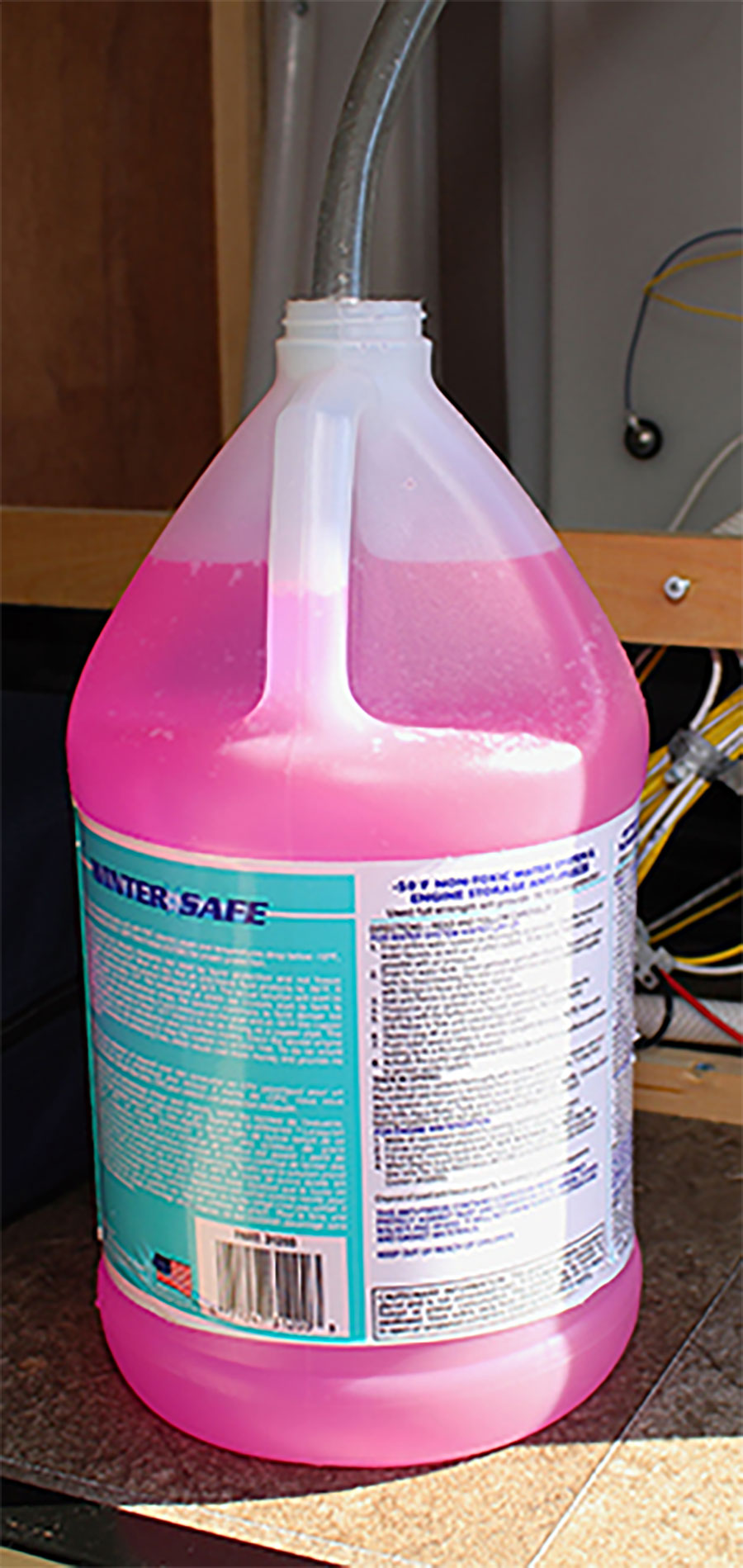
The preferred way to protect the water system is to add RV/Marine antifreeze after blowing out the system. Available in two concentrations — one for down to -50F, and another for -100F — the non-toxic antifreeze displaces the water in the system and prevents a hard freeze. Do not use automotive antifreeze, which is toxic and can lead to death. Most new RVs come with a winterizing valve and hose connected to the freshwater pump; however, kits are readily available from Camco, among others.

Here are a few trouble spots to pay particular attention to:

  • Clothes Washer — Your clothes washer has two water inlets: one for cold and one for hot water. It also features a pump for removing water from the washer tub and sending it down the drain. It’s essential to make sure antifreeze passes through both the hot and cold valves, and then is processed through the ejection pump. Failure to do so would lead to damage to the hot- and cold-water lines into the machine, the internal valves and the pump. If the drain has a P-trap, it too would likely be damaged.
  • Dishwasher — If you have a dishwasher, it’s basically the same as the clothes washer, except it will be connected to only a hot water connection. As with the clothes washer, it must be run through a fill and pump out cycle to ensure antifreeze gets through the whole unit.
  • Ice Maker — Whether a standalone model like those from U-Matic, or the more common built in refrigerator type, all ice makers in RVs need to be winterized. The most basic models will have one 120-Volt AC valve for filling the ice trays. However, some refrigerators have ice and/or water in the door, which will have additional valves and possibly a cold-water chilling bladder. In this case, all will have to be carefully winterized. Refer to the manufacturer’s instructions for instructions. In all cases, the ice makers will have to be run with antifreeze in the plumbing system until antifreeze is in the ice trays and discharged from the door dispenser if equipped.
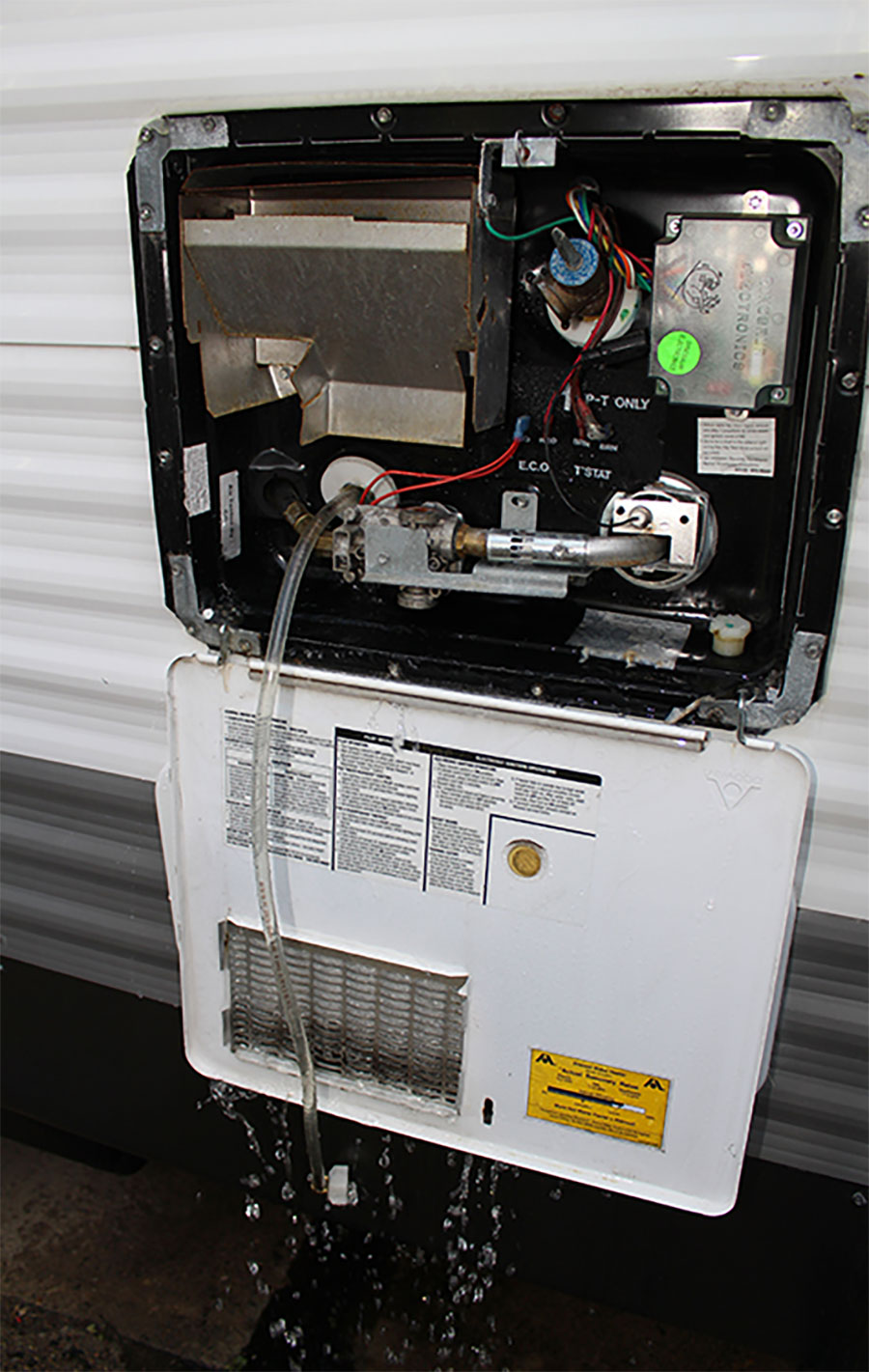
Removing the water heater’s drain plug
Drain
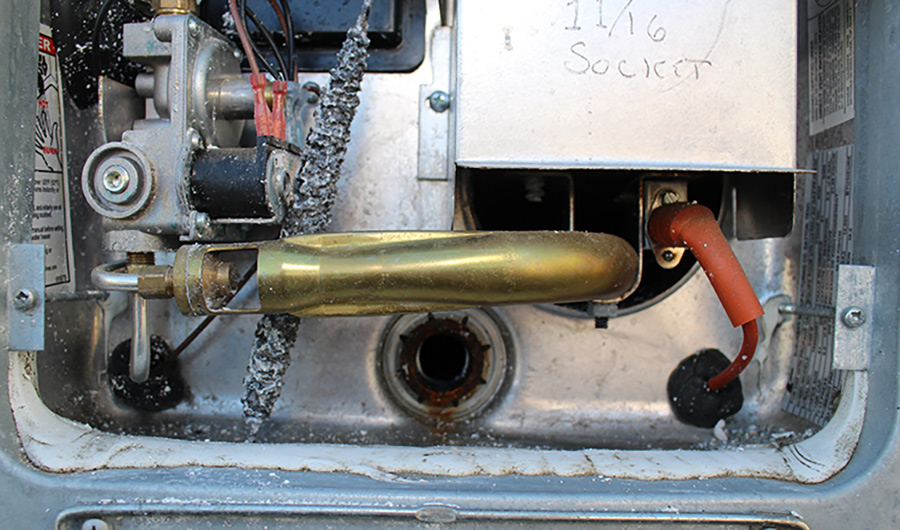
Removing the water heater’s drain plug (or anode rod in the Suburban model) and opening the relief valve will allow the tank to drain quickly. A small tube can be used to siphon extra water from the bottom of the tank, as well as scale that might have accumulated during use. The anode rod here has been “consumed” to a point where it should be thrown away and replaced.
If you don’t have a washer, dishwasher or ice maker, check to see if the RV is plumbed for them; if so, those lines must be winterized as well.

Water heaters, too, must be drained and bypassed before winterizing. Tank-style units are drained using the drain plug and opening the relief valve to let air in. A small tube or hose can be inserted in the drain to siphon the last bit of water out of the tank (which will also help remove scale in the tank). If your water heater doesn’t have a bypass kit, again, Camco and others have an aftermarket version you can install.

What About Batteries?
RVers who live in the North must also pay attention to their batteries — and for good reason. It’s not unusual for owners to return in the spring to dead bat-teries because they failed to take care of them and prevent them from freezing.

Flooded lead acid, (FLA) batteries, should be disconnected and stored fully charged, pref-erably in a climate-controlled environment. As the battery discharges, (about 10-12% per month) the temperature at which the electrolyte can freeze in-creases from approximately -80F to 20F. If the battery isn’t fully charged and disconnected, or left on a maintenance charger, it will discharge more quickly and possibly freeze, destroying any usefulness.
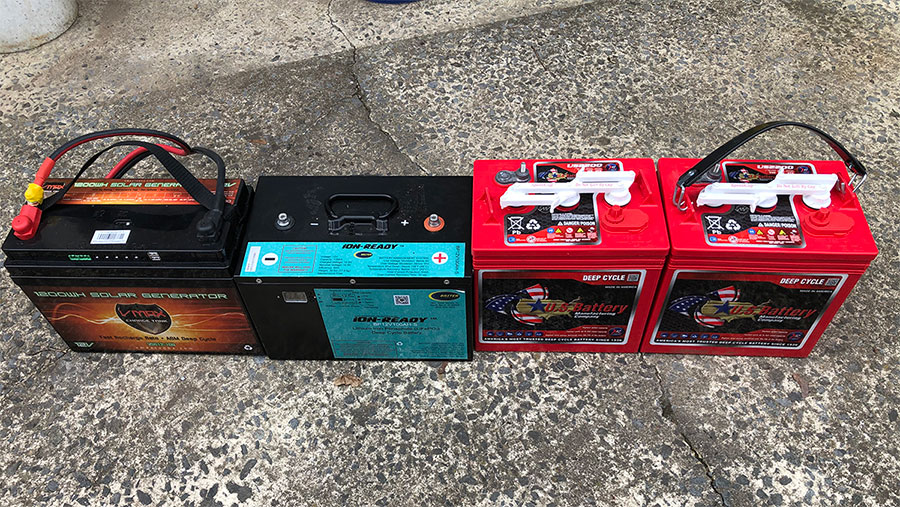
Batteries
Whether you can leave your house batteries on a charger for the winter depends upon their chemistry. FLA, AGM and Gel batteries can, Lithium iron phosphate cannot.
Can you leave the RV plugged in? If your RV has a multi-stage charger, yes. FLA, absorbed glass mat (AGM) and Gel batter-ies can be left on a smart float/trickle charger. Lithium iron phosphate (LiFePO4) batteries must be heated; they will not will not charge when temperatures are below freezing. That said, unlike their lead counterparts, lithium batteries will not lose much charge while sitting. Once switched off from the system, lithium batteries are fine staying right in the RV until spring. (Solar is obviously largely useless for keeping the batteries charged once they’re covered with snow and if you cover your RV, the effect is the same.) There are portable maintenance chargers, like those from Battery Tender, Redarc, NOCO and Pulse Tech, that can work if you can keep it plugged in.
Antifreeze
Once the system, including the low-point draines and appliances, has been blown out with compressed air, close all valves and faucets and siphon antifreeze into the system. The water pump will suck the antifreeze from the bottle, either by using a winterizing kit (built in or aftermarket) or you can make your own suction tube using ½” tubing and a PEX ½-inch threaded female fitting. Just unscrew the freshwater tank feed into the pump (with the tank drained, of course), insert the other end into the antifreeze container, turn on the pump and start opening faucets one at a time.
There are a number of variations on the design of water heater bypass valves, including one-, two- and three-valve models. The three-valve version is most often confusing to folks. The oval handles on the valves indicate whether the valve is open or closed; the long length in line with the pipe means that valve is open, while if across or perpendicular to the pipe means it’s shut. In bypass, the top and bottom valves are closed and the middle valve is left open, completing the loop or connection between the hot- and cold-water sides. In the spring, after flushing the system with fresh water, the bypass kit is reversed; top and bottom valves are opened and middle valve is closed.

On-demand water heaters, like the Truma AquaGo, should not subjected to compressed air or antifreeze. Once bypassed, the drain flap is opened and the screen removed, allowing the system to drain naturally. That’s all it needs. Leave the screen out until spring. Follow the directions for other models of demand water heaters. Likewise, hydronic heating systems use special antifreeze for heating and don’t require attention. Simply winterize the plumbing system as directed and you’re set.

And don’t forget the drains. Plumbing P-traps hold water, and that water must be displaced with antifreeze. Flushing the toilet until you see the antifreeze will usually circulate enough product through to protect the flush valve, even if you have a macerator toilet.

Once the plumbing system and drains are winterized, it’s time to service the holding tanks. Rinse the black tank thoroughly so it’s clean in the spring and lubricate the fullway dump valves if possible. Don’t forget the freshwater tank; if antifreeze is added, it’s a pain to get out. Once the tank is drained it’s fine.

With a bit of work, your RV’s entire system can easily be protected and ready for Old Man Winter’s wrath. On smaller RVs and trailers, this process goes very quickly; larger trailers and motorhomes obviously require more time — but it’s time well spent. It’s no fun to make repairs in the spring when the travel bug bites again. For more information on winterizing your RV, Camco has published an interesting and colorful guide: https://www.camco.net/medias/Winterization%20Booklet%202020.pdf. The owner’s manual for your RV may also have specific information on how to winterize your particular rig.
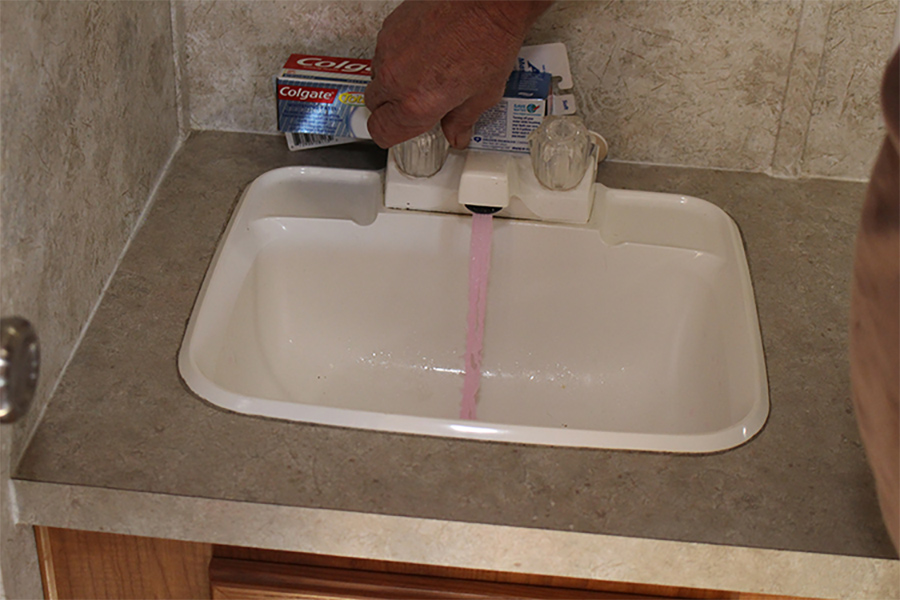
Antifreeze in sink
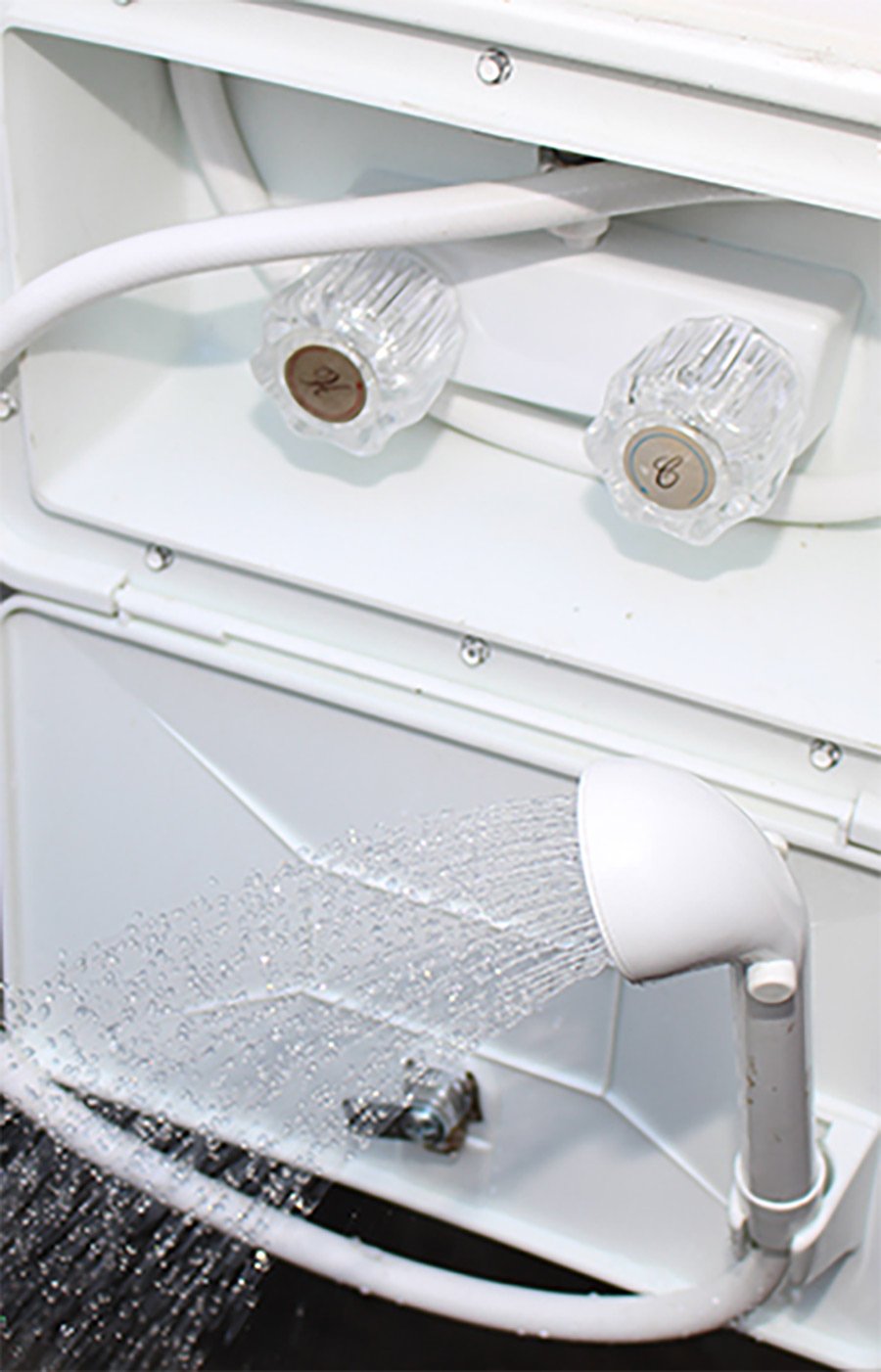
Open the hot and cold valves on each faucet until you see the antifreeze. It may be necessary to change containers after running out of antifreeze. When done, turn off the pump and return it to its original configuration, then go through and make sure all P-traps and the toilet have been treated with antifreeze.
Plumbing system
Where some RVers get into trouble is when they forget or overlook certain parts of their unit’s plumbing system. Don’t forget dead-end plumbing (for washer option, etc.), low-point drains and outside showers.
Low point drains
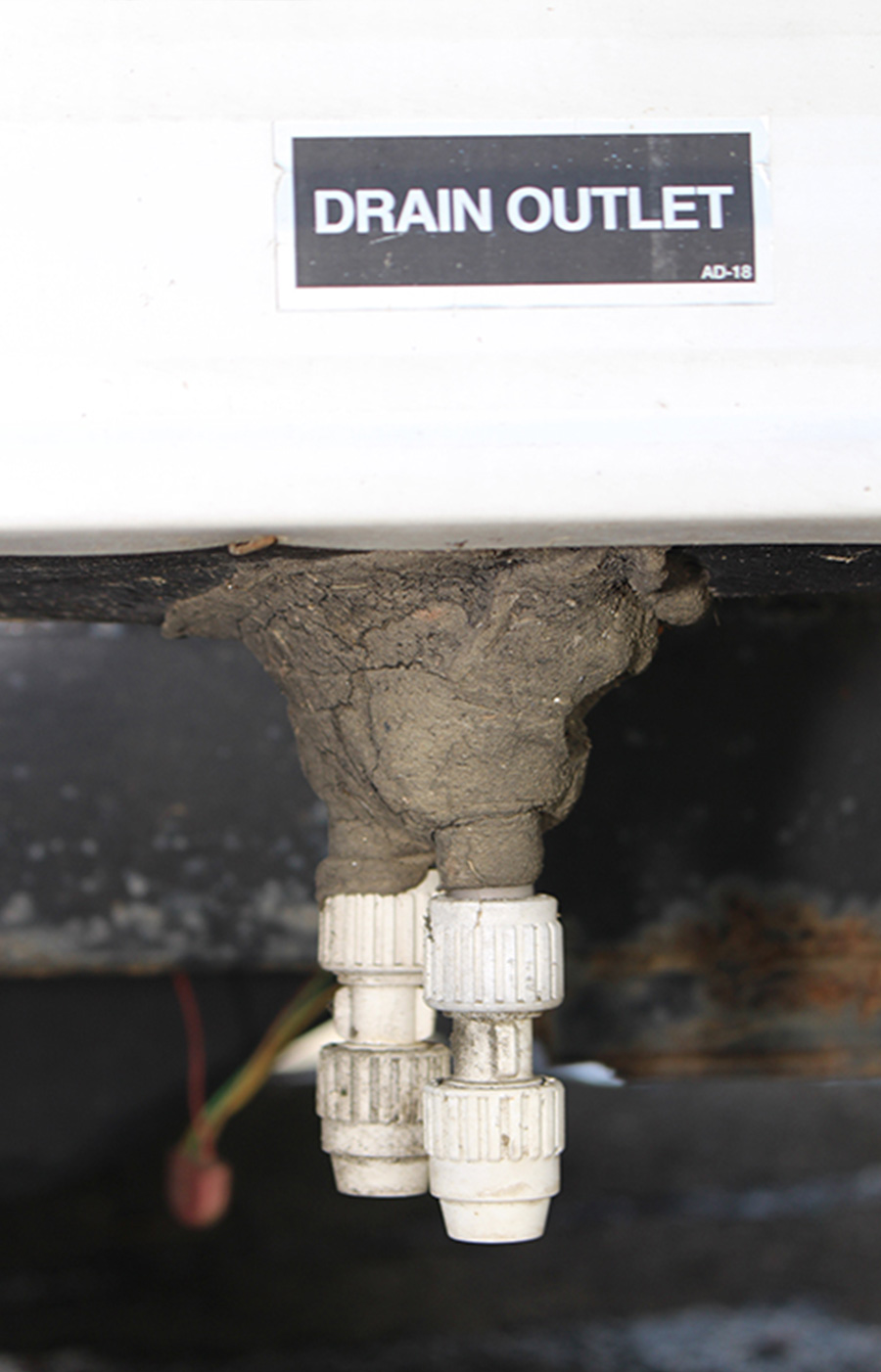
Every RV has low point drains. The valves in motorhomes and four-season RVs may be inside the rig. Others, like this one, have caps or ¼-turn valves under the rig. These pipes have water in them and will freeze unless winterized.
Drain
Don’t put antifreeze in the freshwater tank; flushing out antifreeze come springtime will be difficult and waste a lot of water. However, once you empty the tank, leave the drain open.