


ooking up an RV to city water seems like a simple enough task — just screw on a hose that goes from the faucet to the city water inlet in the RV and you’re done, right?
Well, not so fast.
RV water systems are tested to withstand 80 psi water pressure, but the RV industry requires a reduction in pressure to around 45-50 psi to protect fittings in the network of Pex components, faucets and appliances used in an RV’s plumbing system. Consequently, pressure regulators, commonly available in RV supply stores and online, are installed at the hookup water spigot.
While RV-specific regulators will reduce pressure, they usually reduce volume at the same time, which can lead to an anemic stream of water — and they typically don’t last that long. A better solution is to purchase a home-style water-pressure-reducer online or in a local hardware store and modify the body with fittings to easily connect to a water spigot and hose. A home-style regulator reduces pressure without reducing volume, so it does not impact flow at the faucets inside the RV.

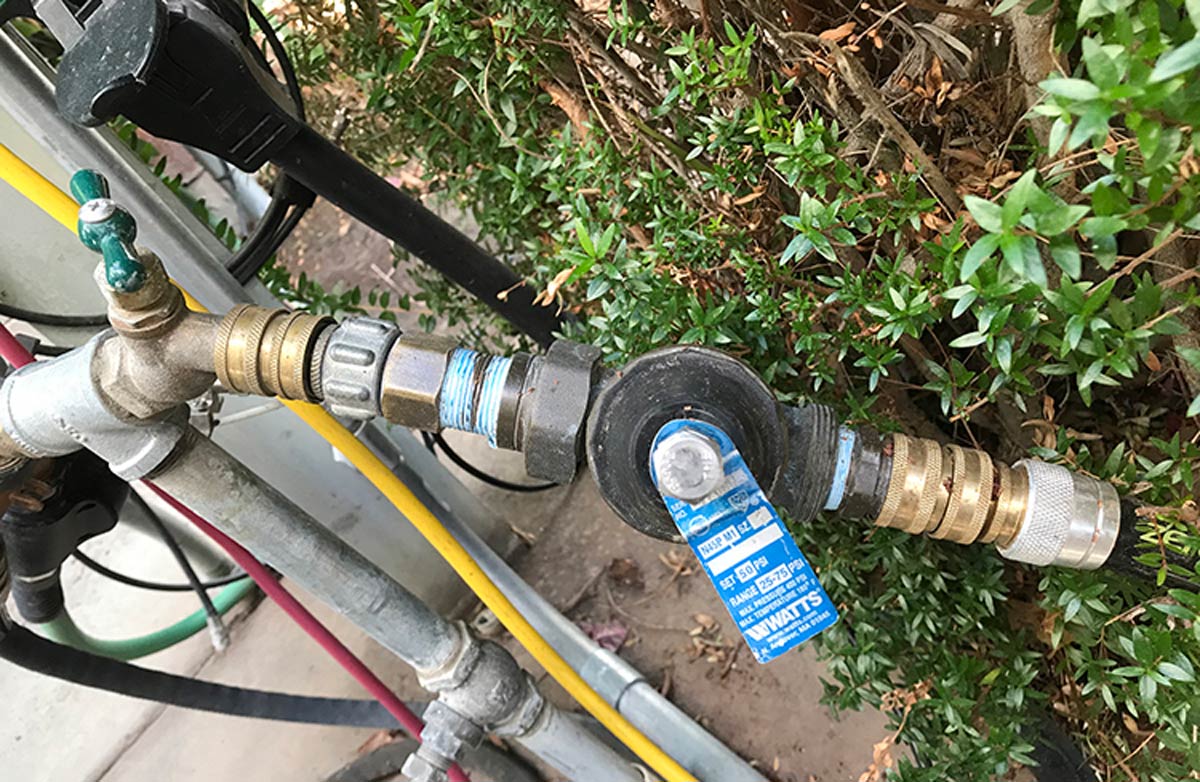
There are a few of these regulators on the market; the most common are those made by Watts and Zurn Wilkins. We’ve been using a Watts N45P M1 regulator 24/7 for many years with no issues, which is to be expected since these devices are designed for homes where there is no interruption in service. This regulator has been replaced with a neaw model, LFN55B M1, (https://amzn.to/3suN9L3) but has the same specifications.
The Zurn Wilkins ½ NR3XL (https://amzn.to/30UmHiB) is another good choice. It has similar specifications but can accept 1/2-NPT fittings instead of the ¾-NPT in the Watts regulator. The Watts also is twice the cost ($99 versus $48), but the entire body is brass rather than the hard plastic top on the Zurn Wilkins; both products have lead-free certification. Both regulators have proven to be reliable during more than five years of full-time service (RV Enthusiast’s Publisher, Bob Livingston, uses the Watts, while Technical Director Bill Gehr employs the Zurn Wilkins).


Since these regulators are designed for homes, RV owners will have to adapt male and female garden hose thread (GHT) fittings on the inlet and outlet to make them work, but this is not a major obstacle. Most hardware stores and Amazon have various versions of these fittings, including female swivel-hose connectors. Plan on using ¾- to ½-inch reducing bushings if you choose the Watts regulator and seal the threads with Teflon tape.
Once the hose fittings are in place, it’s just a simple matter of connecting the regulator to the water faucet and the service hose to the other side. Adding quick-connect water couplers will make it easier (which makes it unnecessary to use a swivel female GHT fitting). These regulators are factory-set to reduce water pressure to 50 psi, which will be fine for most RVs. A further reduction can be made by adjusting the top bolt and retaining nut, while checking pressure with a gauge.
You’ll need to employ some system to help you remember to remove the regulator when breaking camp, since these regulators are installed right at the water source you hook up to. We only left it for the next occupant once before learning this lesson.