

A.I. Comes to RVs

nless you’re a computer geek, you’ve probably never heard of “Moore’s Law.” Coined by Gordon Moore way back in 1965, he hypothesized that transistors in an integrated circuit (microchip) — and, hence, technology — doubles about every 18 months. That’s why the homes we live in today — oftentimes controlled by voice-activated artificial intelligence (A.I.) software that lives in “the cloud” and can control many of the house functions you once did manually — are incrementally closer to the lifestyle portrayed in The Jetsons cartoons of our youth than the houses our parents grew up in.
That similar systems are finding their way into RVs isn’t a surprise. The speed at which they are being integrated into the mobile lifestyle is.
At one time, the RV industry was said to be 20 years behind its automotive counterpart when it came to technology, but the Jayco JayVoice — introduced on select 2022 models — comes only a handful of years since embedded voice assistants gained widespread use among auto manufacturers. And Winegard’s Halo system, expected to debut later this year in 2023 models, pushes the envelope even further.
Is there an RV with A.I. in your future? The short answer appears to be “yes.” And they don’t always need an uplink to “the cloud” to function.
‘Jayco, Night Mode’
“JayVoice has been a one-year project, but we’ve worked on ‘voice’ different times through the years,” said Ryan Forgey, vice president of engineering for Middlebury, Ind.-based Jayco Inc. “This is not the first voice-activated trailer that we’ve done — we actually debuted one at our June 2017 dealer homecoming that was basically an Echo Dot-based system. That was a show unit; it worked, but we didn’t take it to market.
“The other thing to be remembered is that voice is just one piece of the whole system,” he added. “It interfaces with the RV-C network, so we first had to get the network that could run voice built and functional.”
As both Forgey and, in a subsequent conversation, Winegard President and CEO Grant Whipple, noted, voice-activated command systems are integrated into an RV’s electronics. RV-C is a communications protocol developed in 2005 by the RV Industry Association and manufactured by such companies as SilverLeaf Electronics that allows different components made by different manufacturers to “talk” to one another in an agreed-upon language. Costly at the outset, RV-C was first used by manufacturers of high-end motorhomes but has in recent years filtered down to, in this case, select Jayco luxury fifth-wheels. Such systems also are available on higher-end travel trailers from various manufacturers.

“There’s a whole control system hidden in the walls that makes this all work,” added Jayco Lead Electrical Engineer Greg Baumgartner, who noted that the company worked with suppliers for three years to get its CAN (Controller Area Network) RV-C-compliant and RV-C itself functioning. “We had many different components ‘talking’ many different languages, and to get everything on the same RV-C native was one of the bigger challenges — and coordinating with the suppliers of those parts.”
Jayco primarily worked with two companies on the development of JayVoice: BMPRO, an Australian manufacturer of power systems with a U.S. office in Elkhart, Ind., and Elkhart-based American Technology Components (ATC), which worked to produce the Modulus Director that’s at the heart of the system.
Much of the background work, said BMPRO Marketing Manager Brad Hooper, had already been done. “We had an existing system, JayCommand, that was a BMPRO-developed ‘smart’ system for controlling and monitoring various operations in an RV through a touchscreen. There are external technologies that can be integrated into the JayCommand interface — and one of them was JayVoice.”
Developing the voice technology fell to ATC, which worked with another vendor on the “back end” of the system. And, said Chase Healey of ATC’s new product market development team, development time was again needed — this time, to meld its technology with that of BMPRO.
“Our original device can do some different things and speaks RV-C language a little bit different than that used by BMPRO, so there was some software that needed to be tweaked in order for it to work seamlessly with the BMPRO system,” he pointed out. Central to the operating system — which, said Healey, is akin to turning a switch on and off with your voice and operates offline without need for an Internet connection — was formatting the program to respond to keywords to trigger the device. As introduced, the system is designed to react to specific commands initiated by first saying aloud the proprietary keyword “Jayco.” Saying “Jayco — interior lights,” for example, will turn off all lights inside the unit. Other commands control the function of the air-conditioning system, furnace and lights within a specific zone, from the living room or the dinette to the bedroom, along with dimming predetermined lights for optimum TV viewing (“movie mode”) or sleeping (“night mode”).

Presently, the allotted memory available on the microchip used within the system allows for it to be programmed for 15 functions. Jayco, said Forgey, intentionally limited its use to commands such as lighting that don’t potentially compromise an occupant’s safety.
“We elected not to try to move anything that could be accidentally activated by voice,” he said. “So we’re not moving awnings, we’re not moving slideouts, we’re not activating leveling control systems. There are limitations put on the system to ensure that no one can get hurt or nothing can get damaged.”
That said, the company does envision being able to control such systems in the future. “I anticipate in the future it will be updateable and customer-configurable,” Forgey added. “We introduced JayVoice to our dealers last fall at the Hershey Show and the Elkhart Open House and it was well-received. Dealers mentioned a desire to include other features and functions — from controlling motor operations to being able to set interior temperatures. We have a long ‘wish list’ and we’re working with our suppliers to add some of those. But first impressions were that it’s a neat product, and it’s the first time that anyone’s introduced something of this nature that didn’t require Internet connectivity.”
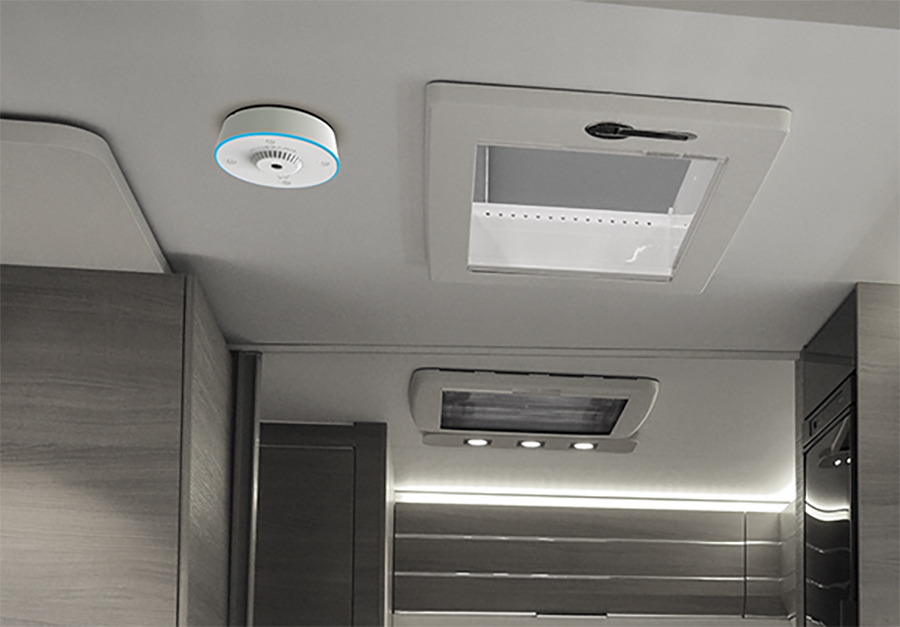
If rust never sleeps, neither does technology — so its not surprising that multiple companies would be working separately on similar solutions at the same time. Winegard President and CEO Grant Whipple told RV Enthusiast he expects to see Winegard’s new Halo system on a number of new models later this season. The product was shown in limited form on several units on display at January’s Florida RV SuperShow in Tampa.
In development for several years, Halo is, said Winegard Director of Product Management Lance Beck, both an online and offline voice control system. “What this means,” he added, “is it uses offline voice commands for anything related to control and monitoring where you don’t need an Internet connection. So, you can say, ‘OK RV, set up camp’ and it will run through all the actions of deploying the slides, deploying the awnings, turning on the lights, turning on your AV system, leveling the RV — anything related to getting set up after you’re parked at the campsite.
“Once you’re there,” he continued, “you can say, ‘OK RV, dim the living room lights 50%,’ or ‘What is my grey tank level? What is the charge level to my house batteries?’” What systems the product will oversee will be up to each manufacturer, but Beck said Halo has been built with the ability to monitor and control myriad functions.
The system also includes optional motion safety switches to ensure safe operation of slideouts. Shaped like a key fob, the switches incorporate a button that must be held down during slideout operation; the slideout will stop immediately if the button is released or the signal is lost for any reason.
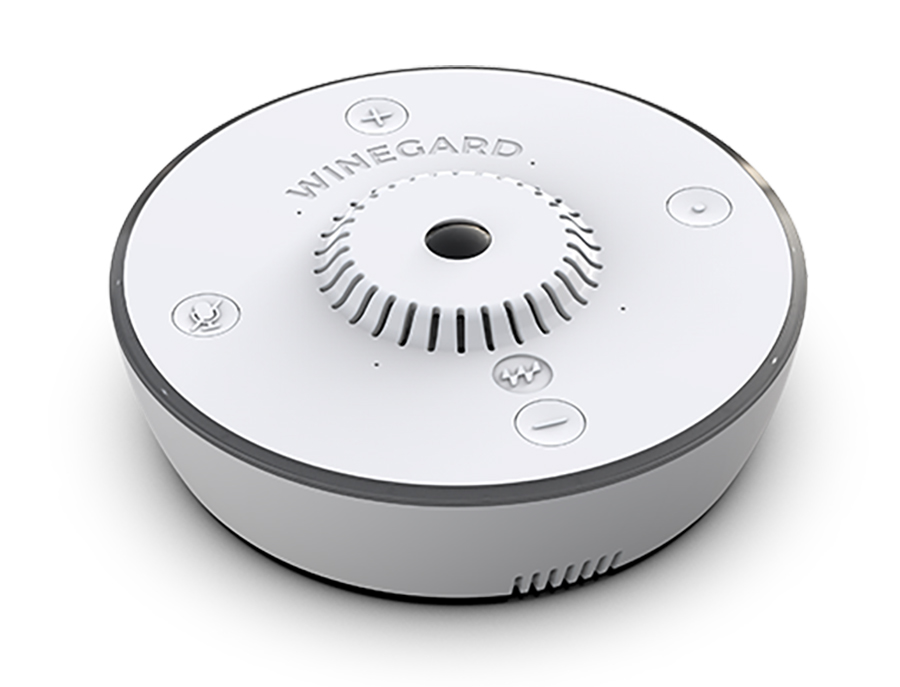

Halo also features a built-in camera with a fisheye lens. When installed as expected in the ceiling mid-coach, Whipple said the camera will allow a user to see front-to-back within the RV. “Through our Halo cloud portal, you’re able to monitor what’s going on in the RV,” he noted. “So if, for example, you leave a pet inside, you can use the RV Halo app to check on it and ensure everything is okay.”
As Whipple explained, Halo also handles multiple protocols — everything from by-the-book RV-C multi-switch implementation to lesser multiplex systems. It also has local network wireless networking built in, so it can operate future wireless systems Winegard might opt to add at a later date. More to the point, he stressed that the system is configured for “real world” use.
“It uses true ‘natural’ language, which enables a person to speak much more naturally versus having to say an odd preset command,” he said. “This isn’t offline voice like in a lot of cars people are familiar with where you have to specifically say in a certain sequence — for example, ‘Air-conditioner On, turn to seven’ — and if you didn’t say it exactly as required, if you inadvertently switched the order those words were spoken, it won’t work. This is true natural language voice control. It’s a very similar experience to Alexa or another online voice control — offline.”
The system, which incorporates four sensitive microphones arrayed throughout the RV, was developed with assistance from Elkhart-based ASA Electronics in configuring the RV-C part of the package. Having previously partnered with Keystone RV Co. in the development of the popular iN•Command global connect app, ASA worked with the product in order for it to be able to monitor certain aspects of iN•Command.
“It (Halo) communicates everything through RV-C protocol, and since iN•Command is the most RV-C-friendly control system on the market today, it was the easiest to integrate with,” said said Jim Hess, vice president, RV division, for ASA. “It allows an RV owner with Halo and iN•Command to be able to access the system and tell it to turn the temperature up or down, ask it what the tank levels are, and more, and have it verbally respond. We’re working on several things with vendor partners to be able to allow that extra level of access.” As Hess indicated, the system can continue to grow.
“If we have sensors in a refrigerator, for instance, someone might be able to get an alert if their refrigerator sensor is detecting a temperature rise above a certain level, or if your holding tank is nearing full. You can get an alert on your smartphone now, but you’d be able to essentially get some kind of verbal alert over Winegard’s system. There are a lot of possibilities. The whole point of A.I. is to do things the customer wants to do, to customize a certain experience based on the user’s preference.
It’s expected that there will be 75 billion connected devices worldwide by 2025. Some of them will now be RVs.
“RVs continue to get more complicated as we add more systems and technology, so we wanted to make things easier,” Winegard’s Whipple said. “There are a lot of apps out there a person can use to check on various components, but in many ways an app is a step backward. It’s not really convenient to pull out a smartphone and scroll through dozens or hundreds of apps and click on multiple screens in order to check the water level. With Halo, you just ask a question as you’re relaxing in your lounge, and you get an answer.
“What we really looked at is trying to make the RV experience better,” he added. “We all know that the world is turning to smart homes. That’s what Halo does — it instantly turns an RV into a fully functioning smart home, with really advanced artificial intelligence.”