
Unusual Photo-worthy Destinations Are All Around Us
[maghub_sidebar]
MAKING MEMORIES
Moose grazing in Maroon Lake was taken in the mid-morning hours, before the site became occupied with tourists. Colorado’s Moose populations are thriving nowadays, due to conservation efforts to protect wildlife in the state. The moose pictured here is a bull (male) moose and stands about 6 feet tall at the shoulder. The Maroon Bells peaks are a lovely backdrop to the scene. This shot was taken using a Canon EOS Rebel T7i digital camera at a 7.1 f-stop and shutter speed of 1/160s.
Photos by author
Moose grazing in Maroon Lake was taken in the mid-morning hours, before the site became occupied with tourists. Colorado’s Moose populations are thriving nowadays, due to conservation efforts to protect wildlife in the state. The moose pictured here is a bull (male) moose and stands about 6 feet tall at the shoulder. The Maroon Bells peaks are a lovely backdrop to the scene. This shot was taken using a Canon EOS Rebel T7i digital camera at a 7.1 f-stop and shutter speed of 1/160s.
Unusual Photo-worthy Destinations Are All Around Us
You can discover great places to visit — by surfing the Internet and talking to fellow RVers — that can be easily captured through the lens of any camera, including a smartphone.
By Sue Strauss
W

hether you are traveling with your RV for a short one or two-day trip or are a full-timer whose RV is your home, you still have to decide where to go. Perhaps you enjoy traveling to well-known places such as America’s national parks, but for those looking to discover small, remote places, keep reading — I’ve spent most of my travels tracking down interesting destinations, many times off the beaten path. Along the way, I’ve also developed — and will share — alternative ways to find scenic and historical locations while also providing a backdrop for watching wildlife.

I like to explore remote settings and capture these memories through photography. The old expression, “a picture is worth a thousand words,” could not be truer when it comes to learning about a location and remembering details often not described in words. I enjoy taking pictures of animals and nature, and I do a great deal of research and planning to find the proper location and time of year to get the best results. When someone is admiring one of my nature photographs, I often get asked the questions, “How did you get that shot?” or “How did you find that place?” Here’s how I do it.

The National Wildlife Refuge System is a great resource for discovering wildlife refuges near your home or travel destination. You can search its website (fws.com) by state, zip code or refuge name. This website will also provide information on “things to see and things to do” at the refuge and provide specifics on what animals/wildlife you can expect to see at various times of the year. National Wildlife Refuges are quite inexpensive to visit: Around 30 national wildlife refuges charge visitors a nominal entrance fee (generally $3-$5 daily) to cover road and facility maintenance.

If you are a regular visitor or would like to see other public lands, you can save money by buying an America the Beautiful Federal Recreational Lands Pass, which is your ticket to more than 2,000 federal recreation sites (Golden Pass). A Senior Pass to the national parks can also be used to enter national wildlife refuges, as well.

My husband, Rich, and I spent the summer of 2020 in Carbondale, Colorado. We accepted work-camping jobs (in return for site and compensation) nearby at the Carbondale/Crystal River KOA. Our son was living and working in Glenwood Springs, and we thought it might be nice to spend the summer close by. While doing a Google search of nature preserves, I discovered the Aspen Center for Environmental Studies (ACES). If you check its website (www.aspennature.org) you will find a wealth of information on outdoor activities and places to visit in Colorado. ACES offers various programs and events including birding and other guided tours in the Aspen area, either for free or at a nominal fee.
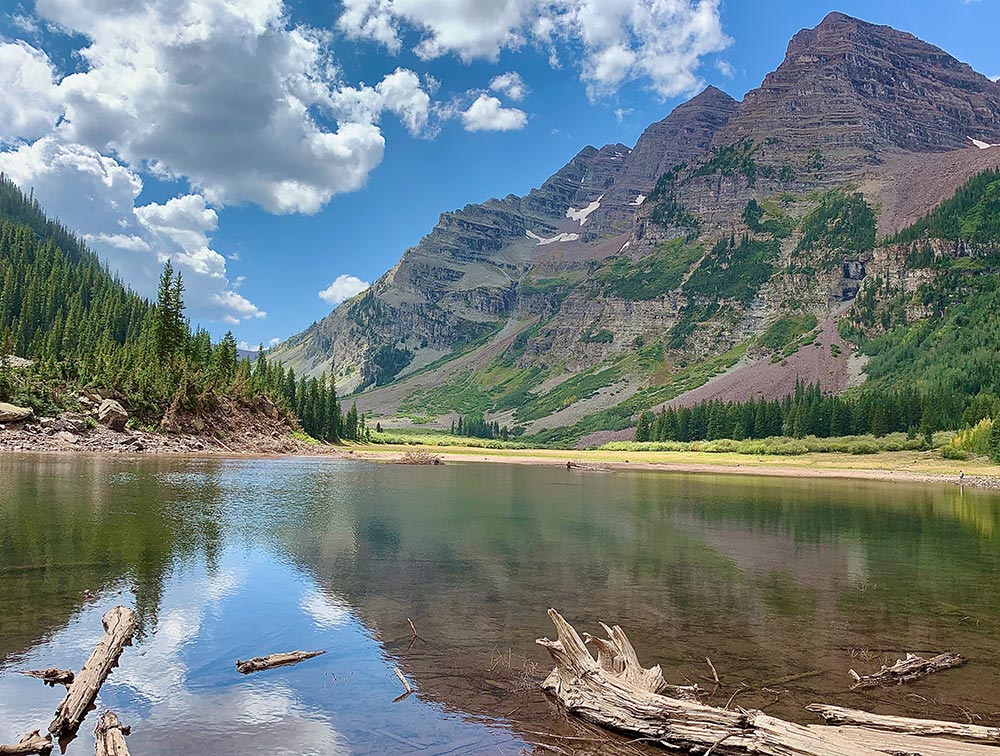
wide-angle look at Crater Lake and the Maroon Bells Wilderness Area
Above is a wide-angle look at Crater Lake and the Maroon Bells Wilderness Area. Crater Lake is a high-altitude alpine lake located 1.8 miles from Maroon Lake and was formed by glaciers. The lake gets its unique blue-green hue from the algae growth in the water. I tried to angle this shot to also catch the reflections from the surrounding mountains. An Apple iPhone XS Max was called into camera service to get this image, recording at an f-stop of 1.8 and shutter speed of 1/689s.
While attending an ACES tour, I found out about The Maroon Bells-Snowmass Wilderness nature preserve. This area, though remote, is quite popular with hikers and naturalists, and requires reservations to see it. Visitors can only drive up to Maroon Bells in their own vehicles before 8am or after 5pm, with a $10 entry fee and a guarantee of little to no parking spaces as the few parking spots there are usually filled by overnight hikers. Individuals wishing to explore the wilderness area during daylight hours must ride a shuttle bus to and from Maroon Bells. Shuttle buses depart from Aspen Highlands and travel eight miles up Maroon Creek Road to drop off passengers at Maroon Lake. Round-trip tickets ($15.95 per person) can be purchased online by visiting www.aspenchamber.org. There is an additional charge of $10-and-up per car for parking at Aspen Highlands (depending on how many hours you stay). It is well worth the time to plan and make reservations for Maroon Bells, as this is a pristine, scenic wilderness area and your memories of this visit will last a lifetime.

The Maroon Bells-Snowmass Wilderness is a 180,000-acre wilderness area in central Colorado, located in the Elk Mountains. The twin “claret-colored peaks” are made of soft mudstone filled with iron-rich materials that have rusted, creating the red hue on the mountains. The twin peaks, Maroon and North Maroon, are two of Colorado’s “fourteeners,” (14,000 feet-and-above elevation) towering high above the glacial Maroon Valley and surrounded by aspen forests and alpine lakes. This scenic wilderness area is considered one of Colorado’s most-photographed locations.

Once you make reservations to visit Maroon Bells, you will need to locate a nearby campground and a place to park your RV. I often use a resource called Roadtrippers (www.roadtrippers.com) to find places to see and stay. After entering a starting point and destination, this website will help you locate not only campgrounds and food/drink establishments but also popular sites, including Attractions & Cultural Sites, Outdoors & Recreation Sites and Points of Interest. Another resource to locate campgrounds is the Allstays App on a smartphone, tablet or laptop. If you use Allstays, you will find the Carbondale/Crystal River KOA Campground, in Carbondale, Colorado. This is the closest campground to Aspen and is approximately 30 miles from the Maroon Bells. It is a very nice campground that can accommodate RVs up to 45 feet, but you will need to make reservations many months in advance to reserve a campsite here.
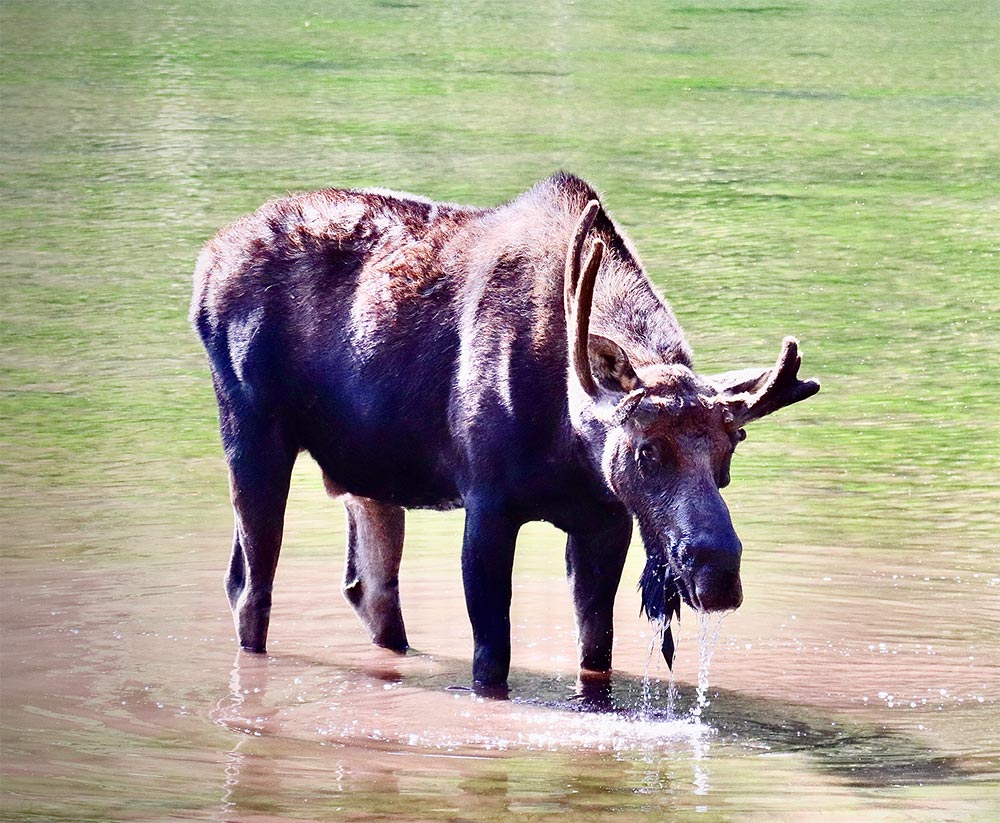
Moose grazing in Maroon Lake
With the use of a zoom lens, I was able to capture a close-up look at the moose grazing in Maroon Lake. A U. S. Forest Service ranger standing nearby told me that the experts estimate this moose to be around 4 years old, and that it had lost its left antler a few years ago possibly during a fight with another moose. A new antler has grown in its place but is obviously shorter than the right one. This shot was taken using a Canon EOS Rebel T7i digital camera with an 8 f-stop and shutter speed of 1/500s.
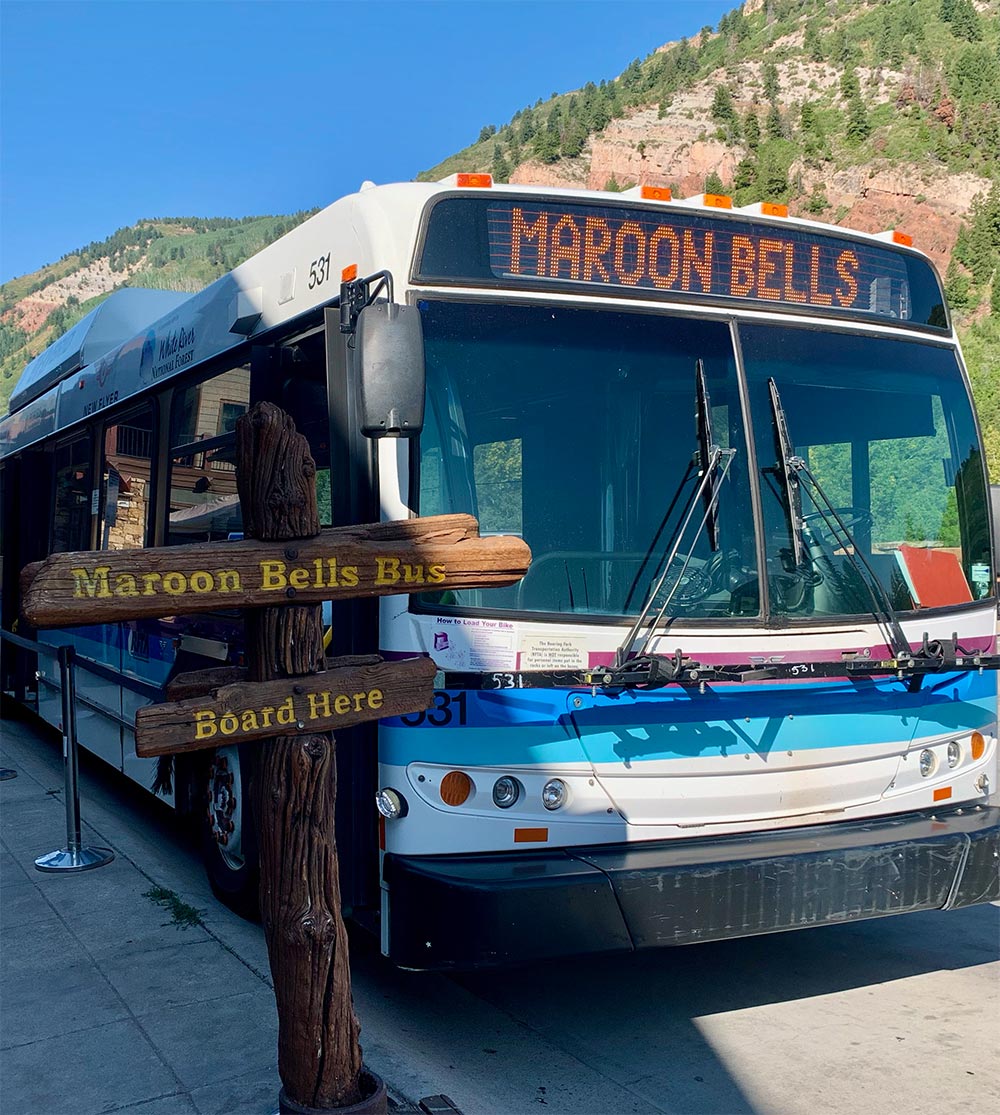
Bus in Maroon Bells in Aspen Highlands, Colorado.
You don’t need a fancy camera to capture images of scenes like this one showing the shuttle stop for boarding the bus to Maroon Bells in Aspen Highlands, Colorado. This shot was taken with an Apple iPhone XS Max with a 1.8 f-stop and shutter speed of 1/1088s. Smartphones are getting better every year, so there’s no reason to miss a shot if you forget to pack a camera.
We made shuttle bus reservations for September 2020 and couldn’t wait to see Maroon Bells. We planned on spending most of the day in this wilderness area and packed a lunch and plenty of water (there is nowhere to buy water or food once you board the bus). We reserved an early morning bus to Maroon Lake, in hopes of seeing wildlife. The best times of the day to “capture” wild animals digitally are either in the early mornings or just before dusk. Our planning paid off as we saw a large moose wading in Maroon Lake, feeding on grasses near the shoreline when the bus arrived. A U.S. Forest Service Ranger was nearby to ensure people didn’t get too close to the moose, but I came prepared with my Canon EOS Rebel T7i digital camera and a 28-200mm zoom lens. I got some beautiful images of the moose, the Maroon Bells peaks, and later, from our hike on the Crater Lake Trail. The images will last forever — and our visit to Maroon Bells will be added to our memories.
Sue Strauss
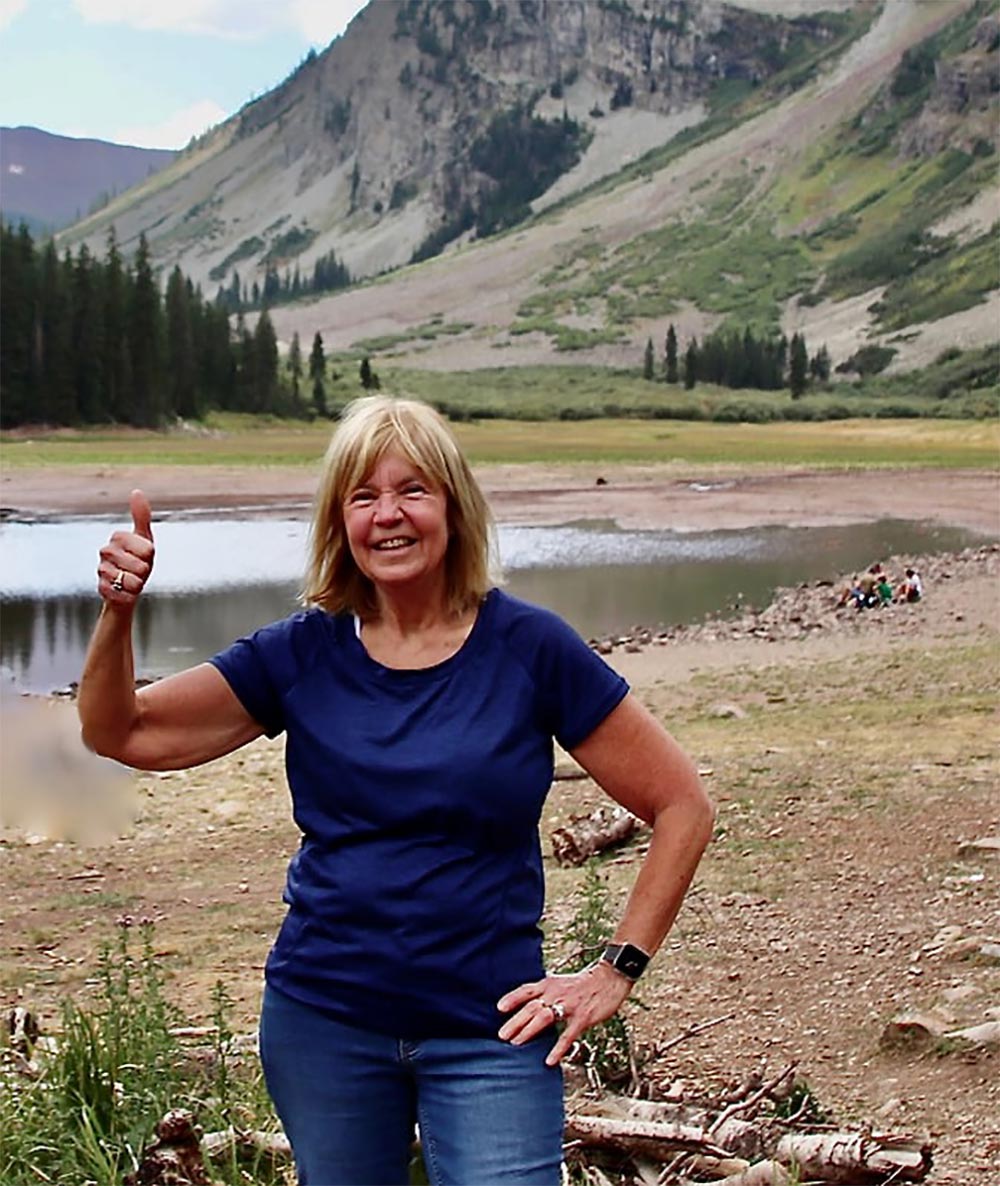
Sue Strauss with her thumb up
Suzanne Strauss and her husband, Rich, have been full-time RVers for about four years. They started out camping on weekends in a pup tent and progressed to cross-country jaunts in their little hatchback. Eventually, they bought a small single-axle travel trailer to “test the waters” and fell in love with RVing. They bought two more travel trailers before selling their home, acquiring a diesel-pusher motorhome, and heading out as full-timers. Their winters are now spent in Palm Springs, California, and they ply the roadways most of the year in search of beautiful and interesting places — many times little known and out of the way.