



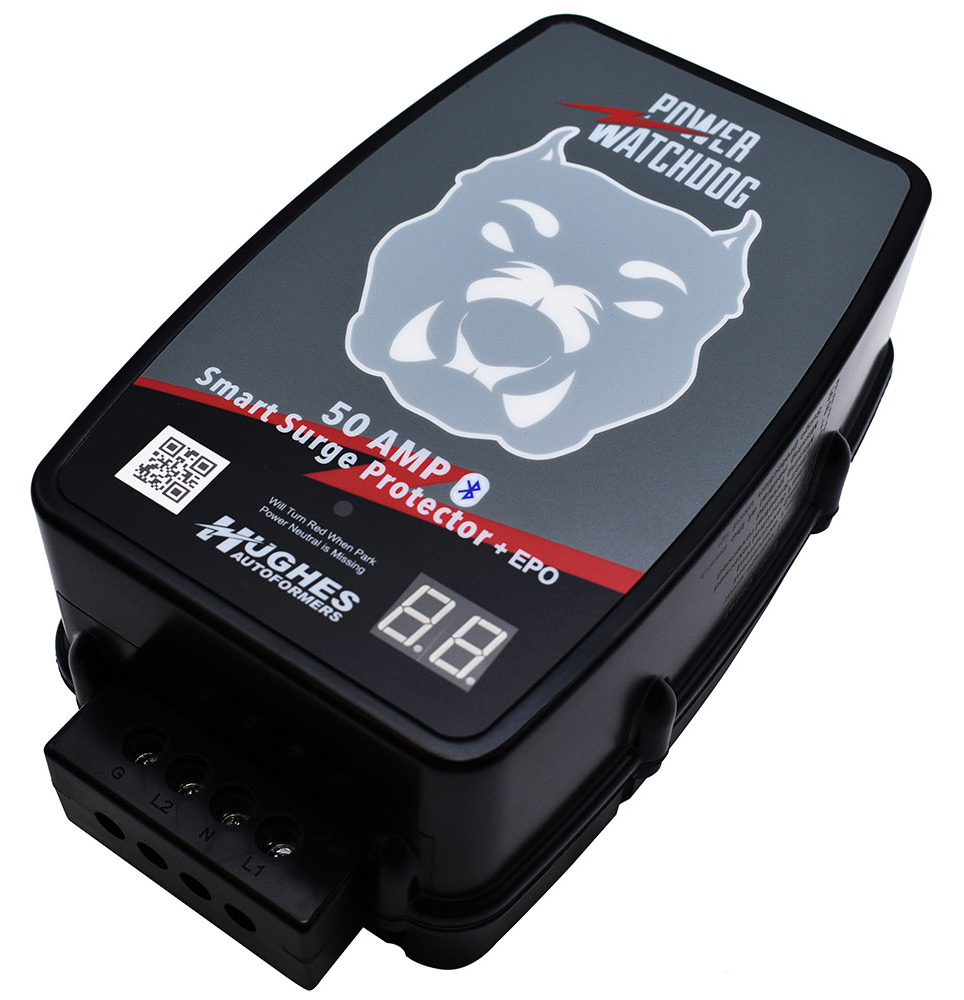
hile many of us have been plugging into shore power for decades without any kind of shore power protection, doing so simply isn’t a good idea — especially today. Campgrounds are often full to capacity with RVs that require up to 10 times the electrical power of their predecessors from even 10 years ago. An overloaded RV park’s power grid can create all kinds of electrical system failures, ranging from low voltage to high voltage, voltage spikes and lost safety grounds. Some of these electrical problems can damage your expensive RV components such as air conditioners, microwave ovens and refrigerators. Worse yet, other RV park (and home) power failures can create potentially dangerous conditions such as electrical shock and fires caused by electrical overload.

Surge protectors are available in different types and offer different levels of protection. Basic units retail for as little as $100, while those offering more protection with added features can cost a number of Benjamins. But if paying up to $300 seems like a lot of money for something you think you may never need, the security of knowing it will pay for itself — and then some — if a serious electrical surge strikes your RV is priceless.
Physical Mounting
RV surge protectors are available in two basic types — portable and permanent — as well as options for RVs with built-in generators.
- Portable surge protectors are inserted between the RV park utility pedestal and the RV’s cordset. This is handy because you don’t need to do any wiring in your RV to use them — just plug it in and go. However, they are susceptible to theft, plus you need some sort of Bluetooth remote control if you want to know what the RV park voltage is or how much amperage the rig is using in the middle of the night. Still, this is the top choice for many owners since a portable surge protector can be retained when moving to another RV.

- As you might have guessed, hard-wired surge protectors need to be wired directly into the RV’s electrical system and actually mount inside the RV. This is more secure since a would-be thief would need to break into a storage compartment to steal it, which is unlikely. However, without an additional remote control (either hard-wired or Bluetooth connected to a smartphone) you can’t monitor what’s going on electrically with these, either.
- Generator/Automatic Transfer Switches with Surge Protection These are a special class of Automatic Transfer Switch (ATS) units that select between built-in generator power and shore power. While a basic ATS is just a relay to connect an RV to one power source or the other, a surge protector ATS also includes voltage spike protection as well as monitoring power to low voltage, high voltage and open grounds.


Like many things, surge protection is available in varying price points with congruent levels of protection.
- Basic Surge Protectors: These generally cost less than $100 and offer voltage spike protection as well as visual indicators of power polarity and grounding. They rely on what’s called MOV (Metal Oxide Varistor), a sacrificial element rated in Joules (a unit of work or energy) that dies just a little bit every time it absorbs the voltage spike from a nearby lightning strike or other electrical issue. Note that these basic surge protectors will not disconnect the RV from shore power if the voltage gets too high or low, nor will they protect the RV from a “hot-skin” voltage due to an open ground. Yes, the lights on the basic units will indicate if polarity and ground is okay when you first plug in, but after that you’re on your own.
- Total-Protection/EMS Surge Protectors: These generally cost around $300, and include some level of voltage spike protection just like the basic surge protectors, but go beyond that with the ability to monitor incoming power for high voltage (above 132 volts), low voltage (below 104 volts), reverse polarity (swapped hot and neutral conductors) and open safety ground (which can allow an RV hot-skin voltage to happen). They all include a large relay that will disconnect the RV from incoming power if it determines that the power is out of spec. EMS stands for Electrical Monitor System, a term coined by Progressive Industries — one of three major manufacturers of surge protector products, along with Southwire/Surge Guard and Hughes Autoformers. EMS has entered the RVers lexicon to become a generic term for any full-protection surge protector that includes an over-voltage/under-voltage/open-ground detection circuit with a disconnect relay.


Hughes Autoformers
hughesautoformers.com
(888) 540-1504
Progressive Industries
progressiveindustries.net
(800) 307-6702
Southwire/Surge Guard
rvpower.southwire.com
(800) 780-4324
First, the ground conductor in the RV shore power cord must be interrupted on its way to connect with the service panel’s ground-neutral bonding point. Second, there needs to be a source of a ground fault current in the RV’s electrical system. This can be a low-current (a few mA / milliamperes) fault source such as the normal ground leakage currents in a converter or charger, a medium-current source (1 or 2 amperes) caused by things such as a burned-out water heater element, or a high-current source (full circuit breaker current up to 20 amperes) caused by a screw through a wire in the wall or an insulation loss allowing a hot copper wire to contact the metal skin and chassis of an RV.
Basic surge protectors can notify you of a lost ground connection via their warning lights but will not disconnect you RV from pedestal power. However, a full-protection or EMS surge protector will disconnect your RV from shore power if it detects a lost ground connection.