



ost of us work hard, so it’s not surprising that we all probably put forth an effort to save money, as well — or, at least, not spend it foolishly. That might translate into using generic paper towels, looking around for the best price on truck fuel and comparing prices for online purchases. It’s simply smart shopping. One place you absolutely shouldn’t cut back on, however, are essential RV accessories like power connectors, water and sewer hoses and assorted adapters.
RV parts and accessories can, for the most part, be separated into three categories: fluff, nice to have and essential. That latter list is the most important: “Essential” items should include everything you need to connect your RV to utilities at a fixed-base operation, such as a campground, Flying J or home. The utilities are what make your RV what it is and failure to have what you need — or to have them fail at the wrong time — can be a trip-ending affair.
Sewage Handling
If you’ve ever been exposed to RV sewage, you know it’s not very pleasant. A cheap hose can fail in mid-dump, creating a ruinous fountain of excrement that you are unlikely to forget anytime soon.


Heavy duty hose kits are made from higher-grade materials that won’t leak, rust through from cheap springs or crush. The fittings lock together firmly and lock to the RV using a 4-pin connection instead of two. The fittings also have leak-resistant gaskets that can be serviced, and the kits have a fitting for inserting into any dump station receptacle. Most of these hoses have a smoother interior surface which makes them easier to rinse and some are collapsible, reducing storage space.


You should also carry a hose dedicated to sewage cleanup and supplying your black tank flush. It should be a short length and a different color than your drinking water hose.
A clear sewage hose elbow or straight union also is a good thing to have. Attached at the discharge port on the RV, it allows you to see what’s happening in case of a blockage as well as when flushing the tank is successful.
Of course, the ultimate sewage transfer device is a macerator system. A macerator grinds and pumps the effluent through a 1- to 2-inch hose. Most can pump uphill and for an extended distance. In fact, some RVers use them to connect to a sewer cleanout outside their home for their own RV dump station!

Lastly, there are still some RV parks with gray pits on the sites instead of full sewer connections. With these, your gray water goes into a pit, which really extends your time between dump station visits. You’ll need an RV sewer cap with a hose fitting, as well as a dedicated hose for gray water dumping.
Fresh Water
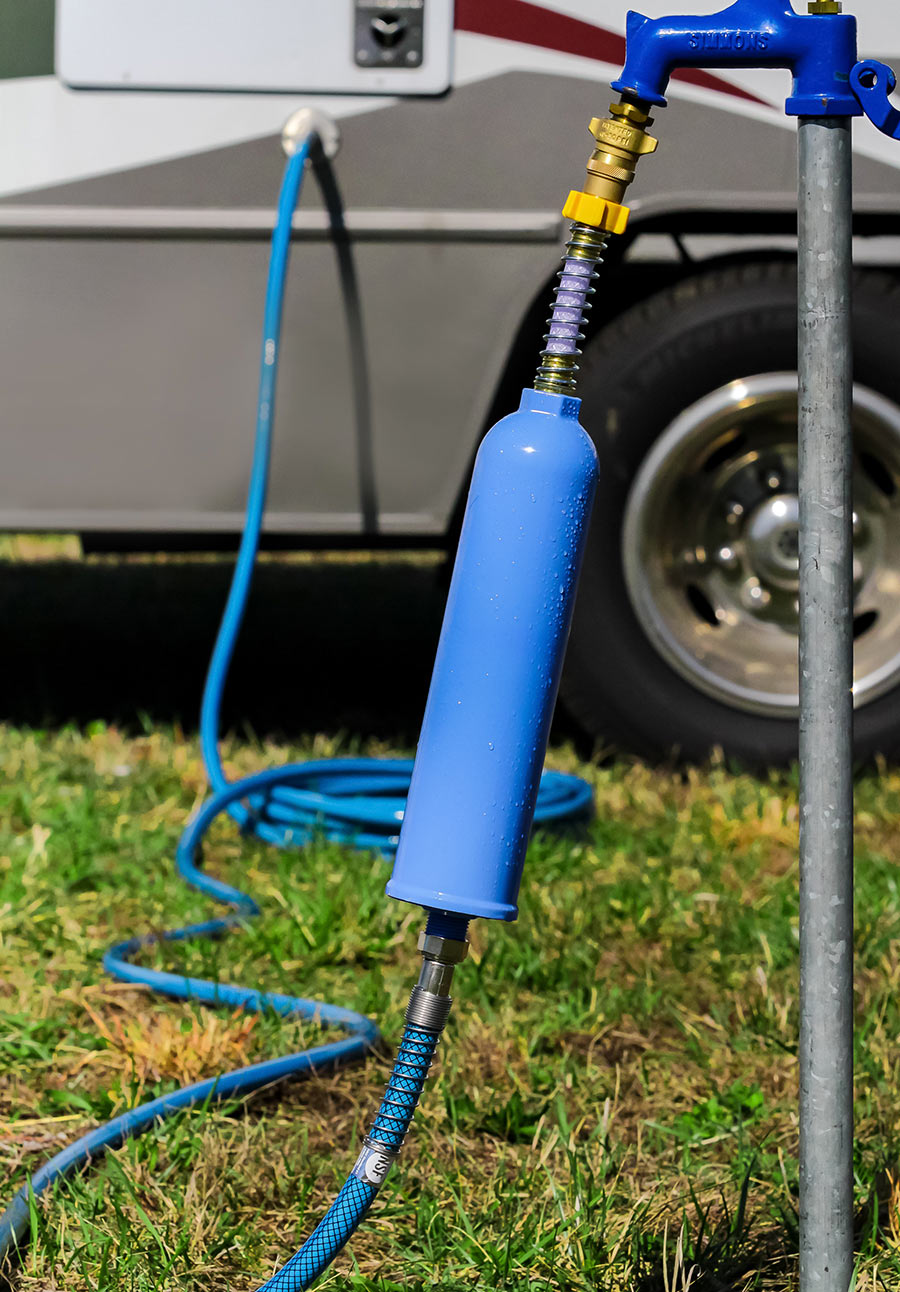
While not as critical as the sewage hoses and fittings, your fresh-water hoses and fittings are important. Spending a little extra here can pay dividends in longer life, be easier to use and microbial resistance (which has nothing to do with RVing and everything to do with your health).
First and foremost, only use hoses that are sold for drinking water use. Most are marked as RV/Marine hoses. Your garden-variety hoses do nothing to prevent internal bacterial growth, are dark in color (masking dirt and growth) and can leach chemicals into the water — especially when they sit in the sun.
Second, pay attention to the hose diameter, especially for larger RVs. Hoses aren’t perfectly smooth inside and they create friction as the water passes through them, reducing pressure and flow at the discharge end. RV hoses come in ½-inch and 5/8-inch diameters in varying lengths up to 50 feet. As you might expect, the bigger the hose and the shorter the length, the better the flow.
Third, take a close look at the hose fittings. While all hose ends reduce the diameter of the hose to some extent, some reduce it down to ¼-inch! You won’t be getting much flow from that. Also, the higher the quality of hose, the better the quality of the ends. This is almost always the first point of failure on a cheap hose and leaks can ensue.
It’s best to carry varying lengths of hose instead of one long one, but still carry 50-100 feet in total if you can. Again, some campsites have a long run to the water spigot, especially if you like to camp at rallies and other special events without traditional hookups. Plus, if one of the lengths fails, you’ll have a backup. By the way: If the ends fail, don’t throw out the hose. It’s easy to replace ends purchased at your favorite hardware store.


Cable TV and Satellite
While cord-cutting is getting more and more popular, Internet service away from home is still dicey, sometimes leaving streamers high and dry. Being able to connect to park cable or your own satellite TV is another good way of getting service.
Just like with sewer and water, CATV connections can be a distance from the site. For that reason, I carry a long length of RG-6 on a plastic reel, plus a couple of shorter lengths and a dedicated length for the portable dish. The ends have Cable Grips on them to make connecting easier. I also have a few barrel connectors for joining multiple lengths together if needed, and a tool kit at home for making my own cables. If you use the cables enough, the ends will break, so being able to strip and press new ends on is, as they say, priceless. Ideal tools and fittings are available at home-improvement stores.
I also have a couple of RG-6 surge protectors in the rig. This have proved invaluable — I’ve rewired at least three RVs that have had lightning surge enter through the CATV. You can buy two of these protectors for $12.99 on Amazon and you can even install it behind the CATV plate on the RV for out of sight, out of mind convenience.
Propane
If your RV is equipped with propane — otherwise known as LP-gas — you might also have a grill quick-connect already on your unit. If you don’t you can add one, which makes grill and griddle hookup and use a cinch.
The parts for hooking up to this are specific but universal and widely available online or through dealerships. Want to hookup more than one device at a time? No problem: Amazon (and other online sources) sells a ¼-inch Y-splitter that you can mate with a couple of hoses to have both the grill and the griddle going at the same time. The same types of fittings also can be used to hook up a propane generator to the onboard system.
Quick-connect propane hoses come in various lengths, and you can build a custom-length hose by attaching quick-connect ends. Be sure to use thread tape designed for use with gas (yellow) where needed (not with compression fittings).
Are there other things you need to improve your life on the road? Absolutely. There are more options than we could list here — and RVers love to customize their rigs and come up with their own hacks for handling their RVs. But at least this list of “must haves” will get you started.