

ike many of you, I’ve become somewhat enamored of late with the concept of 12-volt lithium-ion batteries. Realistically, what’s not to like? Among their other stated benefits, lithium batteries aren’t hampered by a low state of charge, are lighter and offer much greater charge/discharge cycles to last considerably longer.
Of course, the downside to this is that new technology brings with it a high price tag. Lithium batteries are significantly more expensive than their more traditional lead-acid counterparts — they can cost many multiples, in fact — and that’s what got me reevaluating things, because according to the most recent RV market commentary issued by Black Book and reported by RVBusiness magazine, the average age of towables going to auction in August 2023 was just four years.
Divide that big up-front cost by four, and the benefits of lithium don’t seem nearly as vast — especially given the fact that for the majority of RVers, the cumulative days they spend camping only amount to one or maybe two months per year.
That said, lithium still offers some pretty cool features not available in lead-acid batteries that make them the “must-have” products of the moment…right?
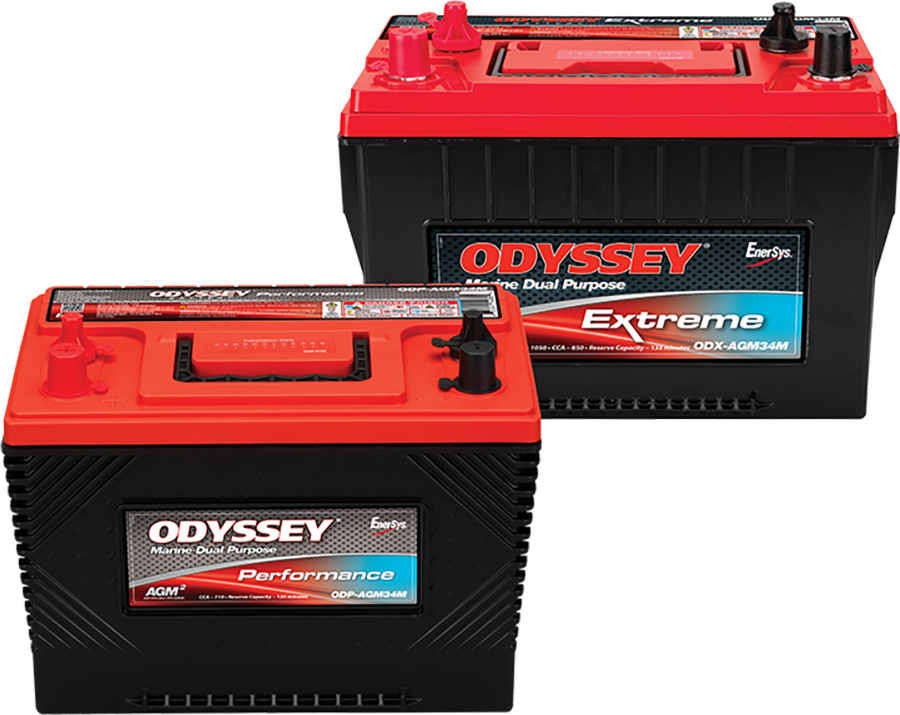
Not so fast. As I discovered, not all lead-acid batteries — specifically, AGM (absorbent glass mat) designs — are created equal. In fact, after speaking with Bryce Gregory, system product manager-transportation and specialty, for Odyssey Battery, I found myself rethinking the whole lead-acid vs. lithium-ion conversation.
As a major manufacturer, Odyssey probably stands alone in its focus on AGM batteries — but that is not, as Bryce told me, because the company doesn’t have access to the technology. In fact, its parent company, EnerSys, is a global leader in “stored energy systems” — batteries, chargers and enclosures to withstand the elements — and it manufactures batteries under several dozen brands. Some of these, said Bryce, are, indeed, lithium. “EnerSys is actually a significant player in lithium-ion,” he noted. “We use it selectively, in applications where it makes sense and there’s a potential for payback in terms of its life or cyclability. Where we have not pushed into the lithium space is in the automotive or transportation market — mostly because we actually offer a lot of the benefits achievable out of lithium at typically a better price and with less concern over integration changes like chargers.”
As Bryce explained, calcium can start the corrosion process on Day One, which gives it a finite life and is temperature- and cycle-dependent. “The plates themselves begin to corrode, which basically prevents the battery from functioning at its full capacity,” he added.
Another advantage Odyssey holds, said Bryce, is in how it manufactures its cases.
“Using an engineered case, we’re able to hold those plates in compression, so they can be thinner — which, because we can fit more inside the case, provides more surface area and, in turn, makes for a more powerful battery. There’s also better contact with the absorbed-glass mats, lower resistance, higher surface areas and better overall survivability in extreme shock and vibration environments.”
And while TPPL technology is not completely immune to corrosion (which can happen, said Bryce, in very specific scenarios), the thin plates can actually shed some of that corrosion within the regular duty cycle. “So long as they are not overcharged or undercharged too often and are kept in good condition, TPPL batteries can easily live three times longer than traditional flooded batteries.”
The design of the batteries also dispels one much-heralded drawback to lead-acid batteries: the falling off of power based on the depth of discharge. The general rule of thumb is that a lead-acid battery should never be discharged below 50% because, said Bryce, that’s where they really start corroding badly. An Odyssey battery, he added, can deep-cycle up to 400 cycles at 80% depth of discharge “and if you use that 50% state-of-charge number, it’s more like 900 times. And that’s a benchtop test, which is just repetitive and wears out a battery. If you’re using it other ways, you could see many, many more cycles. Most people will never touch the life cycle of these batteries.”
By incorporating more plates within the case, the TPPL design also develops massive power.
“There are a couple of trade-offs we’ve noticed with lithium batteries,” Bryce said. “One is most lithium units are either high energy or high power. Our batteries do both. They produce the necessary cold-cranking amps and deep-cycling reserve power.”
Odyssey, Bryce said, uses a rating it calls “pulse hot cranking amps” — “at room temperature, what’s the peak amount of power we can draw from the batteries for five seconds?” Based on battery size, he said, dual-purpose Odyssey batteries produce up to 3,125 amps for that duration.
An example Bryce used to underscore the performance of Odyssey batteries was with over-the-road truck drivers, who have to power up their sleeper cabs once they tap out their regulated driving hours.
“It’s becoming very common where sleeper-cab truck drivers can’t idle their engines,” he said, “So they either have an A/C generator or an inverter. Inverters are becoming more common because they require less maintenance. And that marketplace — where these drivers are cycling their batteries four or five nights a week to run their air-conditioner and other components overnight, then have to start their truck the next morning — is dominated by Odyssey Battery.”
Is there any aspect of the lead-acid vs. lithium-ion comparison where Odyssey hasn’t made inroads? Apparently, just one: weight. There’s simply no getting around the density of a lead-based battery. For the difference in cost, however, many RVers may opt to leave a few little-used pots and pans at home to make up for it. Food for thought.