

here’s probably nothing worse than making a purchase — especially a purchase as substantial as an RV — and not being able to use it. And it happens, more frequently than anyone would like. Subject the array of complex systems found on a typical RV to the incessant pounding caused by poor road surfaces and it’s virtually a guarantee that, at some point, RV owners will find themselves trying to schedule a service appointment at the local RV dealership.
And that’s when things can really get frustrating. The now two-year explosion in the popularity of RVing, created in no small part by the pandemic, has exposed what’s historically been the weak link in the RV lifestyle: the ability of the industry to provide service after the sale. Among owners unable to make their own repairs, complaints of having to wait six to eight weeks for service are not uncommon.
But things are getting better.
In fact, what can be described charitably as a “service snafu” has been on the industry’s radar for years. As far back as 2017, it began working with manufacturers, suppliers, wholesale parts distributors and dealers to reduce what it calls “repair event cycle times” (RECT), the timespan from when the work order is written to when the repaired unit is delivered back to the customer.
Unfortunately, the same pandemic that led to record sales has also thrown a monkeywrench into the process. Prior to 2021, the industry as a whole was seeing solid gains in reducing repair times, but the pandemic — with its associated factory closings both stateside and abroad, parts shortages and shipping dilemmas — not only negated those gains but caused repair times to increase substantially. According to a report at RVBusiness.com by IDS, a dealer management software provider, the time an RV spends at a dealership for repairs has ballooned to an average of 44 days — and can be more than double that if the parts are out of stock.
Those are disheartening numbers. What they don’t reveal, however, are the huge investments being made by various companies in the RV industry to bring them down. RV Enthusiast spoke with key executives from a number of firms — including manufacturers, suppliers, wholesalers and dealers — to find out what was being done on behalf of RV owners to improve repair times, and what we learned was eye-opening. Companies — particularly at the manufacturer level — are spending millions of dollars to revamp and improve customer-service departments and increase parts inventory levels.
What follows is a rare behind-the-scenes look — exclusive to RV Enthusiast readers — into the efforts being implemented throughout the industry to reduce service bottlenecks and keep RVs and their owners on the road. It may, in fact, be more than you ever wanted or need to know about the subject — but it will, at the very least, temper your frustration by knowing what’s being done to rectify those weeks-away service appointments.
NTP-STAG Partners with Suppliers, OEMs on Parts Delivery
Getting parts quickly and efficiently to dealer service departments — whether for an owner-requested repair or to resolve a warranty claim — is the cornerstone to reducing repair times. It was, in fact, one of the first issues addressed when the executive committees of the two major associations — the RV Industry Association (RVIA) and the RV Dealer Association (RVDA) — along with a number of OEMs, suppliers and wholesaler representatives, met during the 2017 National RV Trade Show in Louisville, Ky., to discuss improving aftermarket support for the end-user and for the industry.
“There were a whole bunch of inputs (we identified) that slowed down the ability to repair a unit quickly, but the biggest ones that we focused on were parts identification and parts delivery,” said Garry Enyart, who recently retired as director of RV generator business for Cummins and will continue to oversee the industry’s RECT initiative. “As an example, one of the things that we ‘fixed’ was how dealers received parts. Previously, the supplier would send the part to the OEM, who would then send it on to the dealer. So we needed a robust drop-ship program where if the OEM didn’t have the part in stock, the supplier could ship it directly to the dealer.”
One of the executives in attendance at that meeting was Bill Rogers, president of NTP-STAG RV Distribution as well as its parent company, Keystone Automotive. The company soon implemented a parts-delivery program which maximizes NTP-STAG’s footprint to quickly deliver components across the country. Initially partnering with a supplier, Coleman-Mach, to carry its air-conditioners, NTP-STAG also began working directly with manufacturers including Grand Design RV Co., Jayco and Winnebago Towables.
“We go through a process of determining what parts are probably the most active in terms of warranty,” Rogers told RV Enthusiast. “That means looking at their information and determining whether or not we already have the part and, if not, if it’s a part that is available to us, and working through the process in terms of them (OEMs) dropping us orders and processing them so that we get parts to the dealers as fast as possible.”
That usually means as fast as overnight, a performance metric nearly unknown within the industry before the program was implemented. With eight distribution centers and 45 crossdocks located across the country, “we (NTP-STAG) hit 90% of the population areas the next day,” Rogers pointed out.
The program has proven extremely advantageous, said Piar Adams, vice president of marketing, aftermarket, and international sales for Airxcel Inc.
“Having certain of our products — Coleman-Mach air-conditioners and Suburban furnaces — carried by NTP-STAG works to the dealer’s benefit and to ours,” said Adams. “We work with NTP-STAG on a warranty fulfillment program, so they fulfill warranty orders on our behalf through their logistics/distribution system. We take the warranty inquiry from the dealer as we normally would, but once we do the adjudication, rather than put the order into our system, it goes through NTP-STAG’s system and is fulfilled by them; we work out details behind the scenes after that.”
The benefit to dealers — and, consequently, to RV owners — Adams said, is a dramatically shortened timeframe. Rather than wait on a warranty unit or part to ship from an Airxcel manufacturing facility — a process than usually takes three to five days — the dealer will instead likely receive it within 24 hours.

Jayco, for its part, has partnered with NTP-STAG for “about a year-and-a-half,” said Steven Claude, Jayco’s vice president for customer service. “Using NTP-STAG has been a great asset insofar as us being able to provide fast service to our customers and being able to put product out in the field quickly,” he added. “We’ve been working diligently with our suppliers to get proper inventory in place. That means ensuring that NTP-STAG is stocked as well as Jayco, so we can respond immediately.”
Like other manufacturers contacted by RV Enthusiast, Claude emphasized that parts fulfilment was only one aspect of a revamped customer service program at Jayco that now numbers 300 employees in that department alone.
“It’s also your response time, how well you take care of the dealer and customer, getting preapprovals, making sure that we’re getting the proper information so that they can repair the units — there’s a lot to it,” he said. “We also initiated ‘lean processing’ into our business plan. The customer service management team goes through lean and leadership training every week, looking at how to analyze our business, where the opportunities are for continuous improvement. We’re constantly reviewing our business practices to better support and take care of our consumer’s needs. We’ve made some huge strides over the last year-and-a-half — and we’ve improved our lead times by about 54% across the board, and we’re not happy there. Our goal is to take care of any customer, with any question, within an hour.”


As Claude explained, Jayco also has implemented key performance indicators (KPI) on all departments inside customer service, “gauging how we respond, the accuracy of how we respond, the efficiencies. It’s a daily ‘report card’ that all 13 departments in customer service receive every day showing how they’re performing and how we’re taking care of the customer.”
Keystone, Forest River, Heartland Revamp Parts Departments
If there’s one thing that distinguishes RV manufacturing from companies in related transportation industries, it’s the ability to take an idea and build an entirely new company around it. From the guy who constructs teardrop trailers in a renovated garage to experienced executives who go on to establish a major manufacturing footprint, the entrepreneurial spirit is truly alive and well in the RV industry.
On one level, this trend to start-ups fuels the creativity that’s the hallmark of the RV industry — but on another, it’s also a hurdle when it comes to servicing those units.
“For example, a simple slideout motor may have 10 different part numbers,” said Mike Regan, president of Texas-based Crestview RV. “It’s the same part, but depending upon where you buy it, it will have different part numbers assigned to it by each OEM using it.
“It drives service writers crazy,” he added. “You don’t know what you don’t know — if a service writer thinks the part has a certain number, he doesn’t know to look for it elsewhere under a different number, because no one’s told him it’s the same product.”
While the RV arena is nowhere near the industrywide commonality of part numbers envisioned by Enyart and the RECT “task force,” a growing number of individual OEMs have made the practice a lynchpin in the revamping of their respective parts-fulfillment centers and customer service programs. They include Forest River, Keystone RV Co. (along with its subsidiaries CrossRoads RV and Dutchmen Mfg.) and Heartland RV Co. (including its DRV and Cruiser RV divisions).
Along with the business side of the equation, several manufacturers have created new apps that help to improve transparency between repair facilities and RV owners
Two of particular note have been introduced recently by Heartland RV and Keystone RV.
“The app is incredible. It allows a customer to communicate with us, but also with their dealer,” said Heartland RV President Ryan Juday. “With it, a customer can enter their VIN and see what parts have been ordered and track the parts and the warranty claims through the system. It lets them keep an eye on their coach throughout the service process.”
The app — MyHeartland RV — also allows owners to access a robust library of how-to content, checklists and other resources.
How-to videos, maintenance schedules, troubleshooting guides and direct access to Keystone owner relations are also part of the “My KeystoneRV” app — but the manufacturer has also taken it a step further by introducing its “DIY Program” that provides for a retail customer to submit a request for a warranty part to be shipped directly to them for replacement.
“There is no RECT because the unit never had to go to the dealer,” said Rick Deisler, vice president of service operations. “What we avoid is owner repairs made to propane or electrical systems — situations where a customer could get hurt — but there are a lot of warranty repairs and upgrades a person with some mechanical aptitude can accomplish — water pumps, blinds, cabinet door latches, things of that sort.”
Both apps are available for Apple and Android operating systems and can be downloaded through Apple’s App Store or Google Play, or through the manufacturer websites (keystonerv.com/mykeystone or heartlandrvs.com/myheartland/).


As might be expected, this by itself proved to be a huge undertaking. In the case of Forest River, for example, it established a “sameness” of part numbers across eight separate companies encompassing more than 110 different brands.
Underscoring Forest River’s commitment to customer service, the push for uniform part numbers “came right from the top,” according to Doug Deter, director of warranty, parts and service.
“We were in a meeting when Pete Liegl (Forest River CEO) said, ‘I want to have one universal part number for every part in the company so anyone can locate a part, whether they get it from NTP-STAG or Lowe’s Home Improvement,’” Deter said. “Dealers have since told us they wish the rest of the industry would do this.”
As Jayco’s Claude noted earlier, parts fulfillment is only part of the picture, however, and improving RECT also has been on the radar for several years at Forest River.
“We developed a new parts, service and warranty program, called Dealer Connect, about 3 ½ years ago,” said Deter. “It’s easy to use, whether it’s filing a claim or ordering a part, and makes it a better experience for dealers.” A corporate training team not only trained dealers on how to use the system but also internal employees so everyone was on the same page.
“That’s important, because we all need to speak the same language,” said Deter. “If you’re not filing a claim correctly, if you’re not including the proper description or not attaching photos, it gets caught up in what we call ‘pre-authorization’ status and slows everything down.”
Another critical aspect of Forest River’s RECT approach is training. Deter brought on two service technician trainers who “are constantly on the road” to help train dealer techs, along with an in-house dealer relations expert who assists dealers in presenting data.
Keystone has also taken to heart the need to reduce parts, service and warranty issues in order to help dealers get customer rigs out the door.
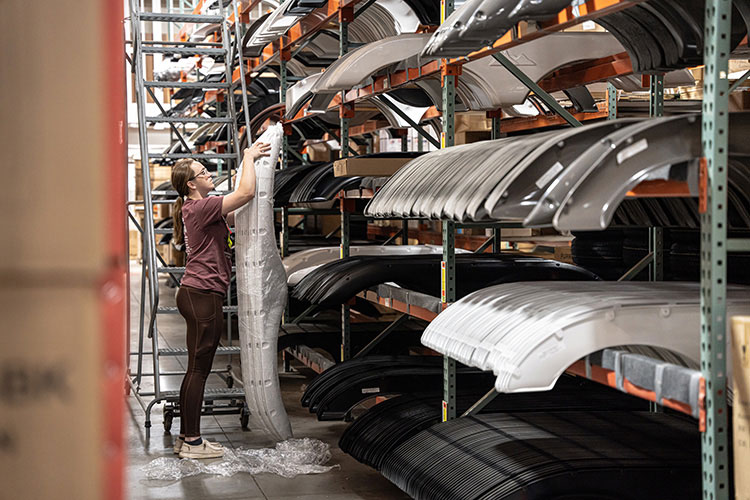
For starters, the Goshen, Ind.-based OEM reorganized its warehouse, adding mezzanine space, then stocked parts according to order frequency. “We identified the top 2,500 fastest-moving parts and stock them low to the ground and close to the pack line,” said Rick Deisler, vice president of service operations. “Anytime you reduce the number of steps needed, you’ll get it out the door faster. By the same token, our motor-freight-type parts also are now stocked together near the freight line — before they were scattered throughout the building.”
Another sea change for Keystone has been a huge investment in inventory.
“In years past, we would not stock things like refrigerators and axles. But you can’t tell a customer ‘the vendor can’t get me a refrigerator for 30 days.’ That’s not acceptable. So now, if it’s a high mover, it’s in the building. It’s now our focus to not run out of product — especially with the current supply-chain challenges.”
According to Deisler, Keystone now stocks in excess of 16,000 SKUs between two locations. “That gives us the ability to fill orders immediately,” he said. “Last month (May) we had more than 30,000 lines ordered — and with nearly 90% of them, we had immediate access to the part. We didn’t have to go to the vendor for it.” And part numbers, he added, were changed to remain constant across all lines at Keystone and its divisions.
Along with its internal stocking program, Keystone has implemented a pair of dealer programs that likewise are intended to reduce RECT.
“We incentivized dealers to order in bulk the fastest-moving parts so they would have them on hand, and offered them at a discount if the order reached a certain level,” Deisler said. “And part of the program is free freight on all orders. Then, we guarantee to buy back unused parts. But, so far, we have 250 dealers signed for the program — and no one’s asked us to buy anything back.”
Heartland RV’s ongoing investment in reducing repair event cycle times also predates the pandemic, said Heartland President Ryan Juday. “Beginning about two years ago, we began a substantial upgrade in how we respond to RECT. We have actually doubled the size of our parts warehouse — to approximately 82,000 square feet — and likewise doubled the number of SKUs we stocked. And we have additional warehouse space both in Indiana and Idaho.”
The upshot, added Jim Fenner, Heartland’s vice president of customer service, quality and engineering, is to get a 24-hour turnaround time on parts fulfillment.
“The goal with the new warehouse is to substantially increase our stocking level,” he said. “We want to get to the point where we stock 90% or more of all parts used on products manufactured in the past three years. The faster we can get a part out, the happier the consumer — and the dealer — is going to be.”
Heartland’s warehouse initiative, Fenner added, includes a greater reliance on technology — including barcode scanning and automation efficiencies — to drive the process. Fenner also has overseen a commonality of part numbers — a sticking point with many dealers — across all three companies (Heartland RV, DRV and Cruiser RV).
“One of the first things Jim and I partnered up on was to realign the expectations of what our parts and our service capabilities would be inside this organization,” said Juday. “That goes through our cataloging, as well — Jim and his team have done an absolutely amazing job upgrading our cataloging system. It will also include our dealer portal, which will have a massive upgrade this fall. There are a lot of logistical things that go along with this project.”
DMS Providers Up the Ante
One of the biggest advancements of late impacting repair event cycle times has nothing to do with parts of delivery times or warranty processing. It’s software.
“RVs are very complex products — there are thousands of components in an RV,” said RVDA President Phil Ingrassia. “That makes the job for the industry complex as well. What we’ve seen over the last few years has been a real commitment from the dealer management software (DMS) providers to provide those measurement tools so that dealers can measure their own repair event cycle time — how long it takes for the repair order to be completed — and then, through that, identify bottlenecks in their own system with their suppliers and manufacturers so they can work through them.”
While it’s not something available to consumers, most dealers RV Enthusiast spoke to consider the advent of including RECT within their monthly reports a “game-changer.” The monthly reports, distilled from the work orders input into the software systems, also allow dealership managers to compare their performance against regional and nationwide service efficiencies. While there are some differences between the software systems used, the reports track such data as total days in the shop, start/finish/delivery days, length of time to identify and procure parts and more. They also “drill down” with supporting reports than dealers can run on specific orders and customers and can suggest reorder points to maintain inventory based upon demand and even seasonality.
“It’s raised the awareness level of dealers as they have been able to now address some of those key items they can control within their dealership,” said Rob Grant, field sales director at CDK Global, one of three software providers to include RECT information in monthly dealer reports. “Some dealers have been able to cut their RECT by up to 50%, on average, compared to the national numbers.”
To be sure, there are a lot of moving parts integral to the RV industry’s push to reduce repair event cycle times, including training of additional service technicians — something that both RVIA and RVDA have made a focus, with a goal of accrediting 1,000 new technicians this year through the RV Technical Institute.
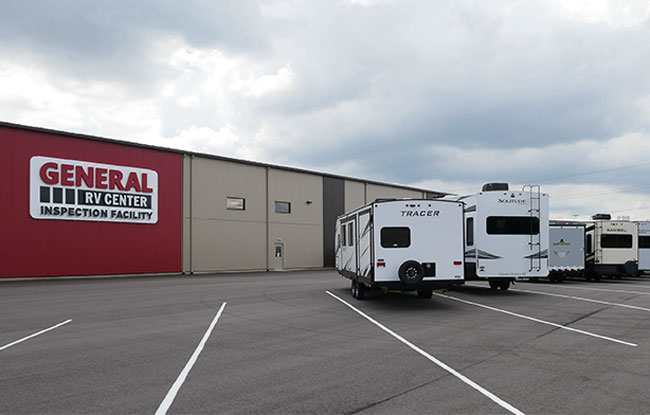
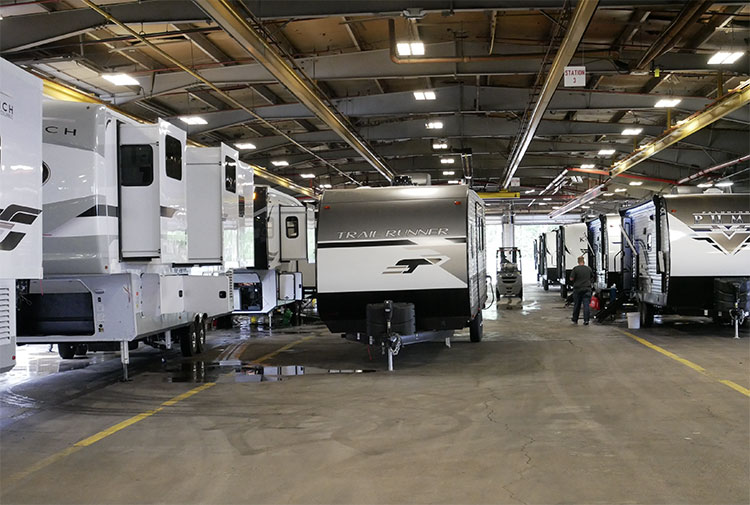
Dealers, too, have taken the initiative. Three dealer groups — Campers Inn RV, Funtown RV and General RV — have established facilities in Elkhart County, Indiana, where technicians perform hours-long inspections to identify and repair any potential manufacturing error before the units even get to their dealer lots.
But there isn’t, said RVDA’s Ingrassia, any one aspect of the repair event cycle time that will, by itself, result in dramatically lowered service times. “All the processes are part of the puzzle,” he said, “and we’re trying to get everyone to work on their parts of those processes.
“It’s not a sprint, it’s a marathon,” he added. “But we all are in the race.”