

UP, UP and Away
[maghub_sidebar]
Making Memories
By Sue Strauss photos by author
UP, UP and Away
A journey to Michigan’s Keweenaw Peninsula will reward travelers with historical sites and fine natural scenery, but don’t forget to grab a pasty, one of the region’s most popular edibles.
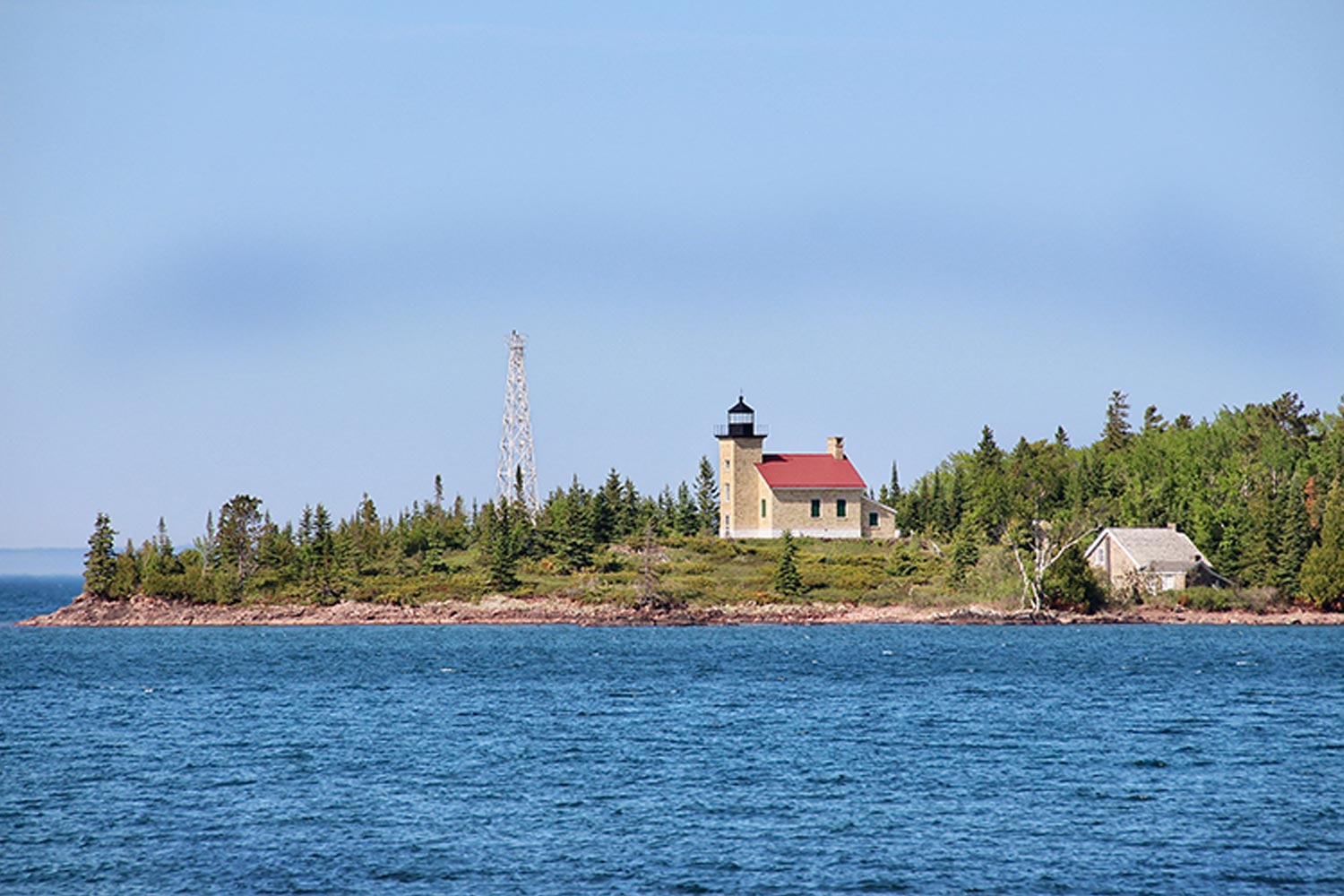
far view of Copper Harbor Lighthouse on Lake Superior
The discovery of copper on Michigan’s Upper Peninsula and the dangers of navigating the waters of Lake Superior created the demand for lighthouses in the 1840’s. Copper Harbor Lighthouse was among the first beacons on Lake Superior, completed in 1848. Today the lighthouse holds a museum that demonstrates the dangers of Lake Superior, its many shipwrecks and the duties and home life of a lighthouse keeper.
I

f you haven’t visited the Keweenaw Peninsula yet, it’s a “step back in time” that you will not want to miss. The Keweenaw Peninsula is a finger of land that curves into Lake Superior — it’s the uppermost tip of Michigan’s Upper Peninsula, or U-P as locals refer to the area. The U-P of Michigan covers 30% of the total land area of the state of Michigan but is only populated by 3% of its residents. Those who do live on the Upper Peninsula are referred to as “Yoopers” and must be tough individuals in order to survive the extreme winter weather conditions.

Most winters, the Keweenaw Peninsula receives an average of nearly 20 feet of snow. In addition, Lake Superior — the largest, deepest and coldest of the Great Lakes — is often visited by storms with hurricane-force winds and typhoon-like waves. Not surprisingly, there have been about 350 shipwrecks recorded on Lake Superior, one of which was popularized by Gordon Lightfoot’s song “The Wreck of the Edmund Fitzgerald.”

Despite this harsh environment, thousands of immigrants rushed to the Keweenaw Peninsula at a time known as “the great mineral rush” in the 1800s. The Keweenaw Peninsula is often called Copper Country. In a 65-mile stretch of land between the towns of Ontonagon and Copper Harbor, thousands of people were once employed in copper mines throughout the Keweenaw Peninsula. Twenty-two Heritage Sites now mark historic areas to preserve the story of the rise and decline of this region’s copper-mining history. There are probably more historic sites than anyone can cover in one trip to Keweenaw, so I’ll point out some of the more popular sites to visit.

A good place to begin your visit is the National Historical Park in Keweenaw Peninsula, located at the Calumet Visitor Center. Then go to the Keweenaw History Center, which is in a building that once served as the Calumet & Hecla Mining Company’s library. This History Center has fabulous displays that include voice recordings of the people telling their stories about the area. Plan on spending at least an hour at the center to soak up all you can of the Keweenaw Peninsula.

While in Calumet, take a walk through the town and look at the many old buildings that have been saved and re-purposed for tourism. The Calumet Theatre dates back to 1900 and once held the Calumet Opera House. St. Anne’s Church, built in 1899 for Calumet’s French-Canadian population, is a beautiful example of Gothic Revival architecture, with a 130-foot bell tower. The Keweenaw Heritage Center is now located in this church and gives visitors a better understanding of the Calumet boom in 1900, with its diverse population of Cornish, Croatian, French Canadian, Italian, Polish, Scottish and Slovenian immigrants who all came here to work in the mines. Be sure to also check out the Copper Country Firefighter’s History Museum, located in the old Calumet Fire Station, dating back to 1898. This museum has an abundance of old equipment, wagons and trucks once used in this town.

The Calumet Opera House located in Calumet, Michigan
The Calumet Opera House is a historic theater located in the town of Calumet, Michigan. This theater, built in 1900, is on the “National Register of Historic Places,” and is one of the 22 Heritage Sites on the Keweenaw Peninsula. In additional to hosting many famous entertainers from the early 1900’s, this theater was also the home of The Red Jacket Jamboree, an old-time radio variety show.
As you leave Calumet, be sure to stop in the town of Laurium and check out the Manor Mansion. This 1908 house is a 45-room Antebellum Mansion once owned by Thomas Hoatson, the owner of Calumet & Arizona Mining Company, one of the most profitable mines on the peninsula. Tours are available every day for a $10 admission charge.

The towns of Calumet and Laurium are located almost mid-peninsula, so you can choose to either drive north to Copper Harbor or south to the towns of Hancock and Houghton. Houghton has a great RV Park owned by the city and offers 25 full hook-up sites ($50 per day), some of which are Lake Superior Portage Canal waterfront. Reservations can be made by calling 906- 482-8745 or booked on-line (cityofhoughton.com).

St. Anne’s Church in Calumet
St. Anne’s Church in Calumet, built in 1899, was constructed for the town’s French-Canadian population. The church is a beautiful example of Gothic Revival architecture, with its Gothic-arched entrances and windows separated by buttresses. The church now serves as the Keweenaw Heritage Center.
While visiting nearby Hancock, we spent a half-day touring the Quincy Mine, a historic copper facility that operated for almost 100 years (1846-1945) and is now open to the public for tours. We chose to take the full tour, which included a guided tour of the No. 2 Shaft House, a walk through the 1918 hoist building, a ride on the cog rail tram, and a ½-mile walk through the No. 5 shaft of the actual mine. There is also a museum on the property that includes an original miner’s home, so be sure to give yourselves several hours. The full tour price is $35 per adult. If you are not up to going underground in the mine, you can choose the above-ground tour for $15 per adult. Be sure to make a reservation (906-482-5569 or 906-482-3101) as space is limited and tours fill up quickly.

As you travel north on Keweenaw Peninsula, make a quick stop in the town of Phoenix. Here you can see the Phoenix Church (once St. Mary’s Church), built in 1858. Phoenix Church is one more of the Heritage Sites found on the peninsula. After Phoenix, continue on to Eagle River and take a short stop to see Eagle River Falls and the historic bridge that spans this gorge; the long rocky slope creates a cascading waterfall. If you are a hiker, be sure to give yourself extra time in Eagle Harbor. There is a scenic 3-mile hike near Eagle Harbor that will take you to the top of Mount Baldy (also known as Lookout Mountain). Mount Baldy is the largest and least-disturbed mountain on the peninsula and stands 730 feet above Lake Superior. The hike can be a bit steep in parts, but it provides some of the most spectacular views of Lake Superior and Keweenaw Peninsula (upnorthtrails.org).

You can treat yourself to some delicious baked goods at the Jampot after your hike. Jampot, home of Poor Rock Abbey, is a local favorite bakery run by Byzantine monks. The Jampot opened in 1986 selling homemade jams made with regional berries and has increased its fare to include muffins, cookies, bars and handmade chocolates. Two of its best sellers are a fruitcake soaked in bourbon and a walnut ginger cake soaked in brandy. Thousands of visitors from around the world stop at the Jampot each year, which is open seasonally from May to mid-October.
No. 2 Shaft House on the Quincy mine tour
Going through this No. 2 Shaft House is part of the Quincy mine tour. Historical film footage of the role the shaft and rock house played in mining operations will make you feel like you are part of the mining crew in Hancock. Equipment from back in the day when this was an operational mine are still in place and will help set the scene to experience a day in the life of a copper miner.
Continue traveling north to Copper Harbor, once a mining town that is really more of a resort town today because of its northern-most location on the shores of Lake Superior. Be sure to see the historic Copper Harbor Lighthouse, dating back to 1865. With the increase of shipping of copper out of this harbor in the 1840s, this lighthouse was one of the first beacons on Lake Superior. Fort Wilkins State Park is a restored 1844 army military outpost that features camping in Copper Harbor. The State Park has campsites with water and 30/50-amp service for $29 per day. Campground reservations can be made up to six months in advance by calling 800-447-2757 or going online (midnrreservations.com.) Tours of the historic fort are also available daily and are free.

Copper Harbor is an outdoor-enthusiast’s paradise. Spectacular views of Lake Superior can be found everywhere. If you are a hiker or a biker, you will love this section of the Keweenaw Peninsula. There are nine spectacular hiking trails in the Copper Harbor area ranging from ½ to 17 miles. You can locate these trails using the AllTrails app. The Copper Harbor Bike Trail System offers miles of gorgeous views and outstanding trails (copperharbortrails.org). If you are not into hiking or biking, be sure to take the Brockway Mountain drive, which offers scenic views of Lake Superior, inland lakes and panoramic views of the Keweenaw Peninsula.

view down the tour way of the Quincy mine
The underground tour of Quincy Mine begins with a 1/2-mile walk through the historic East Adit (1895). The adit (mine entrance) is approximately 15 feet high and 15 feet wide. You will work your way to the No. 5 shaft, where you will see early mine cars on rails and your guide will explain how these cars operated. Drilling operations will also be demonstrated during the tour, and you will learn the rigors of work in this immense copper mine.
By the end of our three-day stay on the Keweenaw Peninsula, we were amazed at all of the sights that this little-known area offers, to include hiking, mountain biking, fishing, kayaking and birdwatching — along with an abundance natural beauty. If you are brave enough to visit Keweenaw Peninsula in the winter months, snowmobiling and skiing are also popular activities here. But, before you leave Keweenaw and the Upper Peninsula of Michigan, be sure to try some pasties, an English pastry filled with meat, potatoes and other ingredients, so you can get a real taste of what this area is all about. In fact, at thepastyguy.com you can find two “Pasty Trails” that dissect the U-P. Among Yoopers, two of the best spots are Pasty Central (pasty.com) in Calumet and Roy’s Pasties & Bakery (royspasties.com) on the Houghton waterfront.
The Phoenix Church on the Keweenaw Peninsula
Commonly referred to as the Phoenix Church, this Catholic Church was built in 1858 to serve the residents in the nearby mining communities. The church continued to serve its members until 1957 when the last service marked a century of providing spiritual guidance to mining families and their descendants. The church is one of the 22 Heritage Sites on the Keweenaw Peninsula.
Lake Superior’s shoreline near Eagle Harbor
This picture of Lake Superior’s shoreline was taken from our campsite near Eagle Harbor. The views from Keweenaw Peninsula are spectacular, and the sunsets are ones you won’t forget.
The Fire Hall in Calumet
The Fire Hall in Calumet, established in 1898, now serves as the Copper Country Firefighters History Museum. The building is one of 22 Heritage Sites on the Keweenaw Peninsula.
The Phoenix Church on the Keweenaw Peninsula
Commonly referred to as the Phoenix Church, this Catholic Church was built in 1858 to serve the residents in the nearby mining communities. The church continued to serve its members until 1957 when the last service marked a century of providing spiritual guidance to mining families and their descendants. The church is one of the 22 Heritage Sites on the Keweenaw Peninsula.
Lake Superior’s shoreline near Eagle Harbor
This picture of Lake Superior’s shoreline was taken from our campsite near Eagle Harbor. The views from Keweenaw Peninsula are spectacular, and the sunsets are ones you won’t forget.
The Fire Hall in Calumet
The Fire Hall in Calumet, established in 1898, now serves as the Copper Country Firefighters History Museum. The building is one of 22 Heritage Sites on the Keweenaw Peninsula.
front view of The Laurium Manor Mansion
The Laurium Manor Mansion is the 1908 mansion of Thomas Hoatson, owner of one of the most profitable copper mines on Keweenaw Peninsula. This 45-room antebellum mansion is now open to the public daily for tours. Take a step back in time and see how a millionaire in the early 1900s once lived.
Suzanne Strauss
Suzanne Strauss portrait
Suzanne Strauss and her husband, Rich, have been full-time RVers for about four years. They started out camping on weekends in a pup tent; eventually, they bought a small single-axle travel trailer to “test the waters” and fell in love with RVing. Now living in a diesel-pusher motorhome, they ply the roadways in search of beautiful, interesting and “off the beaten path” places.
front view of The Laurium Manor Mansion
The Laurium Manor Mansion is the 1908 mansion of Thomas Hoatson, owner of one of the most profitable copper mines on Keweenaw Peninsula. This 45-room antebellum mansion is now open to the public daily for tours. Take a step back in time and see how a millionaire in the early 1900s once lived.
Suzanne Strauss
Suzanne Strauss portrait
Suzanne Strauss and her husband, Rich, have been full-time RVers for about four years. They started out camping on weekends in a pup tent; eventually, they bought a small single-axle travel trailer to “test the waters” and fell in love with RVing. Now living in a diesel-pusher motorhome, they ply the roadways in search of beautiful, interesting and “off the beaten path” places.