


Take the Jarring Out of the Jounce
[maghub_sidebar]
SuperSprings International's SumoSprings being tested
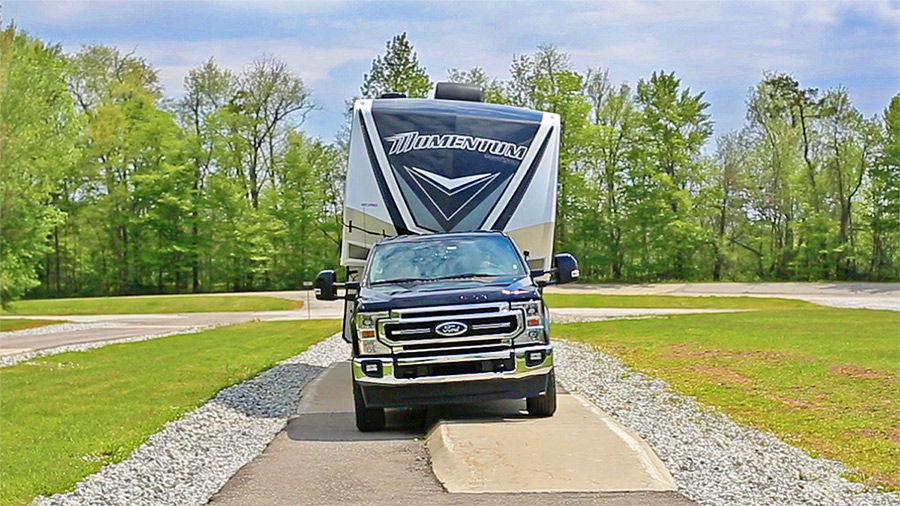
SuperSprings International put its SumoSprings to the test recently at the Navistar Proving Grounds in Carlisle, Indiana. The Ford F250/Grand Design Momentum went through a number of road challenges to document SumoSprings’ performance.
Take the Jarring Out of the Jounce typography
Testing SuperSprings International’s Trailer SumoSprings suspension system at the Navistar Proving Grounds
By Bruce Hampson
T

here’s an old adage among some veteran RV owners that notes that the first rule of camping “is to fix what may have broken on the way there.” It’s obviously an exaggeration — contemporary RVs are built to higher quality standards today, and both manufacturers and dealers have implemented extensive pre-delivery inspections to catch most problems that may have crept into the assembly lines. That said, as RVs age they do tend to experience higher component failure rates; it’s an unavoidable aspect of towing mobile houses across untold miles of suspect roadways.

This is especially true of travel trailers and fifth wheels, which rely on leaf-spring suspension systems. There’s a reason for this: the suspension works, its simple design makes it inexpensive to use and it can be easily adapted to virtually any towable design. But while the venerable design does help to mitigate the terrain, there’s only so much a simple multi-leaf spring pack that’s bolted to the vehicle frame and axle can accomplish.

Not surprisingly, companies have for years been developing aftermarket systems to further enhance the ability of leaf-spring suspensions to reduce the impact of road hazards on trailers. One of the simplest of these — from an installation standpoint — is SumoSprings, an “airless air bag” system developed by SuperSprings International. Founded in 1998, the Carpinteria, California-based company released a version of its SumoSprings for RV towables in 2019 — and, to underscore its confidence in the system, SuperSprings International offers a no-questions-asked 30-day moneyback guarantee on the product. Since January 2020, said Adam Weisner, chief commercial officer, SuperSprings International has only been asked to honor the guarantee five times, “Or about 0.001% of our Trailer SumoSprings sales.”

The performance of SumoSprings has also led to the product being installed at the factory by a number of RV motorized manufacturers, including Winnebago, Tiffin, Coachmen and Midwest Automotive Designs, and SuperSprings International is in talks with towable manufacturers to have them added as factory equipment. The company has also approached a number of dealers, including Fort Worth, Texas-based United RV, which now equips all trailers with Trailer SumoSprings before releasing the units to customers.

To understand the popularity of SumoSprings requires a bit of background on how it came about — and what it really is. The company’s first product, SuperSprings, was initially developed by the sister of SuperSprings International CEO Gerry Lamberti in South Africa. Lamberti bought the patent and set about developing a product line for what he characterizes as a “mechanical spring.”

array of testing equipment by Grand Design
Grand Design providing 14,000-pound (dry weight) Momentum for the test
Grand Design provided 14,000-pound (dry weight) Momentum for the test, which was equipped with an array of testing equipment. SuperSprings’ Adam Weisner also placed a number of GOPRO Cameras inside, outside and beneath the fifth wheel to video the results of the testing.
“The cornerstone of the intellectual property is its self-adjusting shackles,” said Lamberti, “but we always kept bumping up against (the use of) airbags.” Looking to further differentiate the product, Lamberti opened discussions with companies researching micro-cellular technology.

“I was looking for a closed-cell urethane where effectively, instead of the air being in a single-volume airbag it would be in a urethane matrix of nitrogen bubbles and urethane,” said Lamberti, who is an engineer. “Technology perfected in Germany had allowed micro-cellular urethane to be formulated so you can adjust the diameter and the density of those air bubbles. With that technology, we could not only create an ‘airbag’ at various air pressures, but in a urethane matrix — which would allow it to not rely on a compressor. And by being closed-cell, it would never leak.”

The stumbling block, said Lamberti, was that he also wanted the product to have a parabolic spring curve, which is essentially a product with a progressive spring rate. Once that was accomplished, he turned to one of SuperSprings International’s major clients, the U.S. Border Patrol, to test the product.

SuperSprings International executives on hand for the testing
SuperSprings International executives on hand for the testing included (L-R) Chief Commercial Officer Adam Weisner, CEO Gerry Lamberti and Creative Director Tom Bateman.
“Their vehicles had our SuperSprings installed and were happy with the performance,” Lamberti said, “but when I initially approached them about SumoSprings they were hesitant. They felt an airbag system was too high-maintenance for their environment.” Once Lamberti pointed out the system had no traditional airbag accouterments — no onboard compressor or air lines that might fail — the agency began having SumoSprings installed on the vehicles.

“It was a great testing ground because they sometimes have to drive those trucks like they stole them, across extremely rough desert terrain,” Lamberti pointed out. “And SumoSprings withstood that kind of punishment. It was durable and it gave a great drive quality.”

Proven at the Proving Grounds
According to Weisner, SumoSprings have performed just as well since their release to the RV market — but the accolades have always been seat-of-the-pants observations. To understand exactly what Trailer SumoSprings delivers in the areas of ride quality, SuperSprings International executives and technicians spent time recently at the Navistar Proving Grounds in New Carlisle, Indiana. The expansive site —used by an array of vehicle manufacturers — includes a three-mile oval and specialized grades on- and off-road designed to evaluate vehicle suspension dynamics. The oval also was used to simulate the forces on the trailer when being passed by a truck moving in the opposite direction.

“Navistar has developed an extensive array of testing equipment, including 7-way gyroscopes and accelerometers, that can monitor everything the suspension does,” said Weisner, who added 32 remote cameras to the interior, exterior and beneath the Grand Design fifth wheel to further document the testing.

The testing itself was done using a 2020 Grand Design Momentum two-axle fifth wheel with an unloaded weight of 14,000 pounds, pulled by a Ford F-250 truck. The truck and trailer made numerous passes through each track segment in stock form to establish a baseline, then replicated those tracks after the installation of SumoSprings to gauge improvements.

Once collected and analyzed, Weisner said the data provided an eye-opening glimpse into how a typical trailer suspension reacts to road irregularities — and how such forces were significantly canceled out by the addition of SumoSprings to the suspension.

The interior of the Momentum filled with an array of testing equipment
The interior of the Momentum was filled with an array of testing equipment developed by Navisar engineers, including 7-way gyroscopes and accelerometers, to record the movement of the suspension and fifth wheel.
interior of the Ford F-250 tow vehicle equipped with instrumentation
The interior of the Ford F-250 tow vehicle also was equipped with instrumentation, including precision GPS tracking to ascertain vehicle speeds. Testing included monitoring the effect of trucks passing by the fifth wheel, always a concern among RV owners.
The interior of the Momentum was filled with an array of testing equipment developed by Navisar engineers, including 7-way gyroscopes and accelerometers, to record the movement of the suspension and fifth wheel.
The interior of the Ford F-250 tow vehicle also was equipped with instrumentation, including precision GPS tracking to ascertain vehicle speeds. Testing included monitoring the effect of trucks passing by the fifth wheel, always a concern among RV owners.
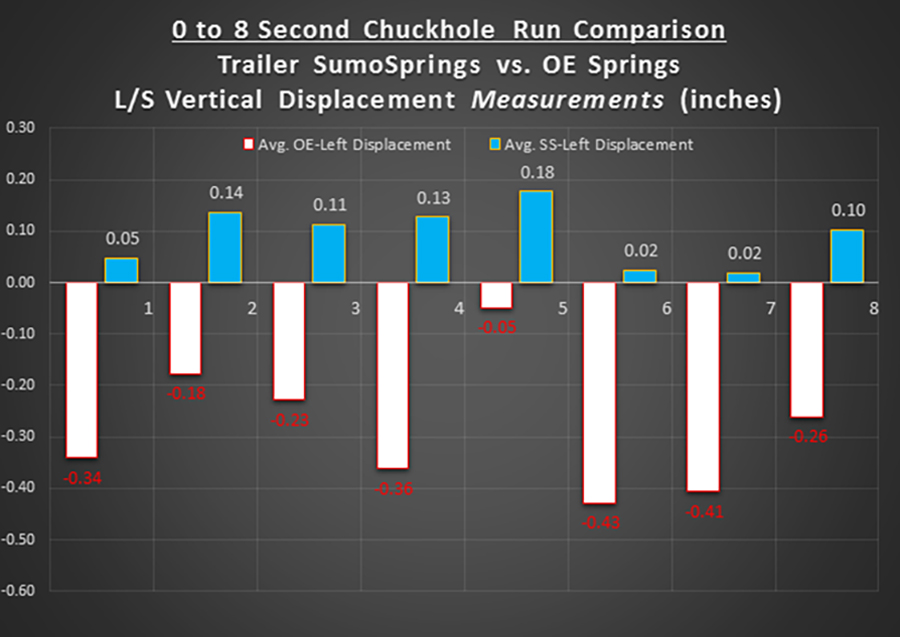
“During an event, we measure at one second intervals and can see how much displacement is taking place — how much movement is happening from a travel perspective,” he said. “What we found out at the Proving Grounds was the addition of the Trailer SumoSprings led to in more than 100% average higher displacement — meaning it kept the trailer from moving as much. The suspension didn’t travel as much across each one of those intervals. In fact, at one of the spikes between the four- and five-second mark, it recorded a 462% higher displacement.”

The “spike” Weisner referred to was a large event — in real-world use, comparable to hitting a pothole or crossing between the curb and roadway when entering a driveway.

“Spring-leaf packs are not really made for spike loading, so it’s a very difficult problem to solve,” he added. “But as the suspension travels and there’s a lot more movement, the SumoSpring gets stronger. It pushes back more as more pressure is applied because of its parabolic spring curve.”

From Weisner’s perspective, an even greater benefit of SumoSprings was the product’s demonstrated ability to lessen the G-forces that act on the trailer.

Portions of the proving ground course include various slammer pads with bumps
Portions of the proving ground course include various slammer pads with bumps to create what a vehicle might encounter on the road or when entering and leaving driveways and fuel stations.
“The data collected by Navistar showed a 68% average reduction in G-force,” Weisner noted. “That’s a huge reduction because it’s these G-forces that create vibration. We’re talking small numbers in G-force — but their toll builds up over time. If you can reduce those forces by nearly 70%, you can really extend the life of the trailer components and of the things inside — including the dishes and glassware that often end up in pieces.”

And, as Weisner pointed out, the performance of Trailer SumoSprings doesn’t come at the cost of compromising any other suspension component.

“SumoSprings complements the suspension versus replacing it,” he said. “And it’s maintenance-free. We’ve done torture tests you can see on our YouTube channel on the product where we drilled holes in it, we threw it in a lake, we set it on fire — and then we put it back on a truck, put a few screws it and then ran it. And performed just the same. It can withstand the elements and extreme use, which is perfect for the outdoor industry.”
data graphs of a 0- to 8-second chuckhole (pothole) run comparison
4,001 data points displayed on chart
As seen in these data graphs of a 0- to 8-second “chuckhole (pothole) run comparison,” virtually every aspect of the fifth wheel’s movement was charted. Relying on 4,001 data points, Trailer SumoSprings maintained a displacement height of more than a half-inch higher during the most extreme points vs. OE springs and the vertical G-force on the frame was 68% less with SumoSprings.
SumoSprings: A 30-Minute Installation
By being able to adjust the density of the nitrogen bubbles within the urethane, SuperSprings International also is able to formulate the product for different applications. Likewise, the company color-codes them — blue, black, and yellow — signifying the different densities. Presently, SumoSprings are available in two densities for towable applications: “Blue” SumoSprings are designed for trailers with gross axle weight ratings (GAWR) of 3,000 to 5,000 pounds, while “Black” springs are for GAWRs of 5,000 to 8,500 pounds. Kits, which retail for about $250 per axle, also are available for over-axle and under-axle leaf-spring locations, said Weisner, and can be installed in about 30 minutes. We followed along on the installation of a spring-over-axle kit.
a combination of spacer plates (0 to 2) that stick up
Before raising the vehicle, measure from the bottom of the trailer to the top of the leaf spring plate. Locate from the supplied parts a combination of spacer plates (0 to 2) that stick up to a height of ¼ to ½ inch taller than that initial measurement. Then, using the correct length 8mm bolt (supplied), attach the SumoSpring to the mounting bracket.
raising the vehicle and measuring from the bottom
Add a light amount of Loctite to the bolt threads and attach, leaving the connection loose for the moment.
carriage bolt being inserted
Insert the 3/8-inch carriage bolt through the bracket. Use the flat washer and lightly attach the 3/8-inch nut to the carriage bolt.
the trailer being secured and the frame being raised
Secure the trailer and raise the frame high enough to position the SumoSprings on the leaf spring. Place the SumoSpring on the leaf, ensuring it is positioned between the U-bolts attaching the leaf spring to the axle.
the brackets together being squeezed
Squeeze the brackets together so the hooks are snug around the leaf spring plate and tighten the 3/8-inch nut until it is just touching. If necessary, slide the SumoSpring so it is centered under the frame rail. Rotate the SumoSpring clockwise by hand until it is as tight as possible. Finish by tightening the 3/8-inch nut fully.
final product revealed ready to be repeated
That’s all there is to it. Repeat steps at each wheel.