

By Bob Livingston
As RVs Evolve, OEMs Need to Mitigate Common Problems
raveling in an RV throughout the peak summer months is always an eye-opener. Spending time among RV owners puts the lifestyle into prospective and, frankly, it’s a great learning experience. There is no doubt that times are changing and the dynamics of RVing are evolving with new owners — including many younger people — offering a fresh viewpoint on social interactions and enthusiasm for the rigs themselves.
To us RV veterans with, well, a “few decades” under our belts, it’s fun to compare how RVers participated in the lifestyle in the early days versus those of today. Although clothing trends, hair styles and the RVs are dramatically different, not much has changed when it comes to sitting under a patio awning, enjoying a plate of potluck offerings and schmoozing with fellow RVers.
But that is where any similarity ends.
Who could have predicted, for example, the reality of pulling travel trailers with electric tow vehicles — or communicating via satellites circling the planet? When the phone rings while sitting around the propane-fueled fire, I simply raise my arm and talk into my watch. (I can see the smile on Dick Tracy’s face.) During one of my stays in an RV park in the Pacific Northwest, I ran into a fellow camper who was towing his 30-foot Airstream with a shiny new Rivian all-electric truck. It was quite the combo, offering a lot of pizzaz to RV ownership; going for a test ride was certainly exhilarating.
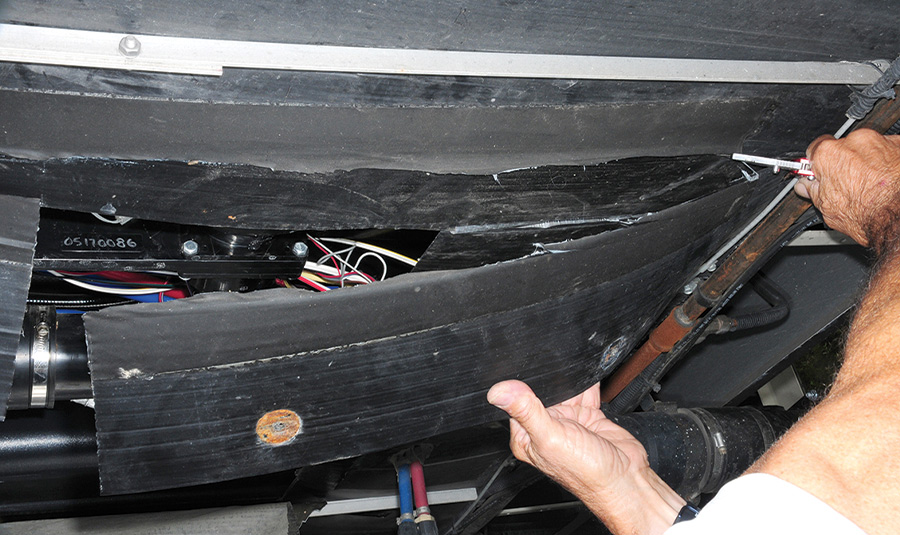
Making the dump valves accessible without having to cut the underbelly will reduce repair time and costs.
Interestingly, the RV park prohibited electric vehicle charging at the sites, a restriction reinforced by warning stickers attached to each utility box. Charging the Rivian at that juncture required going into town and hanging around while the batteries were re-energized at a charging station. Fortunately, the latest quick-charging features limit down time, and undoubtedly, this function will even get faster as technology evolves. Still, it seems like adding charging infrastructure to RV parks will be a logical revenue generator as electric vehicles become more popular and capable.
When asked, of course, about driving range while towing the trailer, the owner was unsure since he hadn’t towed very much at the time of our meeting, but he emphasized that he was in no rush. Good thing, because based upon news reports of late that have tested various EV pickups with a trailer on their tail, it’s likely that he won’t get too far between recharging sessions. But he’s still a happy camper — and this type of patience is contagious within the RVing community. I’ve always said that the RV lifestyle is so compelling that enthusiasts are willing to endure higher levels of inconvenience to stay engaged.
I’ve heard a lot of sniveling about things that go wrong with an RV — and the difficulty associated with getting things fixed — but very few of these people were eager to throw in the towel. Most owners don’t use their RVs for more than long weekends and a few extended vacations, which keep the repair gremlins at bay for most of the warranty period. Refreshingly, however, manufacturers are delving into solutions that promote owner satisfaction — and are cognizant of the more common problems plaguing RV ownership.
That said, there are steps that can and ought to be taken to mitigate the discontent expressed openly on the Internet and in camp. The most common issues focus on the water system, tires, electrical components, awning damage and the sewer system. Fortunately, reinforcing these systems/components can be done easily at the factory level — with, of course, some monetary considerations.
Beyond making sure all the crimp connections on the water lines are perfect (which only requires a few more moments of time and assurance that the tools are adjusted properly), I would think twice about those elaborate utility manifolds with multiple water valves. True, they look sexy and high tech, but I’m still a fan of simplicity. How I miss my gravity water fill! I would assume the economics of providing only a city water connection, a gravity fill and winterizing by-pass valves on the back of the water heater could be justified.
All holding tanks should be fitted with a flushing device — or at least offer an option for the gray tank. Keeping these tanks clean prevents many headaches. And making the dump valves accessible without having to cut the underbelly will reduce repair time and costs.
Considering all the electrical grid turmoil these days, protecting the boatload of sensitive electronic components found in most RVs these days should be paramount. Why not make internal surge protection part of a mandatory option (doublespeak for “standard equipment” though it lets OEMs and dealers tack on a few more bucks)? My portable surge protector cut power to our fifth wheel three times last summer — twice because of faulty hookup wiring.
It also seems like power awnings are more susceptible to wind damage than the old manual models, maybe because we no longer tie down the arms. Insurance claims for awning damage are common; adding an auto-retract feature to all power awnings will certainly prevent most problems, which can be severe enough to result in collateral damage.
I prefer not to rehash the issues with tires on towables, but maybe it’s time to use at least 16-inch wheels and tires on all medium-size (and larger) trailers and fifth wheels.
There are numerous other pathways manufacturers can take to reduce discontent and down times, but one big method is to improve education at the time of delivery. Many problems are owner-induced because they just don’t know what to do. Encourage those taking delivery to video the walk-through. Last summer, for example, most new owners I observed didn’t even use a pressure reducer when hooking up to water. That’s a problem waiting to happen.
Patience is a virtue — but let’s not push it.