


mong the small army of engineers, designers and product managers within the RV industry who are enlisted with the task of developing new concepts for each model year, there’s probably no phrase that has more impact than “What if?”
They hold late-night meetings and challenge one another with possible innovations, concepts and other ideas that might never see the light of day — but nonetheless ask “What if we tried this?”
They attend home and garden shows, picking up on emerging trends in colors, textures and fabrics, and ask “What if this could be adapted to RV use?”
And then they take those ideas, build pre-production prototypes and invite their associates, dealers and consumer groups to tour them — and listen with a critical ear as they again ask “What if we changed this just so?
Finally, at some point “What if” becomes “Let’s do it.”
While the past two years have presented their own challenges — most new models for the coming camping seasons are introduced at the trade-only Elkhart RV Open House, a week-long event that annually turns the streets of Elkhart, Indiana, into North America’s largest RV display but has been interrupted by the COVID pandemic — the staff of RVBusiness nonetheless views hundreds of new RVs slated for production in order to present what it considers to be the best new towable and motorized RVs. For the 2022 model year, editors of RV Enthusiast joined them in visiting dozens of RV manufacturers across northern Indiana. At each stop, we viewed new models and queried executives, product managers and engineers to learn how certain designs and products were developed — and how they were expected to impact the industry.
Everyone involved then collected their notes — and their opinions — for RVB Executive Editor Rick Kessler, and the discussions began. Eventually, a consensus was reached and a list of the Top 25 New Debuts was compiled; from it, five RVs were selected as finalists for “RV of the Year” — and from that lineup, one model was chosen as the year’s penultimate RV.
It’s not an easy process. While the industry is on a roll as consumers continue to “rediscover” the joy of camping with friends and family, manufacturers aren’t simply sitting back and reaping the rewards that accompany record sales. As 2022’s lineup of finalists illustrates, OEMs continue to push the design and engineering envelope.
Among the myriad new models soon to debut on dealership sales lots nationwide, the following five were named as finalists for “RV of the Year:”
- East to West — Ahara 365RL fifth wheel;
- Ember RV — Overland Micro ROK adventure trailer;
- Heartland Cyclone 4014 fifth wheel toy hauler;
- Keystone Arcadia 370RL travel trailer;
- Winnebago EKKO Class B.
As the saying goes, however, only one can win — and in this instance, the Keystone Arcadia earned overall top honors as “RV of the Year.”
That said, every RV highlighted within the following pages as a 2022 “Top Debut” deserves accolades — and strong consideration should you be in the market for a new RV this year.
Want to stay abreast of what’s happening in the RV space? Interested in new models and products as they are released rather than waiting until they appear at dealerships? As the only RV trade publication located in Elkhart, Indiana — the heart of the RV industry — RVBusiness is the premier business-to-business publication in the industry, and RVEnthusiast readers can subscribe to the RVBusiness daily news feed and learn of advancements being introduced on a day-to-day basis. Go to rvbusiness.com/subscribe/ to sign up for the daily news feed as well as the digital edition of the bi-monthly magazine.


Keystone Arcadia 370RL Travel Trailer

ack in January 2021 at the Florida RV SuperShow, Keystone RV Company introduced the Arcadia fifth-wheel. The company touted it as an “all-new” ground-up reinvention of what it means to be a towable RV. The Arcadia 370RL travel trailer takes many of those innovations and incorporates them into a camper that Keystone officials consider equally groundbreaking.
We agree with that assessment and, while terms like “game-changer” and “innovative” are frequently overused, we feel the Arcadia line overall — and the Arcadia 370RL travel trailer, in particular — have rightly earned “RV of the Year” recognition.
Why? We were impressed by the engineering and construction — especially the “crawl space chassis,” the refined interior styling, and adoption of leading-edge technology, particularly SolarFlex, Keystone’s OEM-installed solar system.
Keystone executives admit the road to launching Arcadia was a winding one, primarily due to supply chain difficulties. However, even with these challenges, Arcadia still racks up an impressive list of innovations. We expect many of these eventually will find their way into other Keystone product lines.
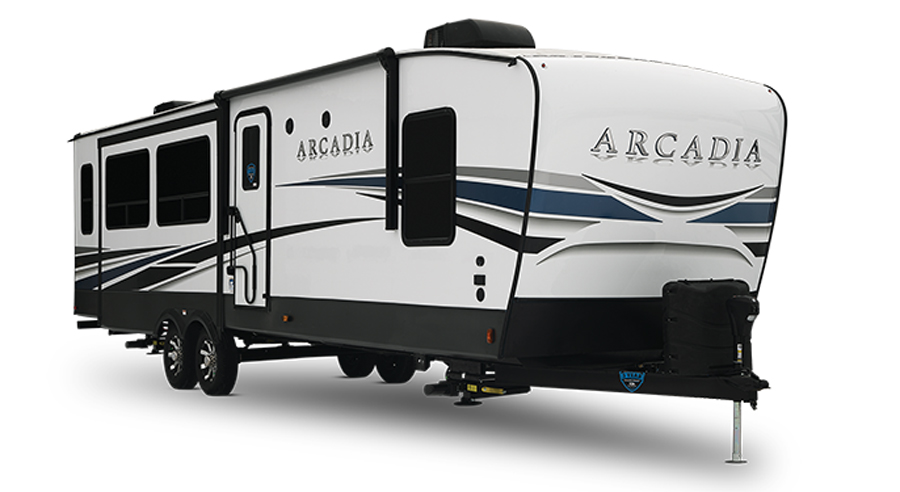
- First and most obvious is the profile of the front cap. It’s hard to miss. On both the Arcadia travel trailer and fifth-wheel, the furthest forward point is near the top rather than at the base. While the shape of the cap makes Arcadia instantly recognizable, the design is also functional. On the inside, the front cap design makes for a deeper walk-in closet, something uncommon in travel trailers, let alone fifth-wheels. Additionally, the unique front cap improves aerodynamics and handling while in tow, based on feedback Keystone is getting from transport drivers.
- Another innovation buried deep inside Arcadia is its foundation. Arcadia is the first (and only, at this point) Keystone product to utilize the NGC2 “crawl space” chassis, the brainchild of Keystone’s Engineering Innovation Lab. The NGC2 features a 3-inch-tall channel running the entire length of the frame, located underneath the Hyperdeck water-resistant flooring — much like a crawl space in homes.
The NGC2 crawl space is used to route plumbing, electrical and heating ducts without navigating obstructions, and makes it possible for Keystone to add extra layers of insulation. Speaking of insulation, below the Arcadia living space are two heated chambers and three insulation layers. Water lines and heat ducts are surrounded by block foam. And underneath the frame is an additional layer of insulation. All this added insulation makes the Arcadia ideal for extended-season camping, according to the manufacturer.
- Finally, the NGC2 chassis includes a “center spine” running the length of the trailer, significantly increasing floor rigidity and strength.
“There are so many innovations in Arcadia, I almost don’t know where to begin,” said Arcadia Product Manager and industry veteran Jeff Rank. “For example, the shape of the front cap and the crawl-space chassis are two big ones, as is the interior look and feel, and the extra attention to detail resulting in better overall performance and a more satisfied owner.”
One example of attention to detail, Rank cited, is the CURT Performance Package, a collaboration between Keystone and CURT that’s available only on Arcadia. According to Rank, pretty much everything on the suspension has been upgraded, including heavier-walled axle tubes, hubs and bearings, forward self-adjusting brakes, extra-thick shackle links, wet-bolts with bronze bushings and rubberized equalizers. In addition, the package comes with a 6-year warranty — yes, you read that right — that is not pro-rated.
Interiors in Arcadia are another strong selling point. The décor features white cabinetry, butcher block countertops, a farmhouse kitchen sink, Roman shade window treatments, and residential-style furniture exclusive to Arcadia. Overall, the contemporary residential look has been a massive hit with consumers, according to Keystone executives.


Storage in the Arcadia also has been optimized to utilize every square inch of space, like in the kitchen with numerous drawers, shelves and butler’s pantry. Another great example is the flip-up butcher-block kitchen island workstation — with USB and power receptacles right where you need them — which also serves as a buffet or snack sideboard and is a focal point of the kitchen.
Exterior storage has also been reimagined with every nook and cranny put to use, and compartment interiors are finished to automotive standards, said Keystone managers. In addition, an “All-in-One” convenience center isolates all wet bay functions and includes a power tank fill, which is said to speed up the time it takes to fill your freshwater tank.
Staying with the “more is more” theme, the Arcadia 370RL bedroom offers an 84-inch ceiling height, extra-large front walk-in closet, dresser, flip-up bench with even more storage, and a California King bed with two drawers below (four, on fifth wheels). The fixed bed base also allows an auxiliary freshwater tank on some fifth-wheel floorplans, appealing to frequent boondockers.
Speaking of boondockers, with campgrounds often fully booked, Keystone anticipates Arcadia buyers will want the capability to go off-grid with all the convenience. So, like other Keystone brands, Arcadia offers several different factory-installed and warrantied solar packages, including the standard SolarFlex 200 or the upgraded 400i, which includes two 220-watt roof-mounted solar panels, a Victron Smart Controller, 2000-watt inverter, and other goodies.
Currently, the Arcadia website shows four fifth-wheel floorplans and two travel trailer floorplans. Three-quarter ton fifth-wheel models include the 3660RL rear living, mid-kitchen floorplan, and the 3940LT with center living bunkroom loft model and one and a half baths. Half-ton models consist of the 3250RL with rear living and the 3370BH with a double bunk. Current Arcadia travel trailers include the 370RL and the 377RL. All are classed as luxury models. MSRP for the 36-foot, 10-inch 370RL is $68,000. However, added Rank, additional product innovations are in the works — and the company is expanding beyond the luxury segment, designing more floorplans to take advantage of the NGC2 chassis’ capabilities.
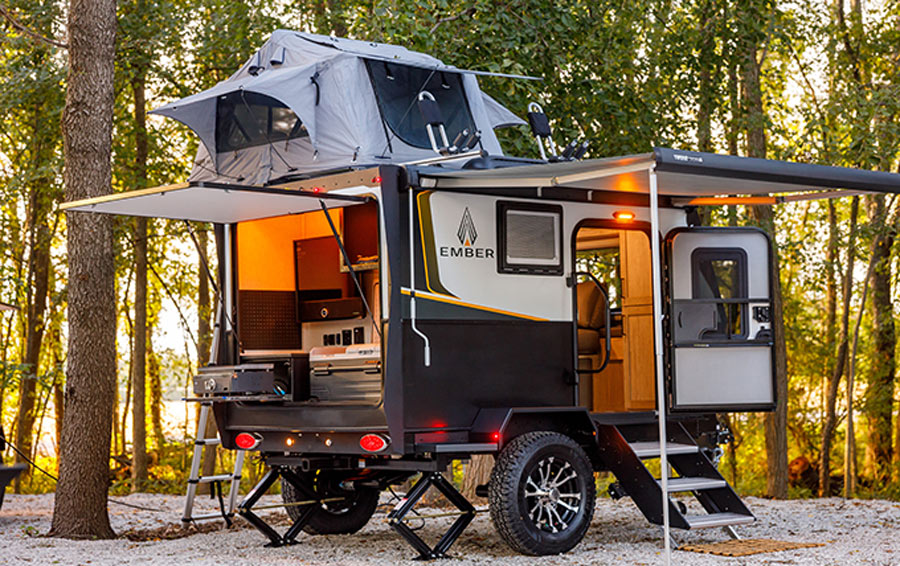

The Micro Series features two models — the ROK and ROL — and both check in at 12 feet, 8 inches long and under 3,500 pounds (UVW). The difference? The ROK (Rear Outdoor Kitchen) and ROL (Rear Outdoor Locker) floorplans give owners the freedom to decide how they want to use their space.
The ROK includes a well-equipped outdoor kitchen featuring a galvannealed-steel countertop with pull-out griddle shelf, a portable 12V/120V compact fridge/freezer combo with dual zone cooling, and a 12V HDTV with Bluetooth-enabled soundbar.
Found on all Overland models — and the centerpiece of Ember’s solid foundation — is a unique chassis constructed of heavy-duty reinforced steel tubing instead of a conventional I-Beam frame. This rugged design creates additional torsional stability for improved off-road performance and durability. Ember’s chassis is supported and reinforced by the all-new, integrated CURT Independent Suspension (IS) System, featuring a high-performance, axle-free design: road-dampening shocks and cushioning springs provide a smoother ride than traditional spring axles while performing better than expensive torsion axles. Add to that 16-inch nitro-filled Goodyear Wrangler Workhorse tires featuring an integrated tire pressure monitoring system (TPMS) that comes standard as part of Ember’s OneControl smart RV system.
In addition, Ember has incorporated a new VersaCoupler Height-Adjustable Bolt-On Hitching, which accommodates articulating hitches as well as a wider variety of tow vehicles with less need for adjustment. An all-new parking brake integrated onto the frame replaces traditional RV wheel chocks and locks the camper in place — it even includes a padlock security option. Other standard features include an upgradable solar package (one 190-Watt Go Power! roof panel, 30-Amp PWM charge controller, 1000-Watt inverter).


“What we’ve done is we’ve taken all the things our customers love about the Tandara, kept that in Ahara, and then added 10 to 15 high-impact features to take it up in that luxury segment,” said Mark Krol, East To West sales manager.
Some of those features include a drop-frame, pass-through storage compartment, six-point hydraulic auto-leveling system, high-gloss fiberglass exterior sidewalls, bigger G-rated tires, bigger axles, three air conditioners, dual awnings and a taller front bedroom.
“And then there are a bunch of other little touches on top of that,” Krol added. “In East To West fashion, we do one décor – Barrington Maple. We think that’s the biggest selling point of this coach.” The galley area also boasts plenty of storage, including a double-door pantry/closet, as well as refrigerator access while the slides are closed and a solid-surface countertop extending all the way across the kitchen slideout.
Upstairs, the floorplan offers 6 feet, 6 inches of headroom and a double-entry bathroom. The bedroom features a slideout with a stationary base, similar to a Class C, where the slide only moves from the mattress up. Plenty of storage and a stackable washer/dryer closet are also included.
The brand launches with two rear-living floorplans: The Ahara 365RL is 36 feet 10 inches long and weighs in at 16,000 pounds. The second floorplan, the 325RL, is 34 feet, 10 inches long with a GVWR of 15,500 pounds. All Aharas are 101-inch wide-bodied units. MSRPs start in the mid-$80,000s.
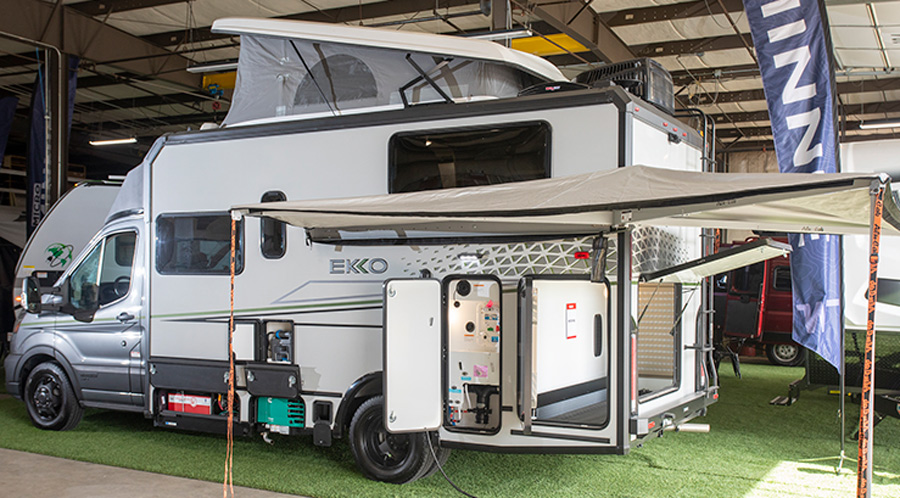
The optional pop-top sleeping area definitely garners the most attention. It not only provides additional sleeping capacity — accessed by a ladder, it adds a 52- by 79-inch sleeping area to the rear twin beds — but it also lends an open, airy feel to the otherwise small motorhome when it is open.
Extra storage racks, the bike garage in the back and storage compartments below the living quarters provide ample space for campers who are more on the go. In addition, EKKO has a 50-gallon freshwater capacity.
The all-season package for the EKKO provides protection for anyone using the all-wheel capabilities to go skiing, for example. With all tanks and water lines inside the coach above the floor, extensive all-season insulation in the roof, walls and floor, dual-pane acrylic windows and multiple insulated exterior compartments, the camping season doesn’t have to end when the temperature drops. Even the drainage system is insulated and heated.
The Winnebago EKKO 22E is 23 feet, 2 inches long and 10 feet, 6 inches tall. EKKO also features a dry bath with a cassette toilet along with an innovative pivoting shower wall and removable flooring to keep the toilet area dry. EKKO is equipped with lithium batteries and 455 watts of solar power from three solar panels. The vehicle also has a second alternator that allows the batteries to recharge any time the engine is running.
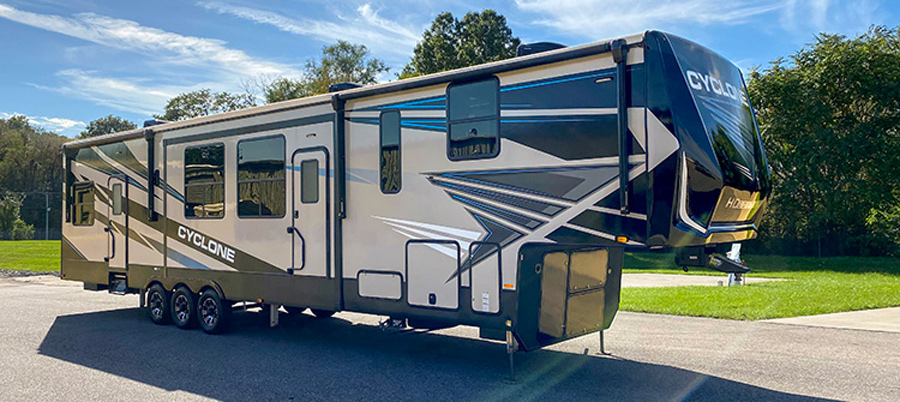

The numbers alone bear this out. Called a “luxury crossover,” the widebody (101 inches) Cyclone 4014 stretches some 46 feet, 7 inches, tip to tail — nearly a foot longer than its closest Heartland sibling — and carries the kind of weight rating (a 21,000-pound GVWR) that requires a tow vehicle with nomenclature like 3500HD in its name.
The biggest number, though, is only evident when the Cyclone’s three slideouts are deployed: the 4014 boasts 480 square feet of living area. That, if anyone is keeping score, is 50 square feet more than the biggest floorplan any RV builder ever rolled out before the RV Industry Association (RVIA) in March 2020 rescinded its Board-mandated limit of 430 square feet for fifth-wheels in set-up mode.
Much of the added length has gone into developing a “true” 14-foot garage, Jones noted, to accommodate the largest of the popular UTV off-road machines. Along the way, power outlets were added to the garage, as was a full second bath. Segmented loft sleeping units sit atop the area, accessed by either the garage or main cabin.
In addition to stretching the Cyclone, which is expected to carry an MSRP of about $150,000 fully loaded, Heartland picked up additional space by redesigning the toy hauler’s front cap. Additional features include moving the entry door to the living area in the curbside slideout and a rarity in toy hauler living spaces: a cross-conversational seating area in the main area with sofas in opposing slideouts. The main bath is on the upper deck and is accessible by both the main cabin and the master bedroom.

“We’re kind of redefining that sharp edge of what’s possible in lightweight campers,” said Cody Schade, product sales manager. “This is a 25-foot completely powder-coated open-top frame, and from the chassis down it’s exactly like a common RV with its I-beam frame, dual torsion axle suspension system, four corner stabilizer jacks and 40 gallons of fresh water.”
But on top of that chassis is where the 10.8 defies description.
For example: a four-seat Polaris RZR ATV can drive right up onto the chassis floor via the rear flip-down loading ramp. Gear boxes on either side of the unit feature a powered Truma cooler/freezer and outdoor kitchen on one side and the Goal Zero power station on the other. Another gear box on the A-frame is for additional storage as well as two 20-pound LP tanks. Meanwhile, the front of the 10.8 features the afore-mentioned platform with a 1,500-pound weight capacity, easily capable of handling the rooftop tent and anyone it would sleep. When the tent and its king-sized bed are deployed off the side, below is another tent for privacy or waiting out the rain.
The real feature, Schade pointed out, is the 10.8 weighs just 2,800 pounds, so even when fully loaded – including a four-seat RZR – it’s less than 5,000 pounds.


The 36SS floorplan features many in-demand elements: a full master bath with a large 50-by-28-inch solid fiberglass shower with shower seat and glass enclosure; a convenient half bath with a vessel sink to provide more countertop space; Adap-Table Dinette; and an extra-long custom sofa bookended with two reclining theater seats from Roadwire. In the entertainment area, the 111-inch-long sofa allows an adult to comfortably lay down to watch TV while providing plenty of room for a companion to relax in the adjoining recliner. The Adap-Table deserves additional mention as it provides dual functionality. When flush against the wall, it’s a convenient workstation or breakfast bar for two. By swinging the table out vertically, it easily hosts a dinner party for four. Both models feature a full flat floor, a design innovation that’s uncommon in the industry, especially in a diesel coach. For owners, there’s no need to step up and over the engine compartment. Additional improvements are in the master bedroom suite, where there’s extra space around the king-sized bed plus a dedicated console for CPAP storage.
Both Frontier models come equipped with the Aqua-Hot 250D tankless water heater to provide ultra-convenience and comfort. The system delivers unlimited hot water and replaces the water heater and furnace, eliminating the need for propane onboard.
In addition, Frontier comes with upgraded standard features including hand-laid solid vinyl Tarkett flooring, residential stainless-steel refrigerator, induction cooktop, convection microwave, solid surface countertops and pantry storage. On the exterior, each model has an entertainment center with an LED TV and oversized patio awning.


The Avenue is a “huge deal for us and our company,” said Coley Brady, Alliance co-founder. “We have taken the last 12 months to really critically evaluate that whole mid-profile fifth-wheel segment in the marketplace. We’ve not only gone to our dealer base and gotten feedback from them, we’ve also gone to the end consumer. And after surveying the landscape, we’ve really come out with a fresh perspective and fresh product with the Avenue.”
Avenue’s key features include its 101-inch wide-body configuration and best-in-class running gear. “On top of that, we’ve done some things with the exterior and interior look that we feel offers a fresh perspective,” Brady added. “And then we’ve done some things construction-wise, too — not only with the wide-body, but with a laminated floor,” he continued. “We’re hitting the weight — ranging from 9,000 to 12,000 pounds UVW — which is so important these days for the end consumer.”
Co-founder Ryan Brady noted the Avenue launched with four floorplans — with more to come — in lengths ranging from 33 to 39 feet, a length that Alliance believes will slot nicely in the ¾-ton tow vehicle segments. “I think the important thing, to reiterate, is what we really focused on in the last 12 months and how this new line is differentiated in the market. If you look at the features and the look, it is absolutely different from our key competitors out there,” Ryan Brady said.
Lengths range from 33 feet, 3 inches to 39 feet, 5 inches, weighing from 11,995 to 14,400 pounds. MSRPs start at $68,000. Alliance is planning to introduce a shorter model as an Avenue sub-brand in the first half of 2022. Lengths will range in the neighborhood of 28-32 feet.


The 20XG is ready for boondocking, he continued, with a power system that features 640-amp hours of lithium battery by Lithionics, 380 watts of roof-mounted solar panels and dual 150-amp alternators on the Transit engine.
“So, whether you’re driving down the road or idling, whenever that engine’s, running it’s charging the batteries. We’ll run everything in the coach off of lithium power. You’re going to get six plus hours of full usage off a full charge,” Saunders said. “Then if you’re at a campground and you have 30-amp service that you can plug into, you’ll charge batteries that way as well.”
Another highlight of the 20XG is its rear cargo area, which runs the full width of the 91-inch-wide coach and is large enough to store two bicycles with plenty of room left over. Above that cargo area is a powered 54-by-80-inch bed that raises and lowers to maximize the storage space. Also, an available package is more geared toward the off-road customer and includes a two-inch lift kit, all-terrain tires, black rims, running boards, front grill guard and a more aggressive-looking graphics package.
The interior of the coach, said Saunders, was inspired by European campervans. “We’ve taken some different design cues doing different wood grains than what is more of a traditional Class C. It’s more modern, more European, and it really opens up the size of the coach. Since it is a smaller coach, having an all-white interior really helps make it feel bigger,’ he said, adding the 20XG offers a full-bath — not the wet bath normally found on motorhomes this size.


Designed with an obvious eye to off-grid living with its increased ground clearance and aggressive off-road tires, the Hitch lineup has expanded to three floorplans in 2022, with a fourth set for production in December. The newest of these is the 18BHS, a 20-foot, 6-inch unit that, while being the shortest in the line, features the first slideout in the Hitch brand.
Like its Hitch brethren, the 18BHS comes fully equipped; its only options are a choice of a new kayak carrier system (it will carry two kayaks vertically mounted at the rear) or a rear-mounted storage box. Everything else — from the 110-watt solar panel, 1,200-watt inverter and charge controller to the electric awning, 4G-capable Winegard 360 Air Pro, gas/electric 4.7-cubic-foot refrigerator, solid-surface countertops, 14,500-Btu AC, 20,000-Btu furnace, USB charging ports throughout and even a sink cover — are standard. So, too, are what Jones called the largest tanks in the segment: 46 gallons for freshwater and 30 gallons for both the grey- and blackwater holding tanks. And then there’s the matter of storage. “When campers go off-grid, they tend to stay out for longer periods of time, so storage is key,” Jones said. “The Hitch has the largest pass-through storage (in its segment) in the industry.”
All this happens in a unit retailing at about $30,000 with a 4,700-pound GVWR. “An RV is a big investment,” said Jones. “Hitch is not only functional, but buyers can tow it with their small crossovers or SUVs.”

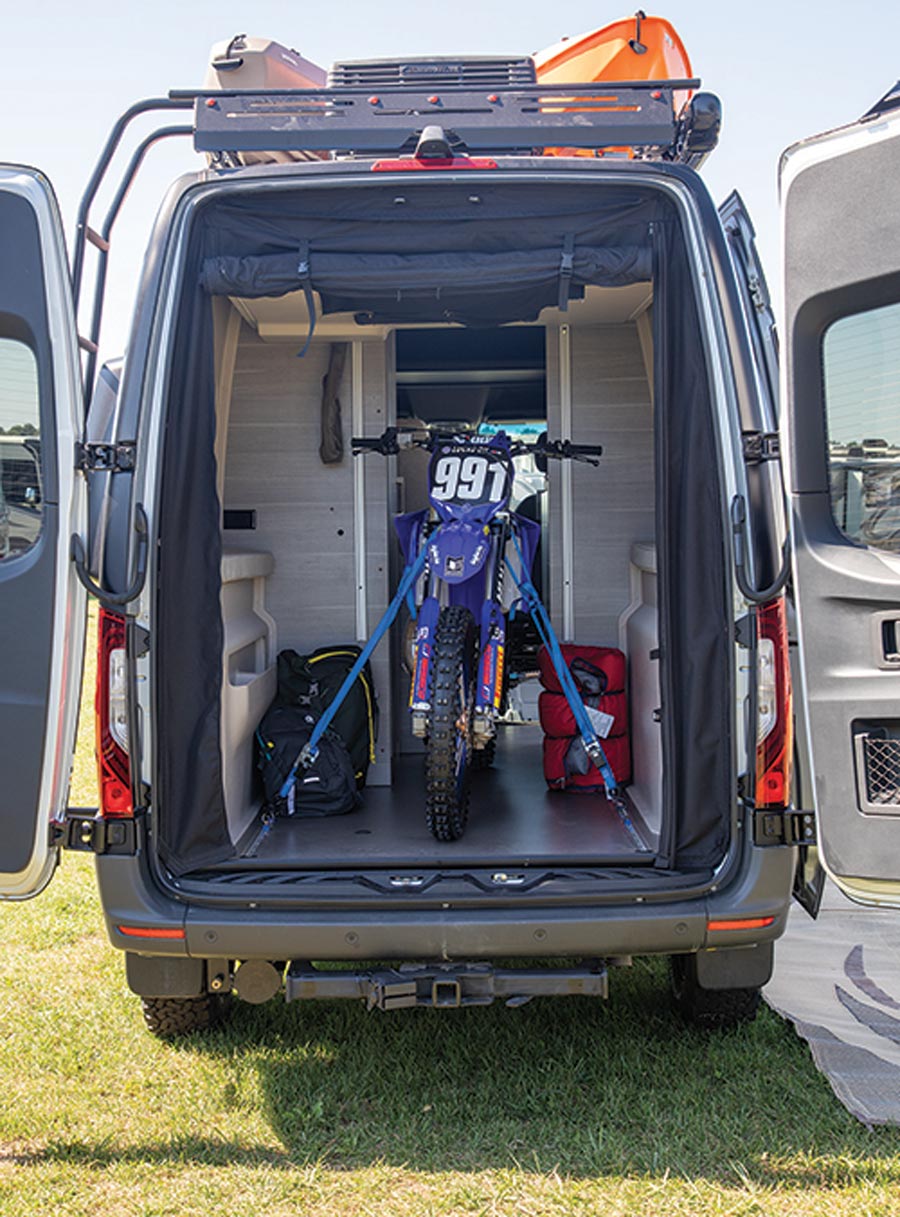
“Since our entry into the van segment we’ve seen tremendous growth. The 4×4 space seemed like an obvious next step for us and we’re all extremely excited with what we’re bringing to market,” stated Nic Martin, General Manager Entegra Coach & Jayco Motorized Group.
With notable standard chassis and exterior components, the Entegra Coach Launch exceeds Class B expectations. Including aluminum wheels with BF Goodrich All-Terrain T/A KO2 tires, 220-amp alternator, 48V Coleman-Mach 10 air-conditioner, Carefree armless power patio awning with LED light strip and wind sensor, double roof rack with moveable ladder, on-board air compressor with front and rear chucks and the E-Z DRIVE ride and handling package (featuring Koni shocks and a heavy-duty rear stabilizer bar), this is truly a full-featured coach.
The well-appointed interior offers custom-molded, vinyl-wrapped ABS interior wall panels, Tecnoform European-style cabinetry, a 3-cubic-foot DC refrigerator, hydronic heating system with LED touchscreen control, multiplex system powered by Firefly and a portable induction cooktop. The power system includes 200 watts of roof-mounted solar panels, 48V, 210-amp hour smart lithium battery providing 10.2KW of power, 3500W inverter and a second 48V alternator dedicated to the lithium battery.The new Entegra Coach Launch MSRP starts at $192,000 and is offered in two optional paint schemes: Aztec partial paint (Silver van only) and Forest Glade partial paint (Sandstone van only).
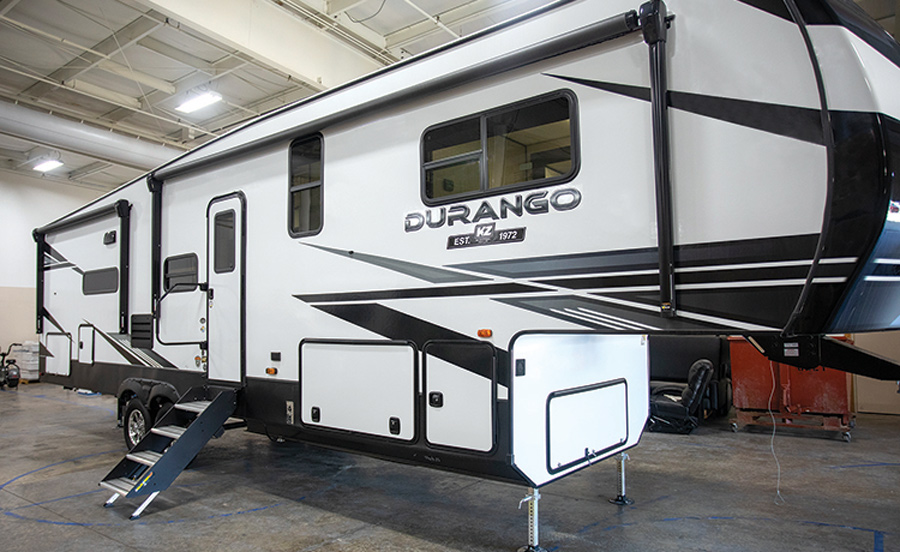

What he and his team came up with is a floorplan with dual motorized bunks in a room at the rear of the fifth wheel inside a hatch door. The two 56- by 80-inch beds are raised and lowered via a Happy Jack setup. “Nobody in North America has ever done two beds,” Frohman said. “There’s a switch that actually runs them up and down.”
When the beds are in the up position, the 6- by 6-foot room, equipped with a television, is available to store bicycles or a kayak while on the road and then can be used as a patio once at the campsite.
Inside, more whites and gray tones brighten the upgraded interior and the kitchen features a 24-inch oven, convection microwave and 12-cubic foot gas-electric RV refrigerator. KZ went with name-brand entertainment components, including a JBL soundbar and Sansui TV, Frohman said, adding, “all of our TVs are smart TVs this year.” The bedroom, meanwhile, houses a king-size bed while the bathroom is equipped with a one-piece fiberglass shower.
A premium solar package is available, offering 440 watts of solar panels on top, expandable to 880, with a 240-amp hour lithium battery, a 30-amp MPPT solar charge controller and a 2,000-watt inverter. The aluminum-framed 35-foot, 2-inch Durango D311 BHD weighs 10,170 pounds unloaded. MSRP will be in the mid-$70,000s.


The growing trend to go farther off-road in the RV segment prompted Mark Badgerow, designer and founder of Mission Overland, to design the first teardrop-sized camper with major off-road capabilities — one that you also can stand or sit upright inside.
While those features are a major differentiator in this market, the Summit also boasts many systems that allow for comfortable off-grid adventures. These include a 37-gallon freshwater tank and propane-fueled forced air heating and hot water system by the industry-leading Truma Combi as well as a 12-volt DC Truma dual-zone 69-quart refrigerator. The slideout kitchen offers hot water at the sink, as well as a dual-burner propane stove for cooking in the great outdoors. The Summit can accommodate sleeping up to four inside.
Coupling those attributes, along with independent suspension by Timbren, 1.5-inch foam-filled aluminum composite walls, full skid-plated chassis, 33-inch tires and a fully articulating hitch, this trailer was designed to take campers where they want to go, in comfort. This complete package weighs in at a nimble 2,350 pounds, which means it is easily towed by most vehicles. But make no mistake, no short cuts were taken to construct this fully RVIA-certified camper.

“The goal back when we started toying with this idea, was to think about how people use truck campers — and we thought it’d be great to be able to fish off the back of it, or hunt off the back of it, or take it to take it to a racetrack and just be up off the ground and have your own little extra living space,” explained Ben Meloche, general manager.
The rear patio also features an outside refrigerator and TV entertainment area, making it quite the spot for enjoying the great outdoors.
“It sounds strange, but everyone is super excited because, again, it’s out of the norm. It’s something they haven’t seen,” Meloche said, adding the rear patio carries a 1,500-pound weight capacity.
Designed to be carried by a 1-ton truck with an 8-foot bed, the 2912 weighs in at just under 3,500 pounds — which is only 17 pounds heavier than what previously had been Palomino’s heaviest truck camper. When deployed into patio mode, the 2912 measures 20 feet in length. As far as the interior of the truck camper itself, Meloche said it comes fully loaded including solid surface countertops, couch and TV, among other amenities.
While the camper itself is a side entry, access to the rear patio is from inside the unit. “Our main focus in our truck campers has been rear entry, but with this floorplan we didn’t want customers to have to put the ramp back down to get into it,” Meloche pointed out.


Impressive safety features include a top-mounted LED light bar with a cover, keyless entry, a back-up monitor and adaptive cruise control. In addition, convenient hands-free control of Apple CarPlay and Android Auto on the large 10.25-inch MBUX multimedia screen is integrated with the tilt and telescoping steering wheel’s control buttons.
Tranquility’s two floorplans, the 19P and 19L, highlight the modern ruggedness of the 4×4 chassis. The 19P floorplan has rear bench-style seating with seat belts for three that electronically unfolds into a sleeping area. With an enclosed wet bath, ample kitchen, and forward seating, the 19L also features an available Froli sleep system in the rear sleeping area and features large pull-out side trays. Both floorplans have Tecnoform Euro-style cabinetry, available in either “Metallic Gray” or “Radiant Silver,” with corresponding cool-tone interior décor.
Rear and entryway screen doors and large opening side windows provide fresh air and plenty of natural light, making the transition from indoor to outdoor living seamless. An exterior table folds out directly underneath the Thule powered patio awning. Portable or wall-mounted, a JBL Flip speaker plays high-quality audio once connected via Bluetooth to a favorite device or smartphone.
The Tranquility is destined to get off-the-grid with a 190-watt solar panel to help maintain a charge on the Re(Li)-able lithium battery package. The system’s 400-Ah lithium battery comes with a Balmar 170-amp alternator, delivering plentiful charging capabilities even at idle. And, for places a motorhome cannot go, travelers have a standard Thule bike rack with room for two adult-size bicycles.


Even still, Grand Design has come out with the 341RDS model in the standard fifth-wheel line. Just shy of 37 feet long with a UVW pegged at 10,910 pounds, the 341RDS is a three-slide, rear-den fifth-wheel that is all about comfort and functionality.
The rear den features opposing slides housing tri-fold sofas that flank the rear entertainment center, offering a 50-inch TV above a 48-inch fireplace set opposite theater seating. The off-door sofa slide also contains the kitchen pantry, microwave, stovetop/oven and 16-cubic-foot refrigerator. A center island with stainless-steel sink as well as a dining area complete the mid-fifth wheel layout.
For the dining area, Grand Design has incorporated a sliding table system that offers a wide range of flexible uses. “With people working remotely, e-learning or even just people that like to do a lot of entertaining with guests inside of the unit, we wanted to create a space in the kitchen that can be converted from a table and chairs for four people to sit,” explained Tony Lizzi, product manager for Reflection travel trailers and fifth wheels. “If there’s only two people, it can be sucked back in the cabinet base so they have more of a walkway, or it can slide from side to side to create an L-shaped desk or buffet-style serving for when you have guests over.”
Up front, the 341RDS offers a three-piece bathroom, bedroom with a 60-by-80-inch queen bed (king bed is optional) set inside the coach’s third slideout and a very large wardrobe with washer/dryer prep tucked into in the front cap.

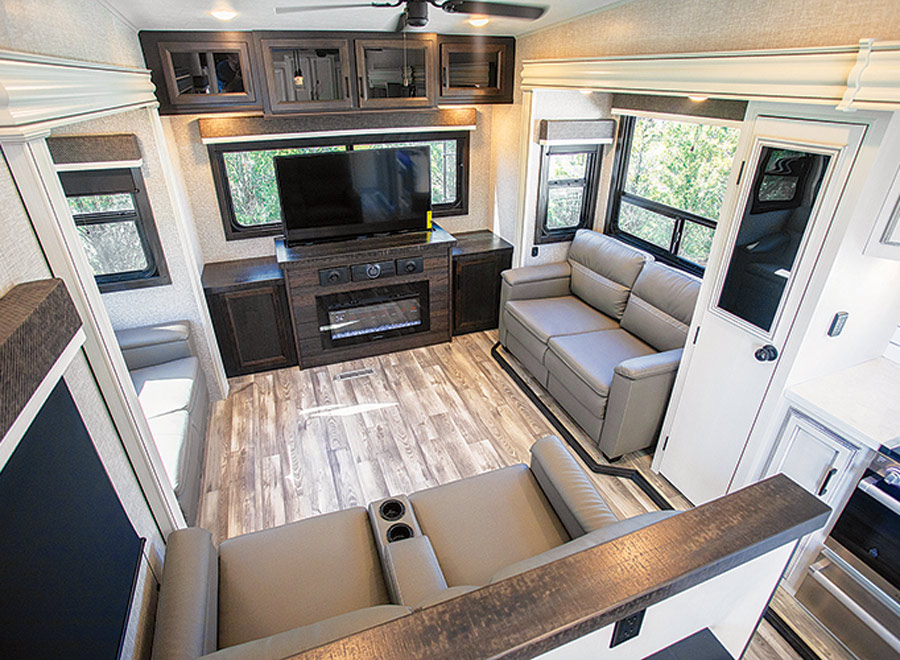
By redesigning the dining area near the unit’s entryway into a bar-height eating area with solid wood table, two bar stools and a bench — plus raising the wall separating it from the rear den — the area allows for separate conversation from anything going on in the den. It’s a great way to partially segment “living spaces” in a relatively short 37-foot, 7-inch unit.
The rear den itself was designed with maximum window area to provide as much natural light as possible. “That’s why we went with a TV on a lift,” said Jason Martin, director of product development for Jayco. “When not in use, it doesn’t cover up the large rear window.” The den also features opposing trifold sofas and distressed woodwork.
Jayco established the now-popular “modern farmhouse” interior, and this year is taking it away from a “country” look to a more contemporary aesthetic. Upgrades include new colors to the vinyl flooring, solid-surface countertops and backsplashes, contrasted by black appliances (including a new 30-inch OTR microwave). There also are dabs of contrasting navy blue in the master bath.
Outside, all Jayco units are now prewired for an inverter. If, like the 335RDOK, the unit comes with an outside kitchen, the refrigerator is wired to the inverter for the RV’s residential refrigerator — so it’s cold by the time you get to your destination. The outside kitchen also includes a griddle and platform tying into the G-port hitch-receiver system. The fifth-wheel also sports internal tire-pressure monitors that communicate with Jayco’s J-command smart system.

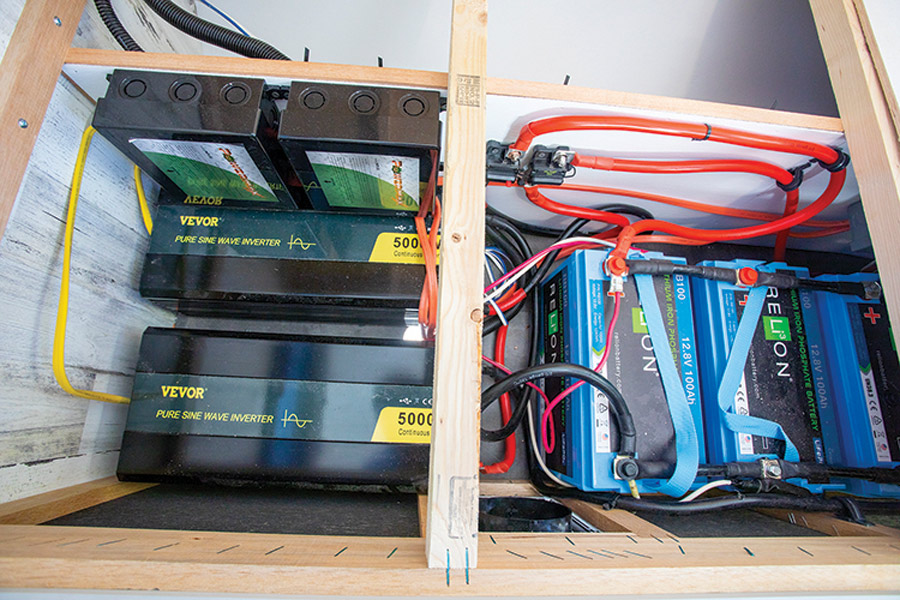
In partnership with supplier Way, the Rove EV is equipped with 360 watts of solar panels on top, a solar controller, two 5,000-watt inverters and a bank of six RELiON lithium-ion batteries — for a total of 600-amp hours in the battery bank, according to Steve Holt, a tech rep from Way. Two transfer switches provide two circuits of alternating current and if a user does plug into shore power, the transfer switches seamlessly bypass the inverters.
“We wanted a coach that you could go out, off grid, and be autonomous — for good,” Rebar said. “You don’t need to worry about gas. You don’t need to worry about a generator. With the bank of batteries, the inverter power and the solar on this unit, you can go off grid and not worry about it.”
The Rove EV specs are similar to Travel Lite’s original Rove Lite, but the EV is heavier because of the solar options. It comes with a Perfect Aire 5,000 BTU air-conditioner that the solar system will run continuously for nine hours. Also onboard is a 3-cubic-foot, 12-volt DC Everchill refrigerator, Greystone single-burner induction cooktop and a Greystone 5,600-watt fireplace that’s rated to provide heat for up to 400 square feet.
The solar system also runs the EV’s electric tankless water heater and power awning. Other features include a wet bath, woodgrain cabinetry and solid-surface table and countertops. The Rove EV is 19 feet, 6 inches long and weighs 2,086 pounds. The $8,000 pass-through cost of the solar package pushes the MSRP to $34,900.
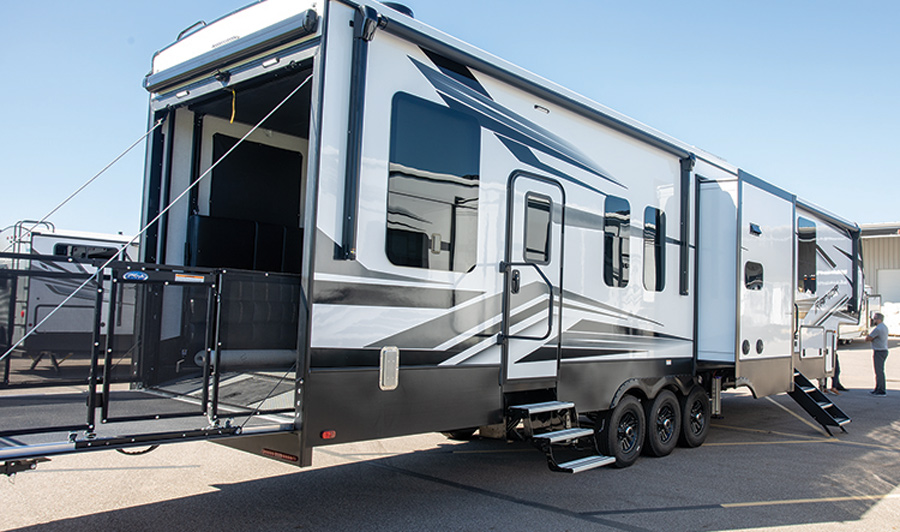

The most striking feature of the Raptor 420 is the massive upper deck bath and bedroom suite. Unlike other toy haulers, the bathroom is located at the front of the unit. The impressively sized bathroom features a 28-by-40-inch shower, 42-wide vanity, a full-width walk-in closet with bench seating, shoe storage and shelves. An east-to-west king bed is located rearward of the bath.
Another selling point of the floorplan, note Keystone managers, is the large front pass-through storage made possible by the expanded upper deck. At 53 inches and about 5 feet in length, this is nearly twice the size of other Raptor front pass-throughs.
For its part, the living/kitchen area has a 97-inch sofa with built-in recliners, an angled entertainment center for easy viewing, kitchen island with flip-out stools, stove, convection microwave and an 18-cubic-foot refrigerator. A half-bath is located off the garage. As for tank capacities, the 420 is ready for anything with a 94-gallon freshwater tank and 82 gallons each for the gray and black tanks, respectively.
The 420 joins a Raptor lineup of no less than nine models ranging from 39 feet to the 420’s 44-foot, 6-inch configuration. Dry weights range from 13,373 pounds up to 15,887 pounds, and exterior heights top out at 13 feet, 6 inches.
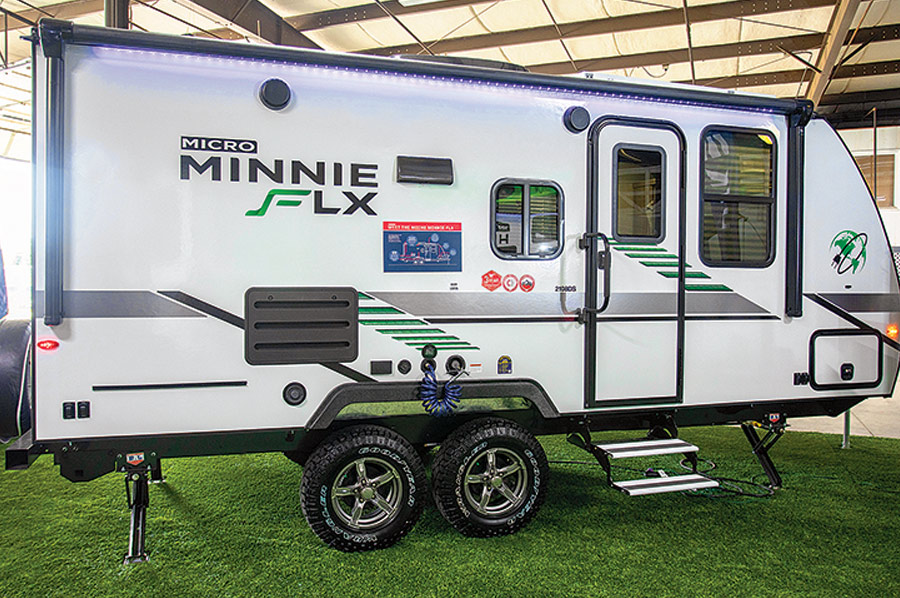
The FLX package, available across the Micro Minnie line, “is derived from working with our brand ambassador, Traveling Robert (Robert Morales),” Chistofferson said. “Traveling Robert has over 200,000 followers on YouTube. He’s a ‘grassroots’ guy and he is currently in his third Micro Minnie. So last year he was in a 1708FB, had some solar, had a smaller lithium battery, had an inverter and a Truma AquaGo water heater.”
But, added Christofferson, Morales and Winnebago wanted to be off the grid longer, so designers came up with an electrification package that would allow the Minnie to be unplugged and off-grid for up to five days.
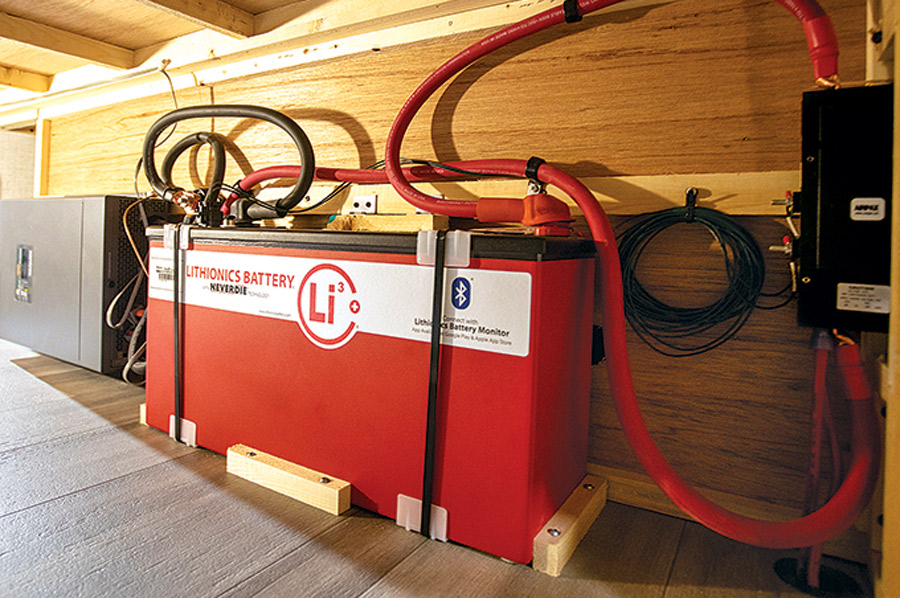
“What that electrification initiative is, is a 320-amp-hour lithium battery, a 3,000-watt inverter,” he said. “We have 2,190 watts of solar panels on the roof, a 30-amp MPPT charge controller as well as side-mount solar prep, so that way customers can add portable solar if they choose.” Electric items on board are all the most efficient available and propane is still used — but, again, leaning toward high efficiency, include a AquaGo water heater and VarioHeat furnace from Truma.
Other features include a queen bed, spacious galley, large private bathroom, stainless steel sink, three-burner cooktop with oven, external patio speakers and external TV hookup.
The Micro Minnie with the FLX package is offered in four floor plans – two couples trailers, a bunk model and a bunk/Murphy bed model. The Micro Minnie FLX 2108DS is 25 feet long with a 4,000-pound dry weight. MSRP is approximately $52,000, with the FLX package adding $13,000 to the cost.
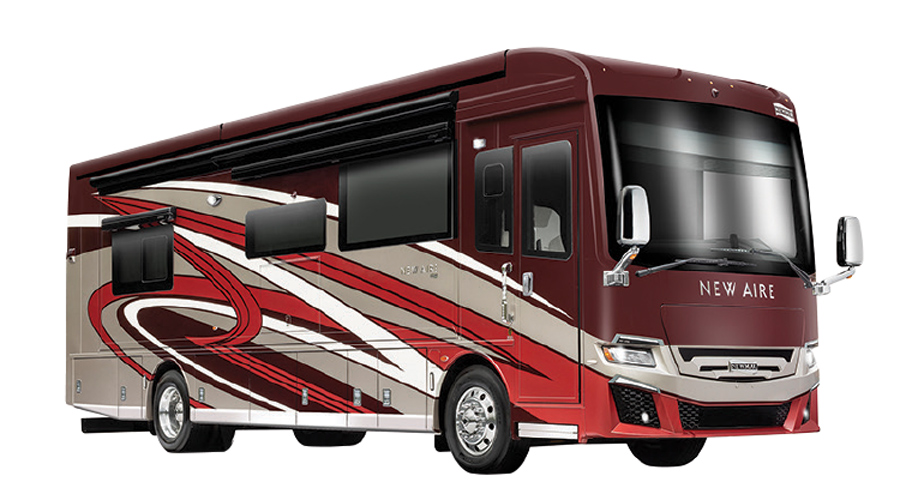
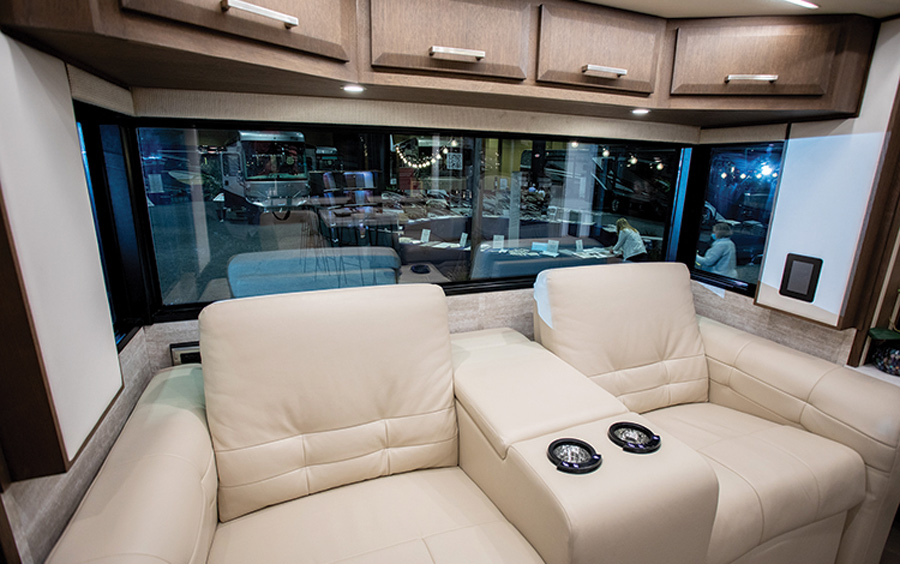
“They’re (New Aire and Bay Star) reskinned on the outside, with new front and rear caps and new instrument panels, but really it’s all about the design cues on the interiors of these two coaches. Whether it’s the slideout fascias, the feature ceilings, the lighting hardware, the cabinet doors…basically all the interior design features are all new in both of these brands, and we’re really excited about them,” said John Sammut, vice president of sales and marketing.
As mentioned, the 2022 New Aire offers a host of new styling features including a lighted Newmar badge on the front cab. Of the line’s three 35-foot models — all feature a 450-horsepower Cummins L engine and10-inch Xcite dash monitor with the new Nav N Go navigation system — the 3543 was singled out. The motorhome features a nearly full-wall slide along with two others on the off-door side, one of which houses the 72-by-80 king bed and the other an 87-inch sofa surrounded by panoramic windows. The full-wall slide includes a Euro-booth dinette in front of a TV on a power lift, galley-style kitchen and dresser below another TV in the rear bedroom. A three-piece bathroom opposite the kitchen completes the layout.
Sammut singled out the panoramic windows in the slideout for further mention. “These windows are not only larger, but they actually meet up with the windows in the end walls of the slide room,” he said. “They appear to be one continuous window that wraps around the three sides of the slide room — it’s really quite dramatic.”
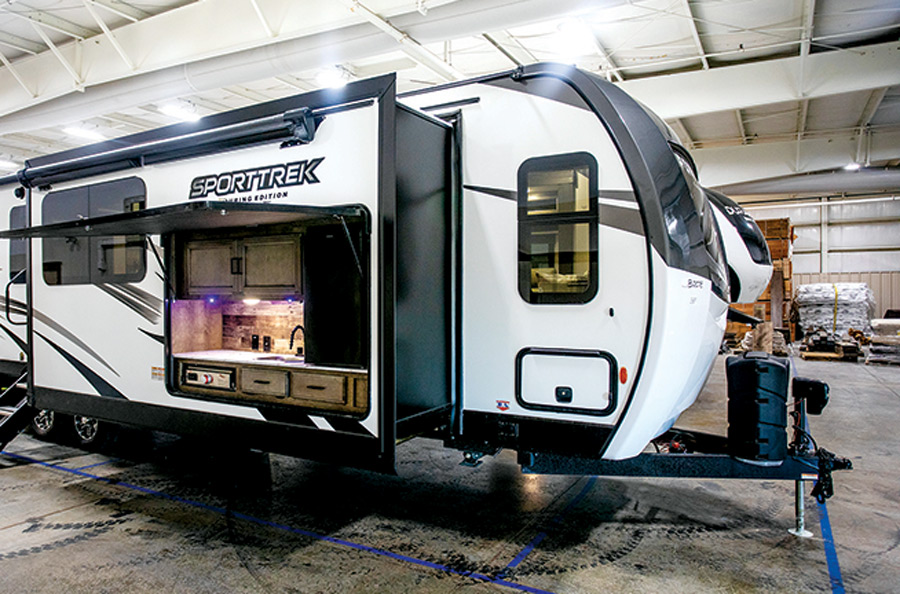
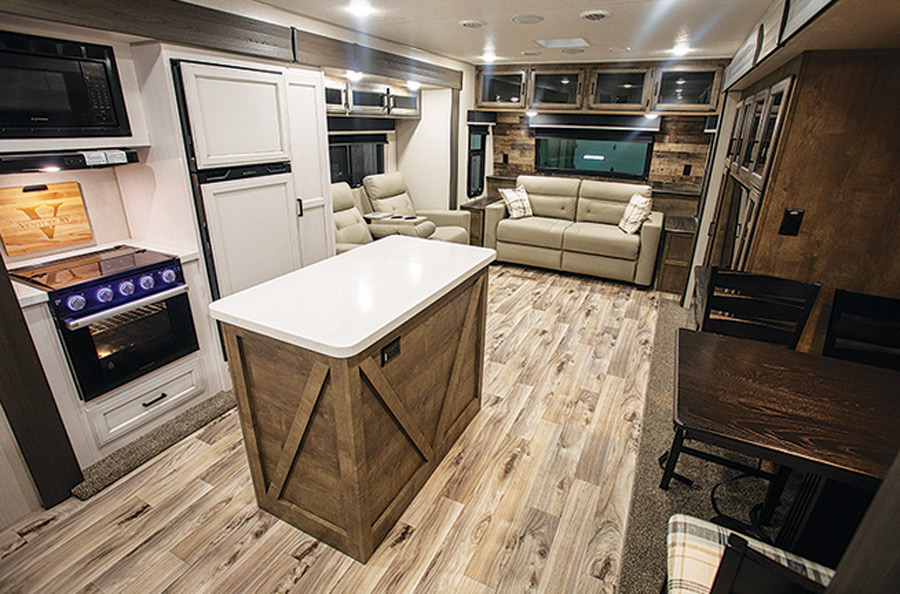
To that end, the 333 is built around a fifth-wheel layout, with an island kitchen, plenty of counter space and hidden storage, a dinette table with a large window in the slideout, a viewing area across from the entertainment center and a living room separated from the kitchen and dining area.
The three-slide unit accommodates a king bed in the back, with a large dresser and plenty of storage, while, outside, two awnings provide shade for almost the entire length of the trailer. Another big feature is the outside kitchen in what’s otherwise considered a “couples coach.”
“A lot of outside kitchens come in bunkhouses because you have kids,” said Boggs. “But if you don’t have kids, that doesn’t mean you don’t want an outside kitchen.” Inside, he added, “You get the amenities of a fifth-wheel with the king-bed slide and storage back there. The bathroom’s close and there’s a big living area with an island kitchen.” Washer and dryer prep — another fifth-wheel staple — also is included. According to Boggs, the unit is attracting buyers from across the spectrum: First-time buyers, owners moving up to a larger unit, previous fifth-wheel owners looking to downsize and even extended-stay customers.
“The guys who want to take this on the road and do their computer work and work on the road,” he said. “Basically, they can take this out and go from campground to campground, just hook up their laptop and work from here. They have all the amenities of home.” The Venture RV SportTrek Touring 333 VMI is 36 feet, 11 inches long with a dry weight of 8,800 pounds. MSRP is $62,000.


“In all honesty, the Ambition’s been seven years in the making,” said Chase Davis, national sales manager. “I don’t want to oversimplify it, but the Ambition is a Beacon with a 13-foot garage in the back.”
The Ambition includes all the features that a Beacon has standard, Davis explained, including full-body paint, dual-pane windows and the interior woodwork finishing that people have become accustomed to with Tiffin products. Specs on the 399TH include 16,900-pound dry weight, 21,000-pound GVWR and 3,500-pound pin weight. Tank capacities top out at 110 gallons for fresh water and 90 gallons each for gray and black.
Other notable features include (and we’ll let the spec sheets take it from here): Triple 7K Axles with Westlake G-rated tires and disc brakes (optional 8K axles); Road Armor suspension; Truma On-Demand water heater; Rockford Fosgate premium audio system; Happi-Jac bed system in garage; Hidden Hinge F.A.S.T. ramp/patio; Spyder Multi-Plex; generator prep; dual 15,000 Btu air-conditioners (one with heat pump); Thule legless awnings; Super Sofa by Franklin Furniture; InterVac central vacuum system; Insignia oven; convection microwave; LG residential refrigerator; 1,000-watt pure sine wave inverter.
Oh, and there are LG “smart” TVs — in the living room, bedroom and garage.

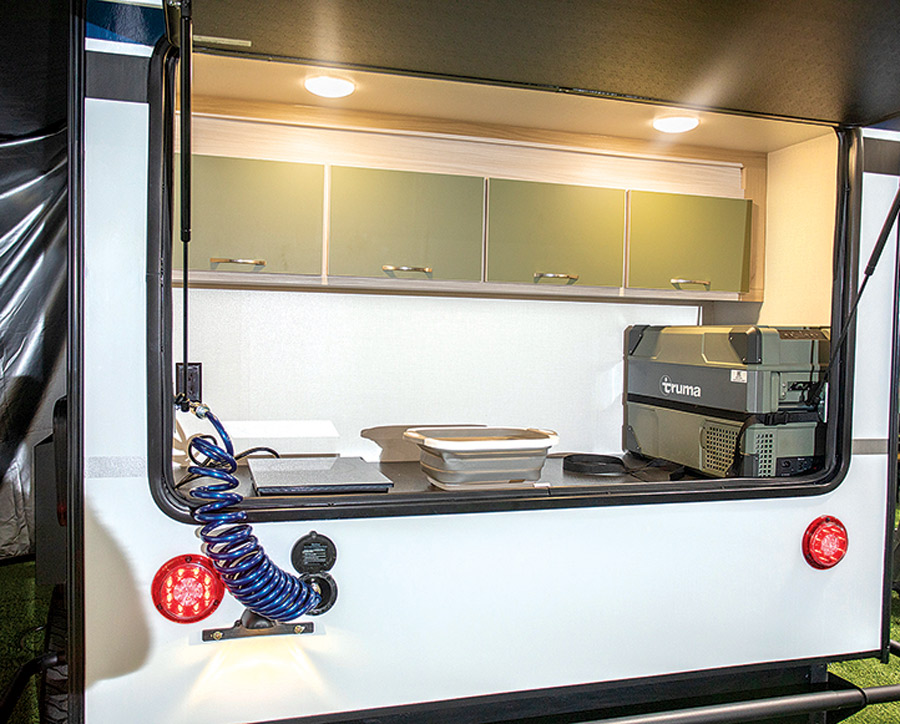
The new unit still has the patented exoskeleton of earlier versions, said Adam Christofferson, senior product manager at Winnebago Towables, “but what we found is we were challenged within the single-axle market, with getting something that was lighter in overall dry weight so we could have more cargo-carrying capacity.”
According to Christofferson, the new lighter, more compact Hike 100 single-axle series opens Winnebago Towables up to consumers with different tow vehicles. The 16-foot Hike 13 featured here, for example, comes in at a svelte 2,700 pounds.
Winnebago took consumer desires into strong consideration when designing the new Hike including more storage, sleeping space and especially outdoor living space. Outside living space includes a standard power awning on the patio side and a manual batwing awning at the rear and off-door side providing nearly 200 square feet of covered awning space. An outdoor shower space is also included under the batwing awning. Meanwhile, the rear outdoor kitchen offers a portable induction cooktop that can be used inside or out, a convertible cutting board and sink and a Truma portable cooler, which can be taken along on excursions away from the Hike.
Inside, there is an under-mount stainless-steel sink with a sink cover for more counter space and a high-mount faucet with a pulldown sprayer. There are no speakers inside or out, but the Hike is equipped with a portable Bluetooth speaker with a dedicated docking station and integrated USB ports. There is a cassette toilet in a newly designed wet bath. A fixed bed and a loft bed are included with a cargo net to store gear. MSRPs will start under $30,000.


Traditionally, PRMVs are hard-sided units that look like smaller versions of much larger manufactured homes, but Cavco flipped the script with this recent model that features a large, tented section on the front end — akin to more of a “glamping” structure.
“We see that there is business for glamping tents and tipis, so our thought was to build a park model, put a nice bathroom and kitchen in it and then, on the porch, give people the ability to put whatever they want on it,” said Tim Gage, vice president of park model RVs and cabins for Cavco. “This unit has a tented area, for example.”
The company teamed up with Bushtech, a safari tent manufacturer based in South Africa, to create the tented section of the unit. The tent is designed to last for decades, according to Gage. It comes with the RV Industry Association’s seal of approval and meets the size requirements to be a PMRV, he noted.
The unit features a master bath and an outdoor shower at the rear of the unit. While the PMRV does not include a full-sized kitchen, it does have a microwave, refrigerator and sink, along with cabinetry near the rear of the tented area. A queen-sized bed, along with a dresser, TV and other furniture make up the living space under the tent. There is even room for a porch at the front of the unit. An AC/heater split unit comes standard.