


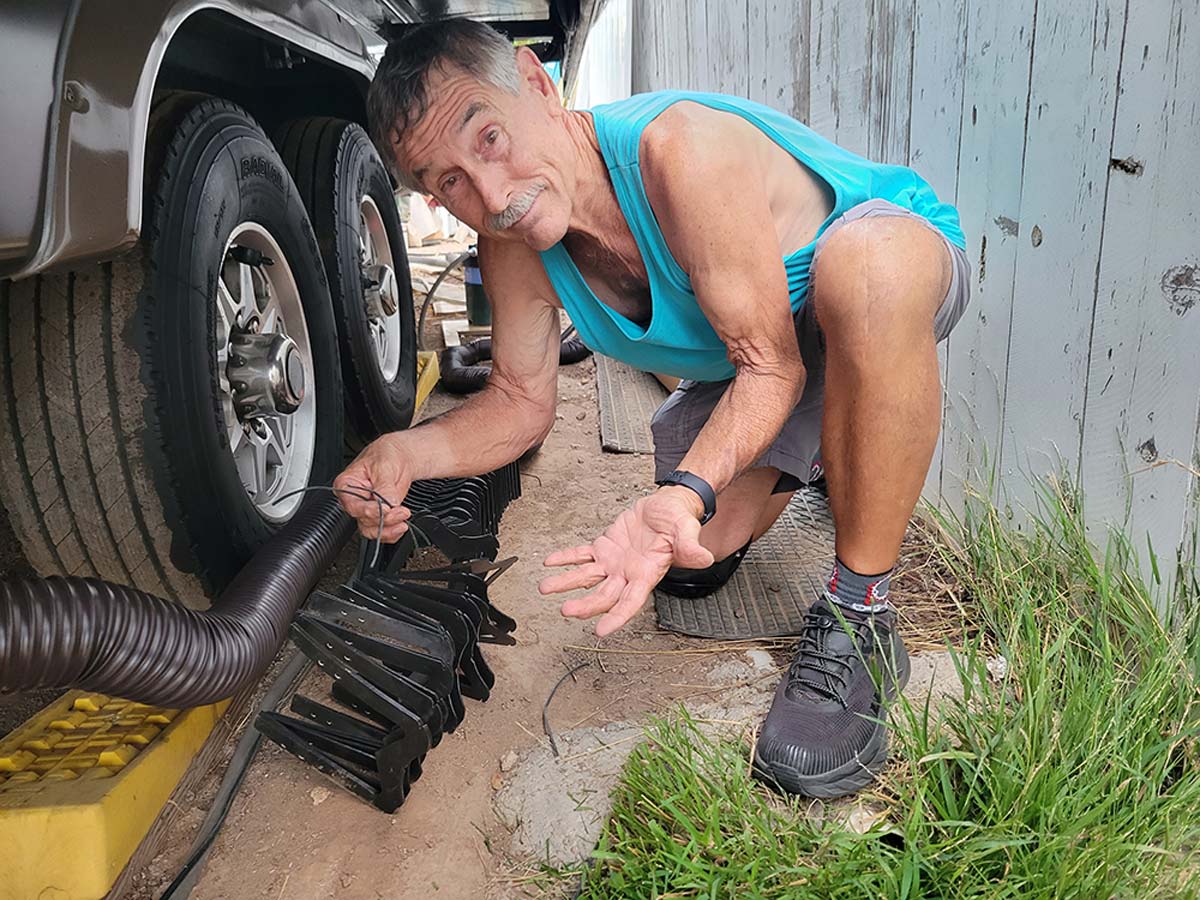
Placing the sewer hose on the support always resulted in a jumbled mess. The original ties were hard to install and did not keep the hose in place, especially when the support was on unlevel ground.
xtending a sewer hose as part of the hook-up process in an RV park is just part of the deal. In fact, in some places (like Oregon), state law requires that your sewer hose be always off the ground. Then, of course, there are those sewer inlets in parks that simply defy physics by extending the hook-up point above the ground — making it necessary to manually lift the hose off the ground so that the contents run downhill.
To overcome these obstacles, RVers use some sort of a sewer support to position and contain the sewer hose. I carry a Valterra 25-foot Slunky Sewer Hose Support (valterra.com), but there are several other excellent choices out there, including Thetford’s Titan Sewer Hose Support (thetford.com), Camco’s Sidewinder Sewer Hose Support (camco.net/home) and Lippert’s Waste Master Flow Down RV Drain Support (store.lci1.com). All can usually be found on amazon and at RV supply stores.
The problem I have experienced — and others probably have, as well — is keeping the hose from falling off when the support traverses unlevel ground. In the case of the Slunky, the provided straps were difficult to handle.
Looking for a solution took some doing. I could always use cable ties, but they would have to be cut off each time to remove the hose; that seemed wasteful and hardly cost-effective. I tried hook-and-loop straps, but they were bulky to use and picked up dirt, which compromised the “stickiness” — and they came apart easily. Then I stumbled on silicone zip ties on Amazon.

Previously, keeping the hose in place while wrestling with the neoprene straps that came with the Slunky was a comedy routine. Trying to keep the hose in place on the snake-like support was frustrating, because the slots built into the Slunky are so tight that working the straps into position causes the support to flop around and the unsecured portion of the hose to fall off. The silicone zip ties, on the other hand, require little effort to lock in place — and they will stretch to 26 inches, if need be. These silicone zip ties even civilized the sewer hose when doing the “wild thing” during when dumping.
After receiving the silicone zip ties, I also found several other uses for them around the RV, including wrapping the water hose with foam plumbing insulation when in areas subject to sub-freezing temperatures. They are also great for organizing hoses and other cables like those for a portable satellite dish. You can even use these zip ties to wrap whole chickens for cooking in a barbecue; the food-grade silicone can withstand temperatures up to 400 degrees.
Of course, knowing that, my girlfriend immediately grabbed a few of them so that she could put them in the kitchen before they got dirty. Maybe you should buy two sets.


If you spend time in cold weather, it may be necessary to insulate the water hose that’s hooked up to the park water supply. The silicone zip ties are great for securing foam plumbing insulation around the hose, especially where there’s a curve in the routing. You’ll find plenty of other uses for these zip ties around the RV.