

Plugging the Gaps
nyone who has worked around cars and metal probably is familiar with J-B Weld bonding products (jbweld.com). They are go-to “epoxies” touted to provide the “World’s Strongest Bond” — and they work. One of my first encounters with J-B Weld was more that 40 years ago when brain flatulence possessed me into drilling a hole in a vehicle gas tank in order to mount a clamp for a wire cable. Yup, pretty stupid, but J-B Weld saved the day and held to the day the vehicle was traded in.
More recently, a couple of places on my fifth wheel’s front cap became damaged because of flying rocks. It’s important to seal any holes immediately to prevent moisture intrusion and J-B WaterWeld made short work of plugging those holes.
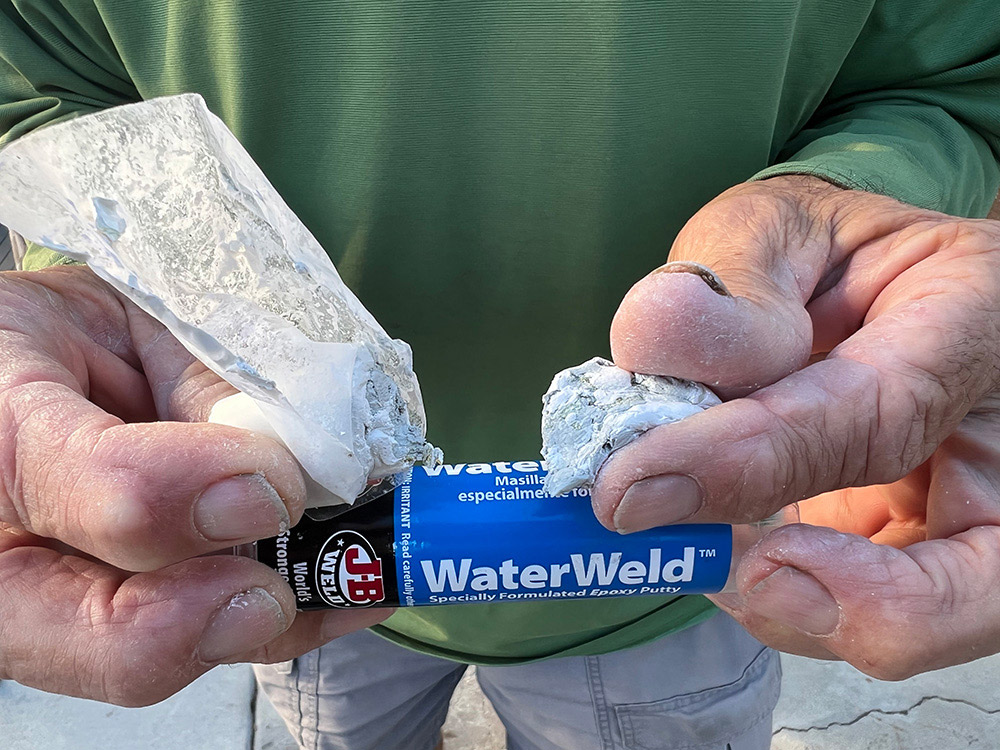
Although J-B Weld is known commonly for its two-part epoxy, the company’s Epoxy Putty is better suited to repair holes or cracks on a vertical surface. Gravity will likely cause the thick liquid-type epoxy to run and create a mess, while the putty will stay in place and set up without dripping. The WaterWeld Epoxy Putty comes in a stick form and, after cutting off a suitable amount to do the job, it’s kneaded with your fingers until the outer and inner compounds are completely mixed together. It’s best to wear gloves, but if you want better control, any residue on fingers can be removed with alcohol — just don’t wait too long. Still, use caution because some people’s skin can become irritated due to possible allergic reaction. The WaterWeld putty becomes waterproof after a one-hour curing time; it can even be applied under water without compromising the curing process.
WaterWeld putty has many uses and since it’s off-white in color, it blends somewhat with my front cap gelcoat. Once cured, the putty can be sanded and painted to match any exterior color. It takes about 15-25 minutes to set up, depending on ambient temperature, and after curing is said to withstand pressure to 4,370 psi and temperatures of up to 240 degrees F.
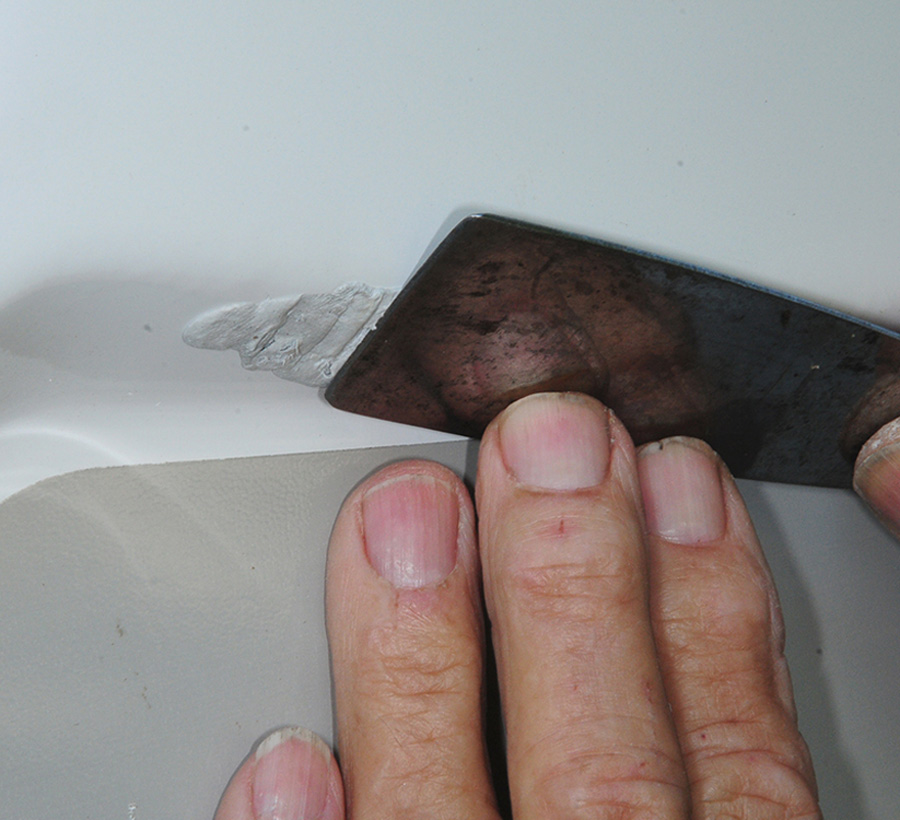
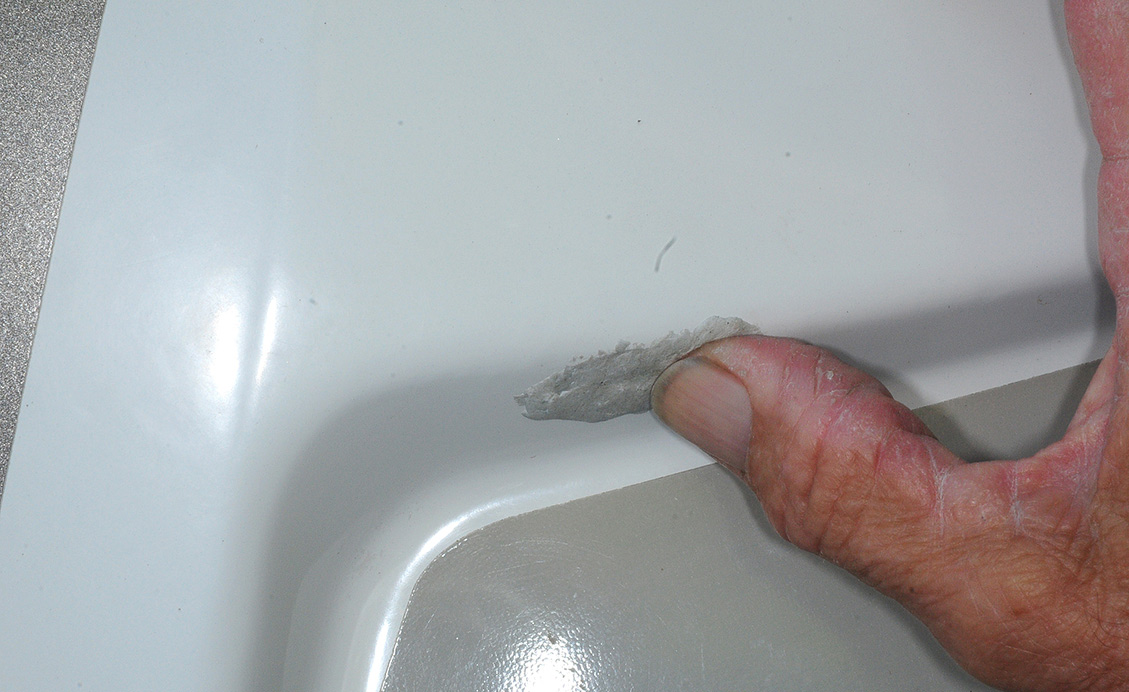
For this repair, the hole was first cleaned out using a pointed knife to remove any loose/hanging fiberglass; if the surrounding surface is dirty, clean it with alcohol. Next, the kneaded putty was pushed into the offending hole and sculpted with a putty knife. The whole process took less than 15 minutes — and after an hour, the putty was rock-solid. From there, just sand it smooth.
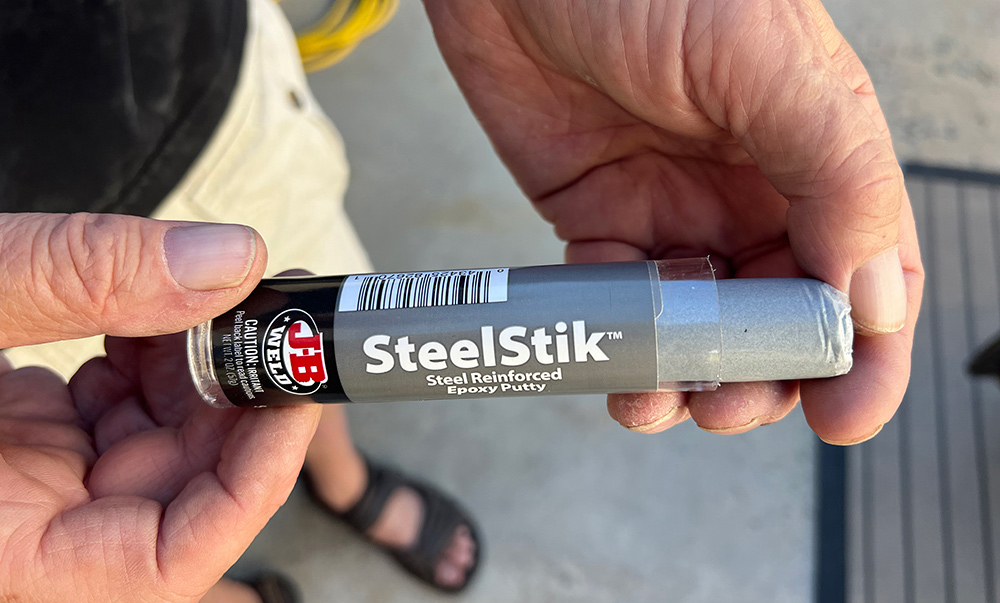
Since I’m a strong believer in Murphy’s Law, I also carry a J-B Weld SteelStik in my bucket of glues, silicone and other items necessary to make repairs. The SteelStik is great for making repairs around the RV but is gray in color. It sets up faster (five minutes) and cures in the same one-hour time frame as WaterWeld. Both versions are available at most auto parts and home improvement stores and online; figure on paying about $8 per stick.
Over the years, I’ve used J-B Weld to make all sorts of repairs resulting from failures and/or self-induced mistakes. I don’t travel without these putty sticks.