

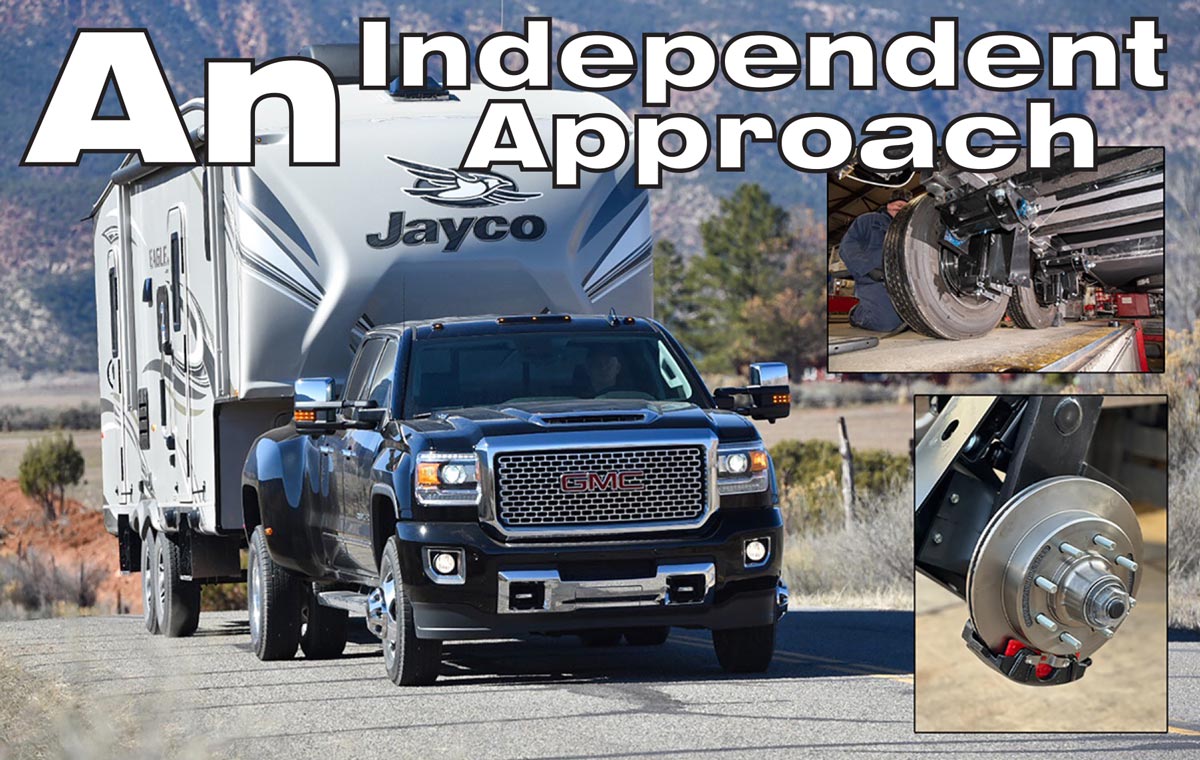

An Independent Approach
[maghub_sidebar]
An Independent Approach typography over an image of a truck pulling a trailer, with additional images showing close ups of the wheels
An Independent Approach
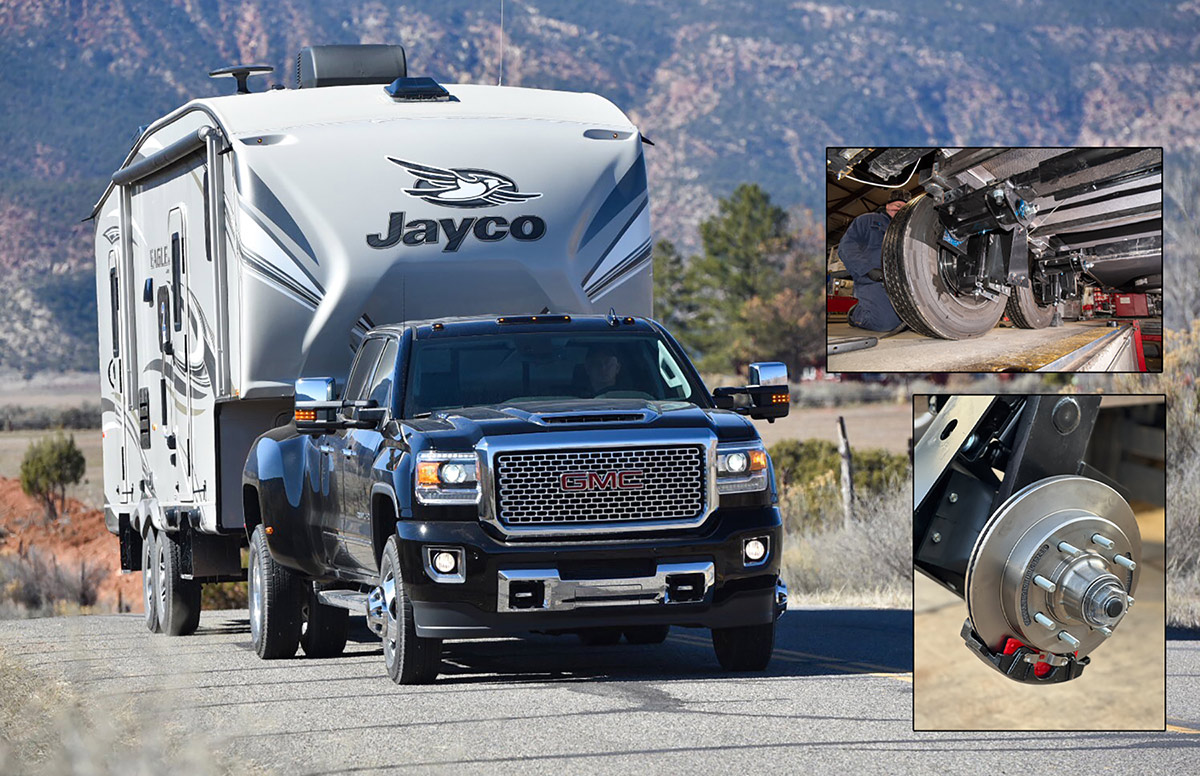
jayco trailer on truck with close up shots of wheels and rims
MORryde’s Independent-axle conversion softens the hits larger RV trailers take on the road
By Bruce W. Smith / Photos by the author
T

oday’s larger travel trailers and fifth wheels are truly houses on wheels. They offer all the amenities needed to provide a comfortable place to stay during a weekend getaway, going on a long vacation or even being used for extended stays. The downside is these RVs take a constant pounding when being towed over rough roads, which are all too common across the country — and those hits from the stiff solid-axle trailer suspensions take a heavy toll on the trailer and everything inside.

“The (OEM) leaf-spring/solid-axle suspension system under RV trailers really isn’t good enough to protect the house on wheels from damage and road shock,” said Jack Enfield, sales and marketing manager at MORryde International, an industry leader in RV suspension systems.

As Enfield pointed out, unlike the abundance of suspension travel afforded in the pickup trucks doing the towing, the typical RV trailer leaf-spring suspension only has about 2 inches of total travel. When the trailer is loaded up, that suspension travel is limited to about an inch.

That’s like having no suspension at all to soften the hits.

“That’s why we developed our Independent Suspension (IS),” said Enfield, who is an avid RVer himself. “Our IS system provides more than five inches of suspension travel, which significantly reduces that road shock and the damage it does to the trailer and its contents. The rubber shear springs in our IS system also reduce road-induced vibration, which takes its toll on everything inside the trailer.”

fifth wheel hampered by the stock leaf-spring suspension
While this Grand Design Solitude 310GK benefitted from an earlier addition of MORryde’s rubber-cushioned CRE3000 leaf-spring equalizer to reduce road shock, the 15,000-pound GVWR fifth wheel was still hampered by the stock leaf-spring suspension.
larger travel trailer on bridge
Potholes, road repairs and transitioning from one surface to another — such as with this bridge-to-road shift — can take their toll on larger travel trailers and fifth wheels due to the vehicle’s stock suspension limitation.
Trailer Suspension Road Shock
So how does road shock affect the trailer? You feel it. You see it.

It could be things that are moving around. It could be chairs tipped over. Doors and compartments open. It could be breaking things. It could also mean seeing uneven tire wear, loose screws and bolts, cabinets and counter tops separating, TV wall mounts torn loose, cracks in sidewalls and doors not opening or closing properly.

“We’ve heard all kinds of extremes,” added Enfield. “On rear-kitchen fifth wheels with leaf-sprung axles, customers have complained they find broken things all over the place. You can also feel the road shock in the truck when you’re towing the trailer and go over a bridge, an expansion joint, crossing railroad tracks, hitting the chuck hole. And you feel the hits twice — once with the truck and once with the trailer.”

When a trailer suspension takes a hit, so does the entire RV inside and out. That means the structural components that make up the walls, floor and roof are being subjected to the same G-forces and constant pounding reverberating upward from the tires through the leaf springs and into the chassis. As the road miles add up, so does the damage — seen and unseen — being done inside the trailer.

MORryde’s Solution to a Smoother Trailer Ride
Elkhart, Indiana-based MORryde has been in the RV suspension business since 1966, and its RV Independent Suspension was introduced back in the mid-’90s and used by OEMs under mainly high-end travel trailers and fifth wheels. But in the past 15 years RVers’ requests to get the IS system installed under their leaf-spring/solid axle trailers resulted in the company offering custom-built IS axle assemblies and installation for retro-fitting to existing rigs.

MORryde IS axle
MORryde IS axle assembly with Kodiak electric-hydraulic disc brake.
rubber-mounted wheel
Each side of the MORryde IS system features rubber-mounted wheel assemblies that move independently of one other.
IS system ready for replacement
Installing the replacement IS system is not a D-I-Y home project. However, owners opting for the system can have the work done at one of three authorized installation facilities around the country.
A MORryde IS axle assembly, which weighs about 600 pounds, consists of a heavy-duty crosstube with the sheer rubber-mounted independent wheel assemblies attached at each end. The base package uses electric brakes just like the OEM solid axles. However, the majority of RVers order the IS system with the optional Kodiak electric-hydraulic disc brake package ($3,500), which decreases stopping distance by about 40%, according to Enfield.

The beauty of an independent suspension is the independent wheel action, meaning that the left and right tires are not connected together. So when the left tire hits a bump or pot hole, the right tire doesn’t know it, and vice versa. Combine that independent wheel action with five and a half inches of travel, along with a heavy-duty hydraulic shock absorber at each wheel to keep that tire from bouncing, those rough sections of road go by almost unnoticed.

Between the IS system and disc brake option, Enfield told RV Enthusiast that RVers toting a heavy fifth wheel travel trailer or toy hauler will see and feel the huge improvement in ride, handling and braking, as well as significantly reducing the chance of damage to the trailer and its contents.

“We see a lot of toy hauler owners, in particular, making the conversion because they’ve got their toy back there and 10 to 12 feet of overhang behind the rear axle. When you’ve got your ATVs, your motorcycle back there, those solid axles act almost like a springboard or a diving board when the tires hit rough spots in the road. Our IS suspension is able to protect their toys much, much better.”

The Cost of an IS Conversion
The MORryde IS trailer axle conversion has gained a lot of interest over the past few years as road and highway surfaces seem to continue on a decline. The most popular trailers getting the IS conversion are tandem- and triple-axle models with the 7,000-8,000-pound leaf-spring/solid axle setups, according to Enfield.

“The sweet spot is trailers with 7,000- and 8,000-pound axles,” said Enfield. “But we can do 9,000-pound axles. We can also do 6,000-pound axles. Once you get lighter than 6,000-pound axles, though, I’m not sure it makes the most sense for the return on the investment.”

Converting from solid axle/leaf spring suspension to the MORryde IS ranges from $5,000 to $12,000 for tandem-axle trailers, depending on the location where the conversion is being done and whether or not the MORryde axles have the disc brakes. (The differences in price have to do with the size of the system, shipping costs and local labor rates.) A tandem-axle conversion takes about 30 hours in labor.

The upside of the investment making the independent suspension axle conversion — beyond the improved ride — is on the re-sale/trade-in side. Most RV trailer owners should be able to recoup a good portion of the expense when they move on from their trailer.

“As long as they let the buyer or sales person at the RV dealership know the trailer has the MORryde IS suspension, that’s definitely an added value because a unit with our independent suspension system will be in better shape than one without. And if they talk about the features and the disc brake option, the owner can tell them, ‘Hey, this is what it costs if you wanted to go get this done.’”

RVers who want the IS axle conversion must have it done at MORryde, or at one of the company’s two authorized installers: New Horizons RV in Junction City, Kansas, or at Henderson’s Line-Up in Grants Pass, Oregon. It’s easy to make an appointment at MORryde’s corporate facility in Indiana or the two other locations.

a Grand Design Solitude fifth wheel with the MORryde IS at Henderson’s Line Up Brake & RV in Grants Pass, Ore
We followed the extensive process for retrofitting a Grand Design Solitude fifth wheel with the MORryde IS at Henderson’s Line Up Brake & RV in Grants Pass, Ore. The entire process takes about 30 hours.
The wait time for the axle conversion, however, requires patience: To get into MORryde to have the conversion done (at the time of this writing) was 10 months, six months at New Horizons and two months at Henderson’s. Changes in supply line issues could make those wait times longer at the Kansas and Oregon locations.

Henderson’s Line-Up Brake & RV converts about 24 trailers a year to the MORryde IS system at its facility in Grants Pass, Oregon. We happened to be there when a customer’s Grand Design Solitude ST310GK fifth wheel was dropped off to have the factory solid-axle/leaf spring (with electric brakes) suspension upgraded to the 7K IS with Kodiak disc brake option, and followed the process. It’s an involved swap — but well worth it.

conversion process being started on rv
The conversion process begins months before the actual installation is done. More than a dozen pre-installation/pre-order measurements are taken when the initial appointment is made — including maximum height of the trailer in several locations front to rear, including vents and A/C units, tire-to-well fender clearance, axle spacing/widths, and the fore/aft frame height differences — because each MORryde conversion axle assembly is custom made to fit the particular pickup/trailer setup. These measurements are done for multiple reasons: To ensure at least six inches of tire clearance with the MORryde setup; to have the trailer close sitting level after installation with the current fifth wheel hitch setup; and to keep the trailer below the 13-foot, 6-inch height so it adheres to the DOT height laws.
clipboard of measurements
Henderson’s technicians put the measurements into a MORryde computer program that lets them know which ones are within MORryde’s specs or out, and the height of the high-strength-steel box-tube “risers” that the MORryde IS axle assemblies are eventually welded to under the trailer frame. The risers provide the needed tire clearance. (This trailer required a six-inch riser on each side.)
RV technician Rob Woodruff working on the wheels
RV technician Rob Woodruff is the dedicated MORryde IS installer at Henderson’s and he’s handled more than three dozen conversions by himself in the last two years. He along with Eric Beck, Henderson’s shop manager/head welder, handle each conversion like it was their own trailer, making sure every detail of the installation is done neater, cleaner and stronger than it would if the IS had come installed from the RV factory.
OEM axles and springs being dropped out
After the custom MORryde IS axle assemblies arrive at Henderson’s, the customer brings in their trailer to have the work started. The OEM axles and springs are dropped out and the hanger brackets are removed from the frame using an air-powered cut-off wheel. (Using a torch or plasma cutter would damage the thin trailer frame rails.)
trailer frame rails being ground smooth
3-inch x 6-inch thick wall (.250-inch) HSS steel
Once the OEM hangers are removed, the trailer frame rails are ground smooth and prepped for welding on the new risers. The OEM trailer frames and leaf-spring supports are often made from thinner material than the ¼-inch steel box tube risers used in these IS conversions. In this particular installation, the risers are 66-inch-long sections of 3-inch x 6-inch thick wall (.250-inch) HSS steel.
technician making sure the centerline of the MORryde axles are positioned in the exact location as the OEM solid axles
One critical part of the install process is making sure the centerline of the MORryde axles are positioned in the exact location as the OEM solid axles. The centerline of each OEM axle is marked on the frame rail and that mark extended to the riser.
Woodruff cutting and tucking the plastic belly material on top of the trailer frame rails
welding being done on the risers
Woodruff cuts and tucks the plastic belly material on top of the trailer frame rails, but it still is susceptible to catching fire from the arc welding sparks. (Having a water bottle handy is a must!) After the welding is done on the risers, a thin angled steel trim is welded on both frame rails to hold the belly material in place and the MORryde axle assembly is welded to the riser. The MORryde IS installation requires a “riser” to be welded to the OEM trailer frame, to which each MORryde IS axle assembly is welded. The height of the riser is dependent on pre-measurements of the truck/trailer combo.
axle assembly welded in place
With the axle assembly welded in place, the MORryde IS looks like a stock OEM system — albeit one with substantial improvement over the stock suspension.
3-inch by 3-inch steel tube crossmember between the two risers for added lateral support
Beck stitch-welds the riser on to both side of the trailer frame. The installers also weld in a 3-inch by 3-inch steel tube crossmember between the two risers for added lateral support. When the IS installation is done, this area of the trailer frame structure is actually much stronger than it came from the factory.
MORryde’s IS with disc
MORryde’s IS with disc brakes requires a stand-alone trailer brake actuator. The Hydrastar HBA-16 unit uses the electric signals from the brake controller in the tow vehicle to activate the hydraulic brake system cleanly mounted in the battery compartment of the fifth wheel.
new brake lines
The new brake lines run on top of the trailer frame rails and routed to each wheel. The hardlines are secured with rubber-insulated mounts attached to the frame with self-tapping screws.
Wheel alignment
Wheel alignment is a critical part of the MORryde IS conversion. Because each wheel is independent and accelerated tire wear is a big issue for trailer axles out of alignment, Henderson’s Line-Up uses the same Hunter Engineering Company DSP700 wheel alignment system as they do for motorhomes and tow vehicles.