


t’s one of the great conundrums of the RV industry: As manufacturers continue to ship motorized and towable units to dealers at a record pace, ever-greater numbers of RV owners vie for a finite number of campsites where they can enjoy them.
Rather than being perceived as a brake on RV sales, however, the relative scarcity of campsites — especially on popular holiday dates and weekends — has given wings to an RV lifestyle nearly as old as the industry itself: off-grid camping. Well before there was Kampgrounds of America and Yogi Bear’s Jellystone Park Camp-Resorts and innumerable other RV parks and campgrounds, outdoor enthusiasts took to open spaces. Today, however, they want to do so without sacrificing the morning coffee, air-conditioning and evening movies — and that takes power, usually the kind of power a camper only gets by hooking to the electrical pedestal at a campground. It’s a quandary that is increasingly being answered by manufacturers and aftermarket suppliers alike.
“It’s something that a lot of us in the industry have been concerned about for a handful of years — how do we create a product that the consumer doesn’t have to use in a campground?” said Cody Schade, product manager for Forest River Inc.’s No Boundaries and IBEX “adventure trailer” lines. “Having those conversations is what led us to develop No Boundaries, and now we’re adapting some of its traits to other (Forest River) products. I think as the industry works its way through some of the issues currently confronting it — such as getting parts through the supply chain — you’re going to see this topic take on greater significance.”


What defines an off-grid RV capable of maintaining the RV lifestyle without being tethered to shore power?
As Schade told RV Enthusiast, two top requirements would be “more water capacity — or the ability to filter its own water — and a more robust energy system that can operate all of the appliances.” Not coincidentally, they also help to describe RVs designed and built for more serious “off-road” use.
“I think we’re still as an industry working to define the differences between ‘off-road’ and ‘off-grid’,” said Schade. “An off-road RV needs the same systems to survive that an ‘off-grid’ unit does, along with enhanced clearance and more aggressive tires to negotiate uneven terrain as well as an underbelly enclosure to keep out dust and debris. So, there is a difference between the two, but right now we tend to use the terms interchangeably.”
A case in point might very well be No Boundaries’ new 10.8. Essentially an open-framed unit with a rooftop tent, 40-gallon freshwater capacity, flexible solar panels, outdoor kitchen and Goal ZeroYeti 1500X Portable Power Station, the 10.8 is expressly designed to carry motorized toys — up to and including a four-seat Polaris RZR ATV. To the consumer, it appears for all the world as if it was designed for off-road use. And it most assuredly can be — but Schade sees it as an off-grid platform.
Meanwhile, the new IBEX carries similar equipment and also sports all-terrain tires, increased ground clearance and heated and enclosed underbelly. Call it “off-road” capable. See what we mean?
Currently, the biggest inroads to off-grid performance are being underwritten by manufacturers of more expensive fifth wheels that can absorb the quest for new technology before it “trickles down” to more affordable units. And that usually revolves around solar power.
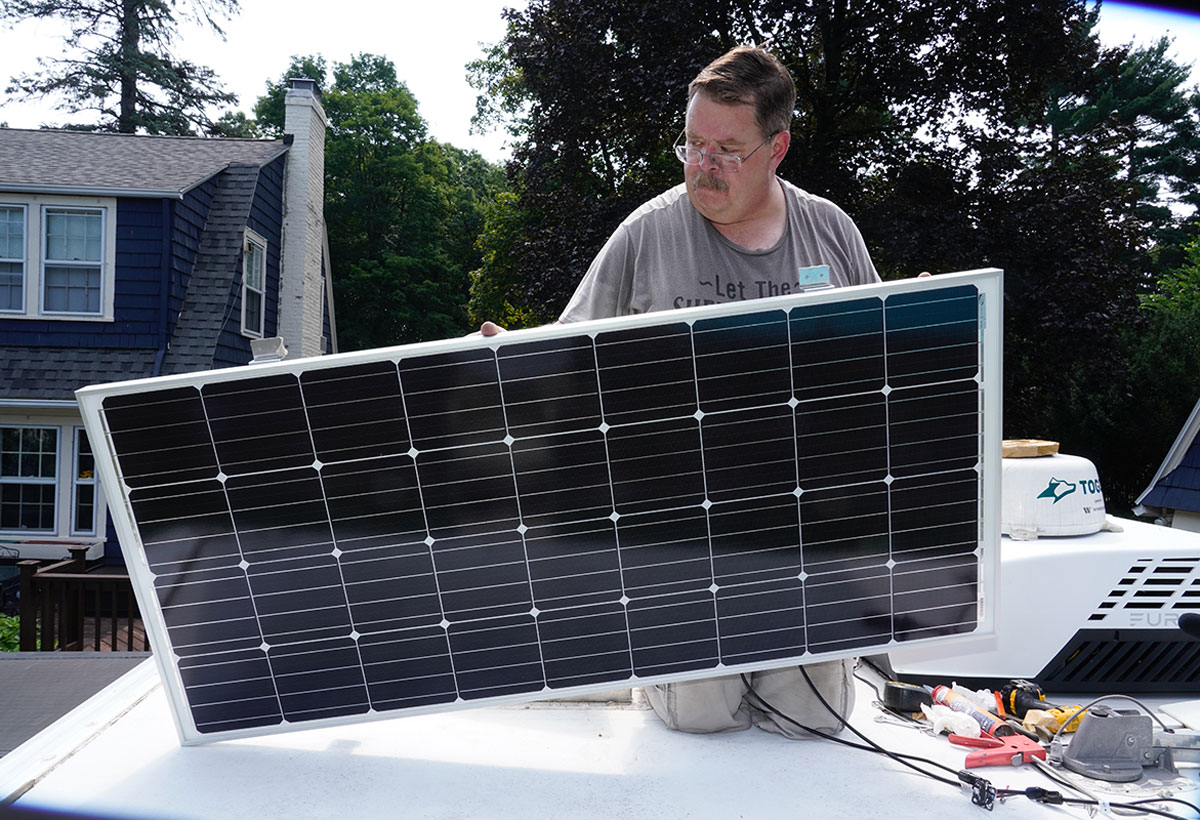
Keystone RV Co., for instance, initially made its Super SolarFlex off-grid package available a few years back on Montana, Raptor and Fuzion models. At the time, it was a $20,000 upcharge and included four 250-watt solar panels for a combined 1,000 watts of solar collection. For the 2022 model year, the Goshen, Ind.-based subsidiary of Thor Industries Inc. announced all its brands will come factory-equipped with one of four SolarFlex packages. They range from 200 to 1,200 watts of power, with increasingly advanced support components, and retail for between $450 and $19,500.
And Keystone isn’t alone in its quest for off-grid performance, by any means. At November’s SEMA Show in Las Vegas, Middlebury, Ind.-based Grand Design RV Co. announced a partnership with Volta Power Systems that will offer buyers of 2022 Momentum toy haulers and other Grand Design products optional systems ranging from 6kWh (6,000 watts) and 3,200 watts of AC power to a massive 18kWh of power.
Jayco, for its part, unveiled its Overlander EXT Modular Power Management system in September. Developed in conjunction with Renogy and Dehco Electronics, the package includes six Renogy 200-watt monocrystalline solar panels, six 12-volt 100AH lithium batteries (for 7.2kWh of stored power), a 3,000-watt pure sine wave inverter charger (with 50-amp bypass), a 100-amp charge controller and a 600-amp battery monitor. It will be offered as an option on 2022 North Point and Pinnacle fifth wheels and Seismic and Seismic Alpha toy haulers.


Go Anywhere
What’s made solar the buzzword of the moment? Affordability, clean power and “go anywhere” freedom.
Samlex America’s Jonathan Krawchuk concurs.
“When the company first started offering solar, it was quite expensive and was kind of a luxury to have a solar system on your RV,” he said. “Now, it’s a lot more mainstream — it’s on the roofs of houses, on RVs, and those economies of scale have brought the pricing down to where it’s much more approachable to the everyday person. And people now understand it. It’s not just some exotic product used on the space station.”
Having cut its teeth on building power products for commercial and industrial markets, Samlex expanded its product offerings — which now include converters, inverters, chargers and power supplies — and its reach. The Samlex Solar brand was introduced in 2009 for the RV, marine and off-road markets, and the company offers everything from 10-watt battery maintainers and portable kits to its new 200-watt solar charging kit, which Krawchuk said is “the largest single solar panel in 12 volts that’s offered in the RV industry.” The Samlex lineup also includes the Battery Guard, which will cut off the battery power before it drops to the point where it can damage the battery — a critical drawback of flooded lead-acid, gel and AGM batteries.
Then, too, the solar industry has made dramatic inroads in the amount of power that can be generated and stored.
“Before, it was more a matter of ‘let’s keep our batteries healthy,’” said Garret Towne, president of AM Solar. “Systems were a lot more basic — and, because of that, more popular with smaller RVs. Now, the technology exists to take a 40-foot fifth wheel off the grid for a week. When I first started, the biggest jobs we’d ever do cost about $20,000,” he said of the custom outfitter. “Now, we’re doing $20,000 jobs regularly — and have even had some that were more than $50,000.”
For most RVers, such systems are well out of the norm. While “starter systems” that include a 110- or 120-watt panel and an inverter are fast becoming the norm with factory-installed solar and work well to keep the battery topped off for a weekend while offsetting 12-volt DC loads such as lights, fans, water pumps and slideout motors, many solar suppliers recommend a slightly more robust package to truly enjoy life off the grid. For example, Eva Mitic, marketing manager for Go Power!, a British Columbia-based company that’s celebrating 25 years of providing solar components — and one million panels sold — notes that the company’s most popular kit, the 190-watt Overlander (about $800), is easily capable of maintaining battery loads, but recommends its 380-watt Solar Elite Charging System for extended weekend use. Paired with a 2,000-watt inverter and a 200-amp/hour lithium battery bank, such systems will run virtually everything in an RV, including limited microwave use, and is buildable.
“A complete 380-watt system would cost about $4,000,” Mitic said. “Most campers would recoup that investment in less than two years by not having to rent an expensive campsite with hookups.”
In fact, Go Power! perhaps best illustrates the “mainstreaming” of solar systems in the RV space. Offering a “soup to nuts” approach to solar power generation by engineering all of its system components from panel to battery, the company — along with Bend, Ore.-based Zamp Solar — recently became part of the growing Dometic family of RV and outdoor equipment companies.
Determine Your Power Needs First
While a half-dozen 200-watt roof-mounted solar panels might earn you bragging rights at the next campground get-together, “going big” isn’t always necessary.
“People always want to ask, ‘how many panels is it gonna take to run my coach?’” said Chris Greer, vice president of product development for WAY. “Our take to that — and it really needs to be everyone’s response — is, let’s talk about the whole system because it’s not just the solar panels. It’s also the kind of battery bank you’re running, what kind of inverter or converter charger you’re running and what devices do you want to be able to use while you’re camping? You have to have a conversation about the entire setup — and that really opens a lot of people’s eyes because they think well, I just need throw some panels on the roof and my coach is automatically ready to go off grid. That’s just simply not the truth.”
As Greer noted, power demands vary, depending upon the size of the RV and the needs of its occupants — be it a stick-and-tin travel trailer, high-end fifth wheel or motorhome — but did offer some advice.
“A good starting system, in my opinion, would include a bare minimum of 200 amp-hours of battery power, 360 or more watts of solar panels on the roof and then 2,500 to 3,000 watts of inverter power. That will give you some camp time. You can’t sit there with the air-conditioner running endlessly, but you can watch TV, run a computer and your refrigerator — achieve some of those basic camping functions and still have some creature comforts. If people really want to boondock, they need to invest in a system.”
WAY, an Elhart, Indiana-based distributor and manufacturer, has been involved in off-grid product development for years. The company pioneered 12-volt DC refrigeration and in recent years has invested heavily in solar and its related components, including partnering with RELiON Battery, a leading manufacturer of lithium-iron phosphate batteries across many applications.
“We offer a couple different options,” Greer said. “The most popular is a rigid glass-panel design. Panels are made of either monocrystalline or polycrystalline, but a mono panel in the glass style is more efficient than a poly. The next step up — and we offer these, as well — is Merlin Solar flexible-style panels, which add another bit of efficiency over even the monocrystalline glass panel. They are probably 15% more efficient than the standard glass panel of the same size.

“From a charge controller standpoint, an MPPT (maximum power point tracking) unit is the type of charge controller you want to use if you’re truly trying to boondock because they are more efficient. I know that many customers still use a PWM (pulse width modulation) charge controller, but that’s more of a cost decision than anything else.”
Let’s Talk Batteries
All the solar panels won’t do you any good without a means of storing the energy they produce. At Dragonfly Energy, purveyor of Dragonfly Energy (OEM) and Battle Born (aftermarket) batteries, the company isn’t just focused on the cell chemistry of “clean power” of solar for the RV arena, but also the manufacturing process. Designed and assembled in Reno, Nevada, Battle Born is also developing a system to utilize a solid electrolyte instead of liquid. That, said company representatives, means its All Solid State Batteries (ASSB) will be lighter, smaller and completely nonflammable.
The first step any camper should make, noted a company rep, is to switch to lithium from lead-acid construction. Comparing its 100Ah 12-volt battery to a 200Ah lead-acid unit, lithium offers a number of benefits. For starters, it can be discharged to 100%, an act that’s the kiss of death to lead-acid units. Self-discharge rates when not in use also differ dramatically: 2-3% per month (lithium) versus an average of 33% for lead-acid 12-volt batteries. There’s also a substantial weight difference — 31 pounds as opposed to 144 pounds — but the real savings are in dollars. While the biggest hinderance to widespread lithium ion battery use in RVs is initial upfront cost — a single 100Ah 12-volt lithium battery will cost two to three times that of its lead-acid counterpart — they will actually save money in the long run. The battery life of a lithium unit is 3,000-5,000 cycles, compared to 500-1,200 for a lead-acid battery. And, the rep added, lithium batteries perform significantly better than lead-acid units at low temperatures.
One of the newer companies in the RV solar arena, Aims Power in Reno, Nev., actually has one of the deepest pedigrees in solar off-grid power generation, having built systems for commercial, NASA and military use. Founded by Bruce de Jong, the company also has the capability to manufacture a specific inverter size for OEM requirements — and has every component in the Aims Power solar products and kits, including its proprietary battery brand, manufactured to its own specifications. While speaking with RV Enthusiast, he warned installers to exercise their due diligence when developing a solar system — especially when it comes to batteries.
“There are a lot of battery technologies available,” de Jong said. “But not all batteries are equal, and not all batteries called ‘new’ actually are new. For example, some are using recycled Nissan leaf batteries or other old vehicle-returned batteries — and the voltage levels aren’t quite the same. So they’ll usually advertise fewer cycles. A new lithium-iron phosphate battery should be capable of 3,000-5,000 cycles, but a lot of companies (on the Internet) will advertise 1,000-2,000 cycles — basically, because they’re used batteries. So the defect rate is going to be much higher, but also the voltage levels are lower so you’re not getting a good charge on them — and most converters and charger aren’t going to work properly with them.
“The batteries are always a limitation to the system,” he added, “so if you limit them further by not charging them properly, you’re setting yourself up for disappointment.”
And while contemporary systems tend to be of the 12-volt DC variety, as more power is needed the systems themselves increase; going beyond 3,000 watts, in the opinions of many suppliers, usually means increasing to a more sophisticated 24-volt DC system. But that requires more knowledge.


Fortunately, many suppliers also have operations in place that make technicians and even engineers available to consumers to assist them when questions crop up. For example, Xantrex — which recently released eGEN Max, an enhanced version of its eGEN system that integrates with the motorhome’s power system and automatically turns on the engine when the battery needs to be charged, eliminating the use of a generator — offered a series of free webinars this year to provide technical information on solar and generator-free systems. Others offer learning centers and support online.
And, while some might consider actual hands-on training to be overkill, it’s available. According to Todd Henson, director of education for the Athens, Texas-based National RV Training Academy, the popularity of solar led the NRVTA to double its hands-on classes dealing with solar installations. “We’ve had a ton of interest,” he acknowledged, “and now offer two classes per cycle — and are already booked up four months out.” And not all of those seats are being occupied by dealer service technicians.
Beyond the constraints of an outdoor hospitality industry seeing record numbers of new RV owners in its space, the popularity of solar also is fueled by younger campers looking for alternatives to a lifestyle with a shore power umbilical cord attached.
“We’re seeing a different type of consumer then we did just 10 years ago, said Wayne Kaylor, CEO of Elkhart, Ind.-based RV distributor WAY. “There are a lot of younger people coming into it who have a different ‘take’ on the outdoor lifestyle — they don’t just want to ‘go camping’ like their parents did, with neighbors parked five or 10 feet away. They really want to get away and enjoy the outdoors.
“I think there will always be ‘traditional’ campers,” Karlor added, “but I also believe the industry will continue to move in the direction of building RVs that won’t require hookups to be fully self-sufficient.”
Interested in solar power? So is RV Enthusiast! Watch for its April issue, where we will take an even deeper look at the growing boondocking trend — and the products that help to make it happen.