

orget about cars.
For the bulk of the North American market, trucks and SUVs are where it’s at. If you don’t believe us, check the Ford website, where you can choose from either the lonely Mustang…or one of eight crossovers/SUVs. You’ll find a similar story on the Chevy website, with choices limited to a ho-hum Malibu or diminutive Spark, but a total of seven crossover/SUV models. Toyota still offers several passenger car models — but its top selling car, the Camry, has taken a back seat to the RAV4 SUV in total sales.
When your budget only allows for one family vehicle, it all makes sense — a truck or SUV can accommodate a family, haul cargo, tow a trailer and travel competently off-road. Combine these benefits with a higher seating position for better visibility, available 4WD/AWD and the perception of greater crash worthiness, and it becomes clear that a crew cab pickup or SUV is the one vehicle that can do it all for most families — especially those that enjoy RVing. With that in mind, we’re presenting this guide to the most noteworthy offerings for 2022. By that, we mean we’re only going to cover the trucks and SUVs that are either new or significantly changed; if it’s not on this list, revisions for 2022 are limited to appearance and/or content, such as trim, packages and the like.

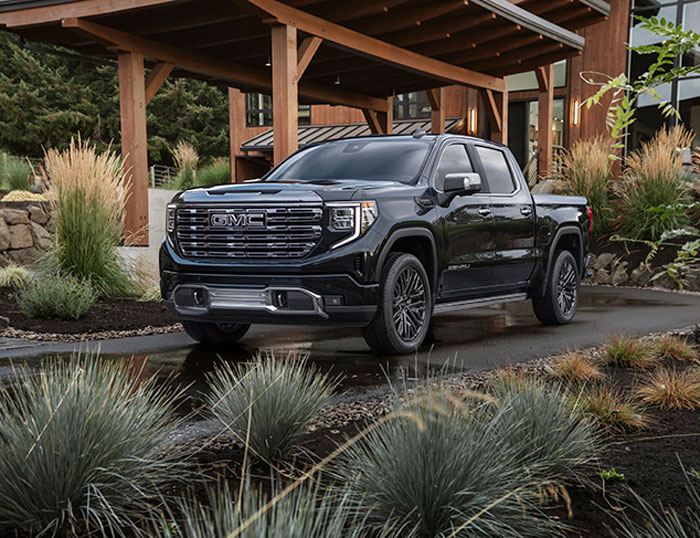
With the introduction of the Chevrolet Silverado ZR2 and GMC AT4X, it is apparent that buyers have not lost their appetite for a truck that can confidently handle a Zombie Apocalypse. Though not as gonzo as the Ford Raptor or Ram TRX, these trucks bring new equipment levels and other upgrades that make them a solid choice for weekend warriors.
Along with a standard 6.2-liter V-8 churning out 420 horsepower wrangled by a 10-speed automatic transmission, both models receive dual electronic locking differentials and racing-derived Multimatic 40-mm Dynamic Suspensions Spool Valve (DSSV) dampers which, when combined with uniquely tuned springs, increase front/rear suspension travel compared to the already competent Chevy Trailboss and GMC AT4. Offering an aggressive appearance as well as off-road functionality are 33-inch mud-terrain tires on 18-inch wheels, a unique skid plate package and a new steel front bumper with an improved 31.8-degree approach angle. At the rear, the dual exhausts terminate before the rear bumper, protecting them from damage on steep uphill transitions. Also included are “specific” off-road chassis and suspension calibrations, according to GM, and a new Terrain Mode, which allows one-pedal rock-crawling capability. Even with all this off-road-specific gear, both trucks maintain a 1,400-pound payload capacity and an 8,900-pound tow rating.
Another welcome change for the 2022 models are revised interiors, which incorporate new materials (LT and above on Chevy; SLE and above on GMC) and a fresh layout designed to give the cabin “a spacious and more premium feel,” according to GM. Getting in line with its competitors, both the Chevy and GMC are equipped with a 13.4-inch-diagonal horizontal touchscreen and a 12.3-inch diagonal digital configurable instrument cluster. New available colors, seat designs and more premium materials are used throughout.
The upscale Chevy Silverado High Country and new GMC Sierra Denali Ultimate models will also be available with Super Cruise hands-free driver assistance technology for use on more than 200,000 miles of compatible roads in the U.S. and Canada — and yes, it can even be used while trailering.
The base 2.7-liter Turbo High-Output DOHC inline four-cylinder and 3.0-liter Duramax I-6 turbodiesel also receive upgrades that enhance capability. The 2.7-liter engine benefits from a new, more rigid engine block and a 30% stiffer crankshaft, which has enabled a claimed 20% increase in torque compared to the previous engine (GM estimates 420 lb-ft at press time) and quieter operation. In addition, its eight-speed automatic transmission benefits from shift-scheduling enhancements designed to improve refinement and quicken downshift time. Who would’ve thought that one day a four-cylinder pick-up could tow up to 9,600 pounds? In 2WD trim, this one can.
While GM isn’t quite so specific as to the 3.0-liter Duramax upgrades, it does allow that trucks equipped with this engine have undergone chassis upgrades that allow the inclusion of the Max Tow Package, which yields a max tow rating of up to 13,300 pounds — a 4,000-pound improvement over the 2021 models.
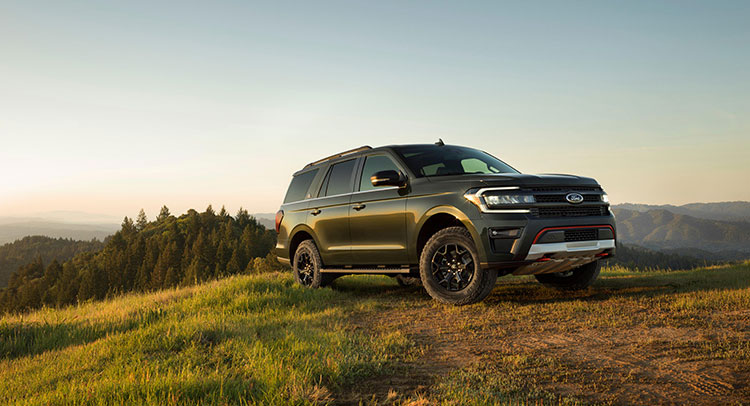
As the company’s largest SUV offering, the Expedition has always been a competent people-mover — but this year Ford expands the lineup with a new Stealth Edition Performance Package and a Timberline model. While the Stealth Edition is limited primarily to blacked-out trim and 22-inch wheels, the Timberline offers features campers can really use. Powered exclusively by the high-output 3.5-liter EcoBoost V-6 producing 440 horsepower and 510 lb-ft of torque, the Timberline boasts real trail capability thanks to 10.6-inches of ground clearance (Ford claims best-in-class), wider track and improved approach/departure angles. Trail Turn Assist, the same system used on the new Ford Bronco, can tighten the turning radius on twisty trails, while 33-inch Goodyear Wrangler AT tires, a two-speed transfer case and F-150 Raptor underbelly shielding help navigate the rough stuff. The Expedition Platinum, meanwhile, debuts Ford’s BlueCruise hands-free highway Driver-Assist Technology. Expedition tows up to 9,300 pounds when equipped with the Heavy-Duty Trailer Tow Package.
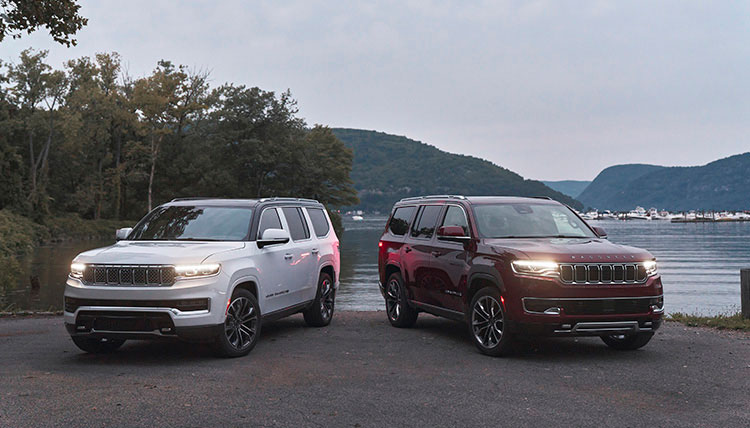
GM has the Escalade, Suburban, Tahoe and Yukon. Ford has the Expedition and Lincoln Navigator. But until now, Stellantis (formerly Fiat Chrysler, formerly Daimler Chrysler, formerly Chrysler Corp.) didn’t have a true luxury full-size SUV. That changes with the all-new 2022 Wagoneer and Grand Wagoneer — full-size SUVs so outlandishly luxurious and capable, Stellantis bills them as a “premium extension of the Jeep brand.” In fact, you’ll find no “Jeep” badging on them.
Unlike its competitors, however, the Wagoneer and Grand Wagoneer must promise more than luxury and refinement; being associated with the original Wagoneer that bowed in 1962 as a successor to the Willys Jeep Station Wagon, these new models have a reputation to uphold and some big shoes to fill, Jeep badging or not. With that firmly in mind, these SUVs were built to be as capable as they are comfortable, with a choice of three 4×4 systems (Quadra-Trac, Quadra-Trac II and Quadra Drive II), active low range, a rear electronic limited slip differential, a crawl ratio of 48:1 and Selec-Terrain traction management system. The Quadra-Lift air suspension not only delivers a smooth ride, but up to 10 inches of ground clearance — and contributes to the vehicle’s claimed 24 inches of water-fording capability.
Wagoneer is powered by the venerable 5.7-liter V-8 rated at 392 horsepower and 404 lb-ft of torque, boosted by a standard 48-volt eTorque system, while Grand Wagoneer ups the ante with a 6.4-liter V-8 producing 471 horsepower and 455 lb-ft of torque. Both are matched to an 8-speed automatic transmission. A generous 10,000-pound maximum tow rating and Trailer Hitch Line-up Assist with active grid lines and camera zoom should find favor with RVers. Of course, both models are loaded with luxury and safety features, as well as beautifully crafted interiors that can seat up to eight passengers.
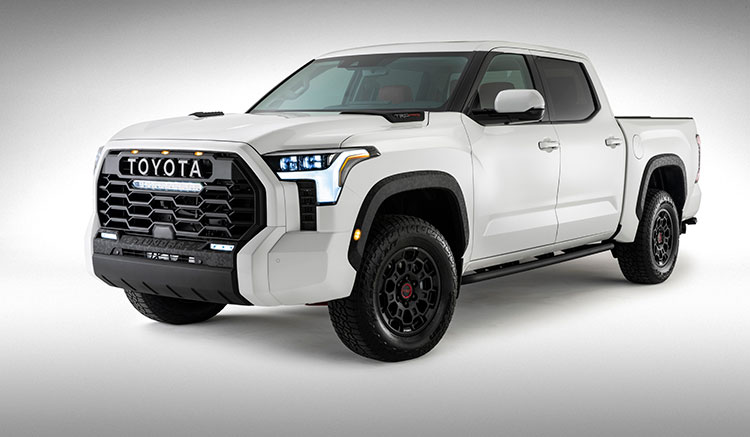

Marketing teams have a propensity for calling a vehicle “all-new” when it simply looks like it is. Updated sheet metal, interior revisions and more power are all welcome — but they don’t make a vehicle all-new. At least, not when the same frame, engine, transmission and suspension are retained. The 2022 Toyota Tundra, on the other hand, is all new — the company left no stone unturned in an effort to make its full-size truck better in every measurable, tangible way.
Let’s start with the engine choices. Technically, there’s just one — an i-FORCE 3.5-liter twin-turbocharged V-6 — but it’s offered in three variations. In base SR grade, it is tuned to produce a respectable 348 horsepower and 402 lb-ft. of torque; in higher grades, it kicks out 389 horsepower and 479 lb-ft of torque. Choose the i-FORCE MAX, and you’ll get the higher-output engine paired with a hybrid system that generates a total of 437 horsepower and a whopping 583 lb-ft of torque at just 2,400 rpm. All engine combinations will be matched with a new 10-speed electronically controlled automatic transmission with intelligence (ECTi). In i-FORCE MAX applications, the transmission will be paired with a motor generator and clutch assembly located within the transmission bellhousing; engine start-up, EV driving and energy regeneration are accomplished through the parallel hybrid components. A newly developed Power Control Unit works with a 288-volt sealed Nickel-metal Hydride (Ni-MH) battery located underneath the rear passenger seat. Toyota claims that the electric motor will do most of the heavy lifting at low speeds, but once above 18 mph and while in Tow/Haul mode, the engine will be in continuous operation.
An updated, high-strength steel frame structure features a widened rear section to improve stability. Frame crossmembers are more than doubled in size to provide additional reinforcement and rigidity, while aluminum is used in strategic areas to reduce weight. In the rear, a new multi-link suspension system replaces the leaf spring arrangement, which improves ride quality and allowed engineers to move the shock absorbers outside of the frame rails for improved roll damping. The new system also provided the flexibility to add optional load-leveling air suspension on certain models.
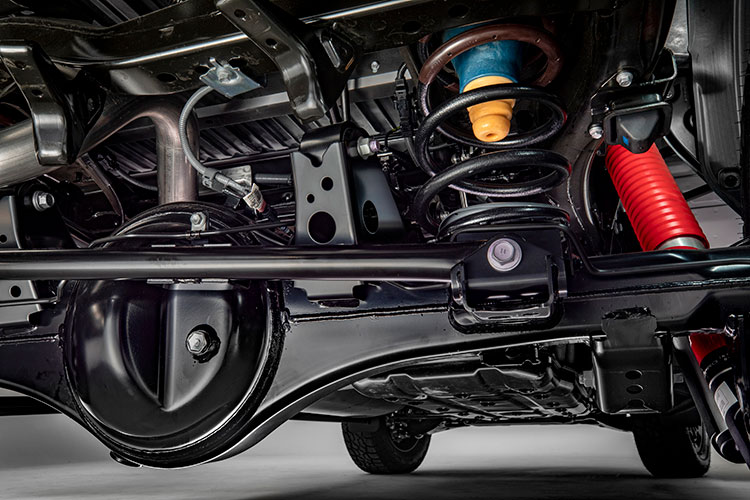
Up front, a new front cross member was constructed for the steering gear box, which adds rigidity for enhanced steering input and handling dynamics, according to Toyota. Additionally, the chassis features a newly developed double-wishbone front suspension and electronic steering system, plus the availability of Adaptive Variable Suspension, which is designed to adjust damping force based on prevailing road conditions.
Maximum tow capacity increases to 12,000 pounds (a 17.6% improvement versus the outgoing model), while payload increases to 1,940 pounds, a gain of more than 11%. The additional capacity also comes with a host of new towing features. First, there are two Tow/Haul modes — standard Tow/Haul for smaller trailers and Tow/Haul+ for larger travel trailers, box trailers and boats. New camera systems can display multiple exterior angles that are viewable from the available 14-inch touchscreen or an available rearview camera accessory that mounts on the back of the trailer. Of particular interest to RVers is the available Panoramic View Monitor (PVM), which uses cameras to display a top-down “bird’s eye” view of the truck on the available 14-inch monitor for added visibility. Views include the rear truck bed to check on cargo, a rear split view to show what’s nearby on each side of the trailer and a hitch view to assist with connecting. Trailer Back Guidance aids in overall maneuvering of the trailer, while a Straight Path Assist feature is designed to ensure the truck and trailer will back up in a straight line. When connected with Toyota’s integrated trailer brake controller, the standard Blind Spot Monitor can recognize blind spots for the truck as well as the trailer.
Also available are new power extending and folding tow mirrors for an improved view of the trailer, thanks to a taller profile and revised mirror curvature. The mirrors are heated, feature an integrated turn signal and Blind Spot Monitor (BSM) notification and house the cameras for the available PVM and Multi-Terrain Monitor (MTM) systems. LED trailering lights, controlled via a button inside the cabin, direct light toward the trailer during nighttime or low-visibility situations.
As before, the Tundra will be available in SR, SR5, Limited, Platinum, 1794 Edition and TRD Pro Grades, and are offered in Double Cab (6.5- or 8.1-foot bed) or CrewMax (5.5- or new 6.5-foot bed) with available TRD Sport and TRD Off-Road packages on certain models. With the trend of off-grid camping today, we predict the TRD Pro model will be a popular choice, with its standard i-FORCE MAX powerplant, 2.5-inch diameter, remote-reservoir FOX internal bypass shocks, electronic rear differential lock, Multi-Terrain Select and Crawl Control hardware. Also included are a front skid plate, underbody protection and unique Falken Wildpeak all-terrain tires. On TRD Pro or models with the TRD Off-Road package added, the aforementioned Multi-Terrain Monitor allows the driver to check the immediate surroundings for potential obstacles by simply pressing a button for front, rear and side-camera views on the display.
Toyota Safety Sense 2.5 (TSS 2.5) is standard on all models and includes features such as a pre-collision system with pedestrian detection, dynamic radar cruise control, lane tracing assist, automatic high beams and a rear seatbelt reminder. Other standard safety features include Blind Spot Monitoring and Rear Cross Traffic Alert.
We’ve heard about them for years now — electric trucks that will accelerate, handle and tow as much (or more) than their fossil-fuel powered brethren and offer technologies and benefits yet unseen in the truck market. Developing these trucks and bringing them to market, however, has proven more of a challenge than initially anticipated, but make no mistake, they are coming — and you can put one in your garage next year. What follows is a brief overview of what will be available and what features they offer for RVers.
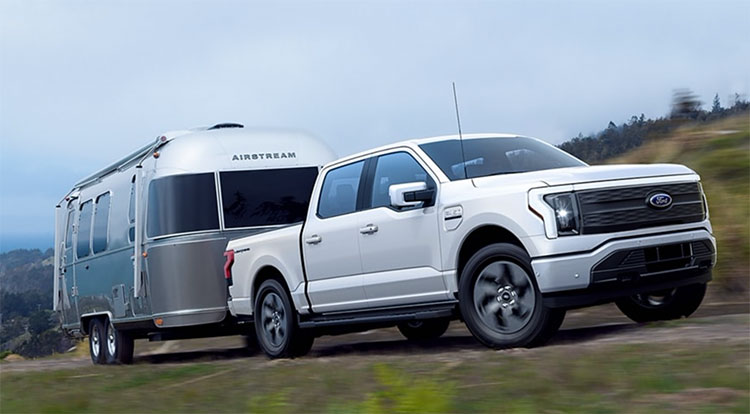
When Elon Musk presented the now infamous video of Tesla’s Cybertruck dragging a Ford F-150 in a staged tug-of-war contest back in 2019, he awakened a sleeping giant. Ford is not one to shy away from competition — and was not about to be embarrassed by a newbie in the truck game. Soon after, Ford displayed its electric F-150 towing… ahem…a train, and put the world on notice that it was serious about bringing an electric truck to market.
Billing it as “the smartest, most innovative truck Ford has ever built,” the F-150 Lightning targets 563 horsepower and 775-lb-ft of torque, good enough for a 0-60 mph sprint in the mid four-second range when equipped with an extended-range battery, according to Ford. A max payload of 2,000 pounds is projected in the standard-range model with 18-inch wheels, along with a 10,000-pound maximum tow rating on XLT and Lariat trucks with the extended-range battery and Max Trailer Tow Package.
Since what you’re hauling can affect range, the truck’s Onboard Scales feature — which uses the truck’s sensors to estimate payload and tell customers how much they’re hauling — is integrated with Intelligent Range to help ensure F-150 Lightning gives an accurate estimate of how far you can go. F-150 Lightning also debuts an available Pro Trailer Hitch Assist, which automatically controls steering, throttle and brake inputs to make hitching trailers even easier. Ford’s Power-Up software updates will be available to improve the performance of the Lightning, deliver upgrades, update existing features and add all-new functions and capabilities to the truck in under two minutes, according to Ford. Power Up can also fix issues without a trip to the dealership — something that usually can’t be done with a gas or diesel engine.
Speaking of engines (or lack of same), Ford makes use of the vacant space under the hood with its “frunk,” a portmanteau of “front” and “trunk.” The dedicated storage space is secure, lockable and accommodates up to 400 liters of volume and 400 pounds of payload. That’s plenty enough to haul a large generator — but you probably won’t need one, because the available Ford Intelligent Backup Power feature can offload 9.6kW of juice to power up anything you need, and for extended periods. Based on an average 30kWh of use per day, Ford claims the F-150 Lightning with extended-range battery provides full-home power for up to three days — or as long as 10 days if power is rationed — with varying results based on energy usage. Pro Power Onboard, meanwhile, supplies built-in electrical outlets to directly power a variety of tools, electronics and appliances when you’re away from home.
Admittedly, the shortcoming of an electric truck from an RVer’s perspective is range. The Lightning’s standard-range lithium-ion battery is projected to yield 230 miles of EPA-estimated range, while an available extended-range battery can stretch that to 300 miles. Obviously, these figures will drop considerably when towing, but Ford reports that its customers will have “seamless access” to North America’s largest public charging network through FordPass with more than 63,000 charging stations (and growing) across the U.S. On a 150-kilowatt DC fast charger, the extended-range F-150 Lightning is targeted to get up to 54 miles of range in 10 minutes and charge from 15% to 80% percent in about 41 minutes.

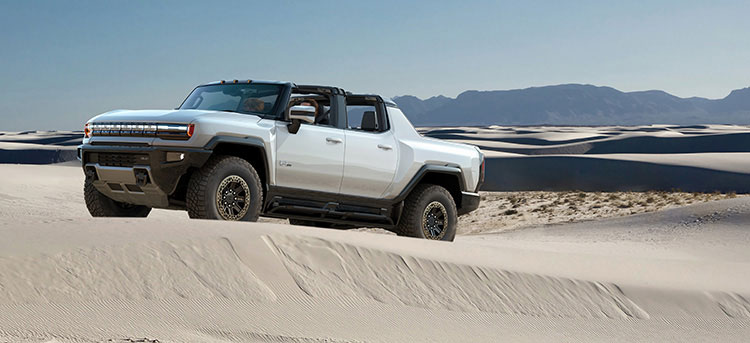
Comparatively little is known about the GMC Hummer EV from an RVing perspective — GM has not yet released payload or towing capacity figures — but with up to 1,000 horsepower and up 11,150 lb-ft of torque from its three electric motor combination, we’re expecting figures that should at least be competitive with other manufacturers.
What we do know is that the Hummer EV should be fun, especially off-road. Features will include e4WD, 4 Wheel Steer featuring CrabWalk (allows the front and rear wheels to steer at the same angle at low speeds for additional maneuverability), adaptive air suspension, 35-inch Goodyear Wrangler Territory MT tires and UltraVision, which incorporates front and rear underbody cameras to help drivers negotiate extreme terrain without a spotter. Indeed, GM reports that the Hummer EV will offer up to 18 camera views.
Powered by a 24-module, double-stacked Ultium battery propulsion system, the truck will be capable of 0-60 mph runs in the three-second range and will offer 800-volt DC public fast-charging compatibility of up to 350kW. The industry-first technology, according to GM, mechanically switches the batteries from parallel to series mode during charging, which makes the Hummer EV compatible with the fastest 350kW DC fast chargers. That means drivers can juice up nearly 100 miles of range in just 10 minutes of charging, according to GM.


Rivian isn’t exactly a household name — yet — but has made significant inroads in a very short period of time. It recently inked a deal to provide electric delivery vans for Amazon, and its R1T pickup and R1S SUV have both garnered critical acclaims.
To start with, the R1T is the smallest EV truck offering to date; its overall length and wheelbase are more than a foot shorter than a Chevy Silverado Crew Cab, for example. This bestows it unexpected on-road performance and handling, as well as off-road capabilities that have thus far impressed even hardcore trail-beaters. Looking like a shiny toy alongside the likes of a Ford Raptor or Ram TRX, the R1T offers 24 inches of ground clearance and three feet of water fording capability, plus a tow rating of up to 11,000 pounds. Its quad-motor, all-wheel-drive system enables 0-60 mph sprints in as low as three seconds flat, and independent air suspension should provide a comfy ride on any surface.
It’s also got some thoughtful features that RVers are sure to love, like a Gear Tunnel (think pass-through storage) located between the cab and bed that can stow up to 11 cubic feet of stuff. The Gear Tunnel doors also have storage compartments in them and each can support up to 250 pounds, so you can use them to step up into the bed or load things on a roof rack. What’s even cooler is the availability of a Camp Kitchen, which slides in and out of the Gear Tunnel. Designed to be moved and set up by one person, the Camp Kitchen includes a 1,440-watt two-burner induction cooktop plus a four-gallon water tank, pump, collapsible sink and spray faucet. And just in case you want to whip up a smoothie or enjoy a hot cup of Joe with breakfast, there are four 120-volt AC power outlets, plus two 12-volt DC outlets.
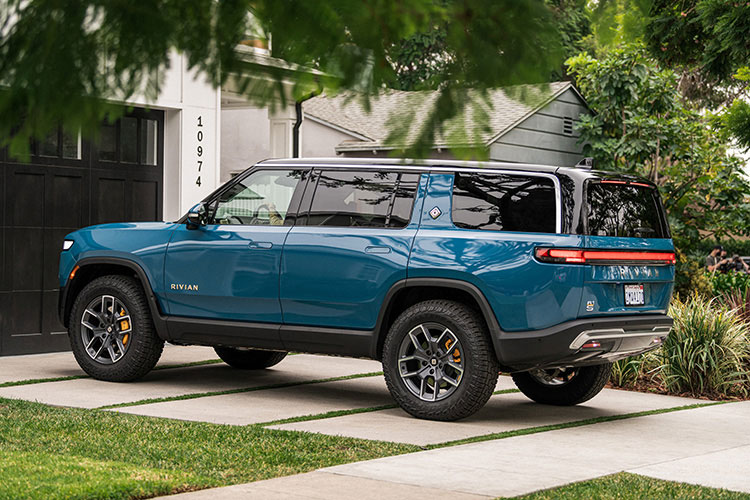
Meanwhile, the truck’s structural composite bed is an exercise in utility. A relatively short 4.5-foot space expands to seven feet with the tailgate down — and there’s weatherproof, lockable storage in the bed floor that, with its integrated drain plug, can double as a cooler. An integrated air compressor port includes a hose long enough to reach all four wheels, and two weatherproof, lockable tonneau options are available.
Available in Launch Edition, Adventure Package and Explore Package, the Rivian R1T has an EPA-estimated range of 314 miles. Specs for the R1S SUV are similar, but with a lower 7,700-pound tow rating and 14.9 inches of ground clearance. The nationwide Rivian Adventure Network of DC fast chargers (capable of adding 140 miles of range in 20 minutes) is expected to reach 3,500 chargers at 600 locations by the end of next year. You can learn more about ordering yours at https://rivian.com/experience/purchasing.
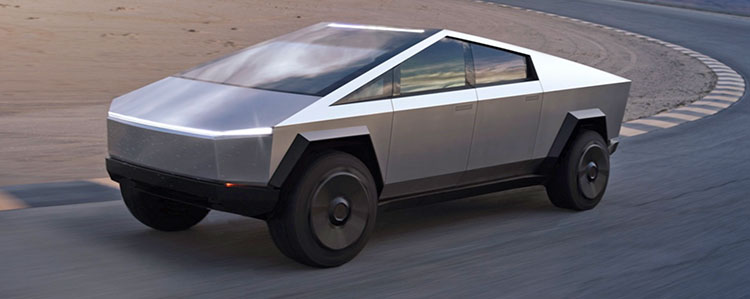
Arguably the one that started the electric truck movement, the Tesla Cybertruck offers some real innovation if you can get over its polarizing, angular looks. Its much publicized cold-rolled stainless-steel exoskeleton and Tesla armor glass promise strength and durability, underscored by the highest available payload capacity (3,500 pounds) and tow rating (14,000+ pounds) in the electric truck game thus far.
In its top-tier, three-motor configuration, Tesla maintains the Cybertruck will go 0-60 mph in under three seconds and have up to a 500-mile range. Other interesting features include adaptive air suspension, which allows the user to raise/lower the suspension up to four inches in either direction for easier loading/ingress/egress; a lockable “magic tonneau cover” that is tough enough to stand on, and onboard power and compressed air.
There has been a lot of speculation that the Cybertruck will not look as radical once it reaches production, but don’t count on it — this is Elon Musk we’re talking about, and he’s no stranger to raising eyebrows. If you want one, you can order it today for $100 (fully refundable) at https://www.tesla.com/cybertruck. The site maintains that personal configuration can be completed as production nears in 2022.