


Blowing Dust
[maghub_sidebar]
More Tech Tips and Tricks
Blowing Dust
More Tech Tips and Tricks
using air compressor to blow dust in fireplace
After running the fireplace to kill the chill, cleaning the heating element and blower assembly will keep the warm air flowing freely
By Bill Gehr
E

lectric fireplaces are common in RVs — not only do they provide ambiance, but the fan-driven heater feature eliminates the hassle of finding a suitable location for a portable space heater. It also allows owners to take advantage of electric hookups in RV parks rather than burning propane to power the furnace. And, well, there’s no denying the “homey” feel a fireplace can give an RV.

Rest assured that running the fireplace is safe, but like any heating device that forces warm air out of a register via a fan, it must be kept free of dust and lint to assure efficient operation. Fireplace maintenance is often overlooked because problems usually wane slowly and sometimes are not even noticed until it’s too late. Fortunately, the process is relatively simple — so cleaning once or twice a year should be in your active maintenance log.

In most cases, removal of the fireplace to access the heating element and blower motor is easy; the housing is surprisingly light and compact. Once the fireplace is partially removed, it must be unplugged before servicing. While the fireplace can be cleaned inside the RV, it’s best to carry it outside to allow more room to access the back, top and sides — and to prevent blowing built-up dust and lint all over the interior of the RV.

Overhead view of fireplace with wood cabinets
Using drill to take screws out of mounting on fireplace
Removing a Greystone fireplace is really simple. The surround is lifted off, exposing the screws that hold the fireplace in the structure (in this case, under the entertainment center). Once the screws are removed, the housing can be lifted out of the wall — understanding it’s plugged into a 120-volt AC power receptacle, so you should not pull aggressively. Unplug the fireplace before attempting any service procedures.
It will be necessary to have a source of compressed air, and — since the heating element is somewhat delicate — the pressure must be regulated to 60-70 psi to avoid damage. Using a bright flashlight, direct the air nozzle side-to-side and up-and-down to ensure that all areas of the heating element and fan assembly are thoroughly cleaned. If you are sensitive to dust, use a facemask. Once the dust and lint are removed, the surfaces can be cleaned topically with a dust cloth or a damp microfiber towel. Depending on brand and model, it might be necessary to disassemble the heating element and fan assembly for cleaning. If this is the case, take a picture of the wiring, so it can be reconnected properly.
Using swiffer duster to dust fireplace
We found that Swiffer dusting pads work best for cleaning the housing once it’s lifted out of the wall. You’ll be surprised how much dust accumulates in a short period of time.
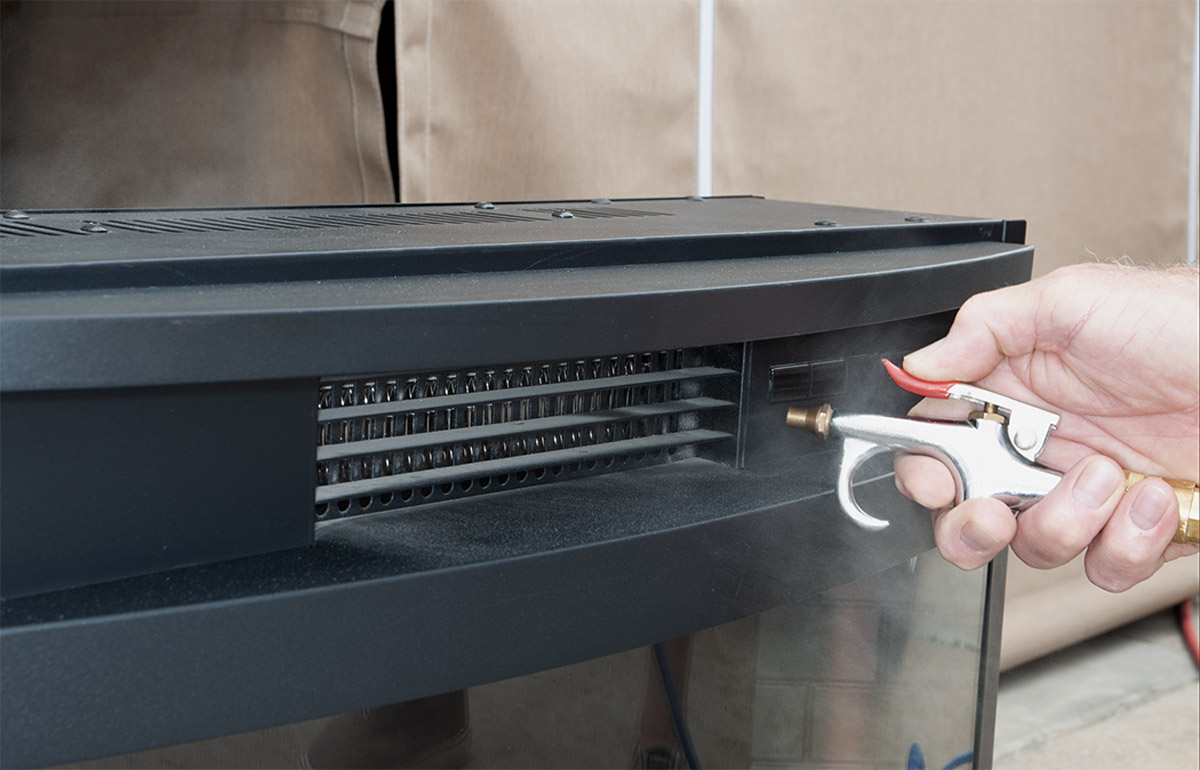
Using air compressor to blow dust out of grille
The heating element and fan assembly can be blown out with compressed air, which should be regulated to 60-70 psi to prevent damage. Consider taking the fireplace outside when blowing out the components, otherwise you’ll likely set up a dust storm inside the RV.
After several years, the glass also can become dusty and dirty on the inside of the fireplace. Removal procedures are dependent on brand, and the owner’s manual should offer specific instructions. It’s best to remove the glass from the housing while the fireplace is on its back — this ensures that the glass will not fall forward and shatter. Clean the glass with a window cleaner that will not leave streaks and, before re-inserting the glass, use the compressed air to clean the logs and surrounding areas in the cabinet. Before re-installing the fireplace, plug it into an extension cord and run it through its paces.

Consider cleaning the fireplace after running it through the winter. You should clean it again before the colder season sets in. That way you’ll ensure peak efficiency.

Using drill to disassemble fireplace mounting
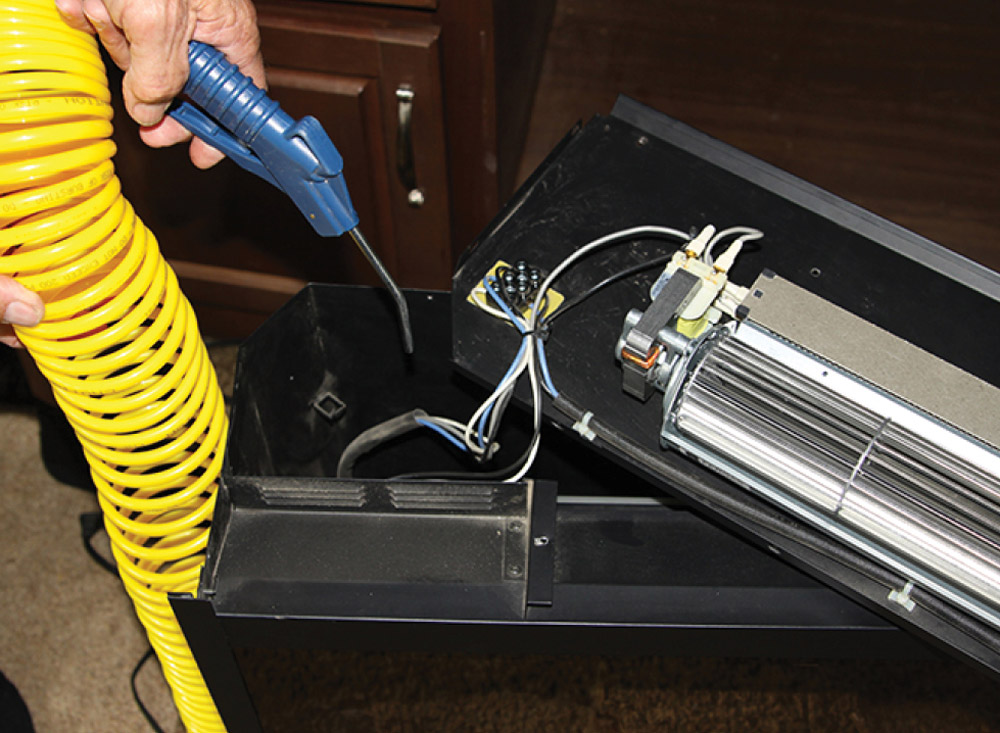
Removing fireplace and using air compressor
This Dimplex (BF8000ST) fireplace required removal of a shroud to access the heating element and fan assembly. In this case, it was possible to clean the housing and components inside the RV because they were recently serviced. If it’s been a while, the heating element and fan assembly can be disconnected and taken outside.