

et’s talk about icebergs for a few minutes.
Yea, I know — it’s the middle of summer. Who wants to think about overgrown ice cubes when your air-conditioner is having a tough time keeping up with the temperature outside your rig? But it’s precisely now, when you are using your RV — or, possibly, looking for one after having finally decided to start enjoying the outdoors — when you oughta be aware of your immediate surroundings.
An iceberg, if you remember your high school physics class, behaves just like that cube in your evening drink — it’s a solid, but it floats, because it’s about 9% less dense than the water around it. That said, its density also means 90% of floating ice is under the surface, and as any ship’s captain knows, it’s not only what’s visible that will hurt you — it’s what you can’t see. If he were around, no doubt Edward Smith would concur (he was the captain of the Titanic — and that’s the limit to your history lesson for today).
The same is true with recreational vehicles. There are plenty of things that can — and often do — go wrong with an RV, and many of them portent even greater maladies. Fortunately, they also often tend to reveal themselves long before real calamity strikes. Being able to recognize such problems will go a long way to alleviating major repairs down the road.
Want some examples?
Moisture spotted around a window. Sure, it might only be condensation caused by the temperature variable between your AC-cooled interior and those 90-degree afternoons — but it also could indicate the weep holes might be plugged. If that’s the case, well, water always finds the easiest route down. Ignore it, and water will leak into the interior and wreak havoc on the wall coverings and structure.
A bubble in the roof membrane. You do check your roof several times a year, right? If so, be aware that the roof membrane normally doesn’t release from its substrate all at once — it usually starts with just a small bubble. Catch it in time and it’s a relatively easy job to cut it away, replace that part of the membrane, glue it down and recoat the area with a capable rubber sealant. Ignore it, and things can go bad quickly.
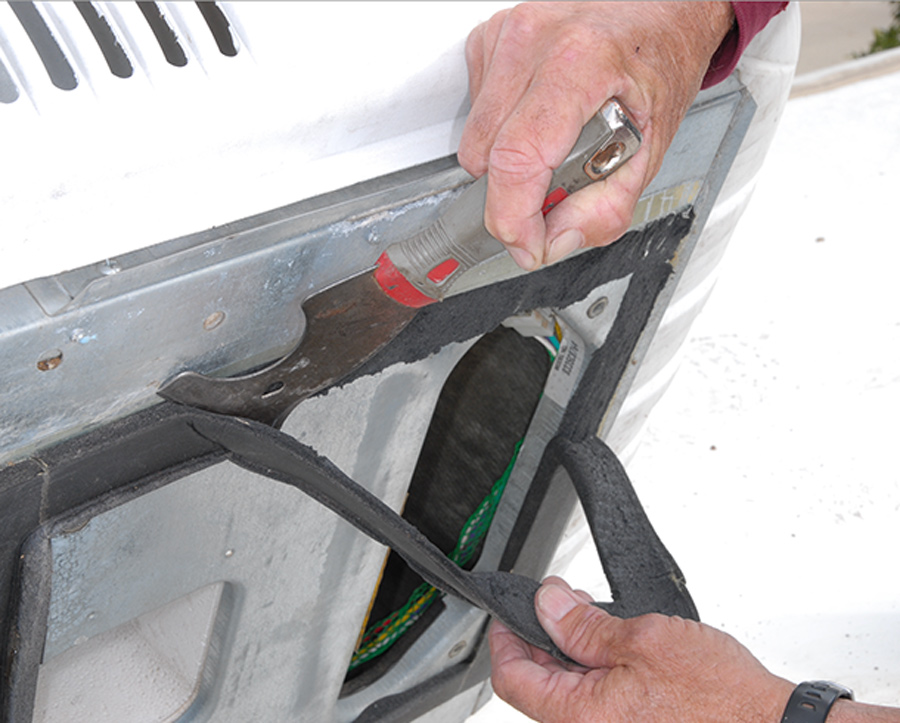
Ceiling discoloration near the AC unit. Here’s an equation that you never heard in your Algebra class: wood + water = rot. While using aluminum for framing and composite materials in place of lauan is becoming more common today, most RVs still utilize a plywood deck for the roof substrate. Fortunately, roof leaks tend to make themselves known early; they begin to discolor the interior ceiling and/or walls. Such discoloration around the roof AC can indicate a bad seal. Overlook it, and the scope of the job magnifies dramatically.
Granted, not every dilemma posed during your travels is so easily rectified. For example, smelling ammonia near your absorption refrigerator means the cooling unit is bad and you’ll have to replace it or the entire refrigerator, while stress cracks spotted on a fifth wheel’s cabover often requires stripping the area down to check the frame for broken welds. Even then, though, dealing with big problems sooner than later means you’ll oftentimes be dealing with a problem of lesser magnitude.
All you need to know is how to go about it.
That’s where RV Enthusiast really shines. This issue is a great example. We address everything in these pages from upgrading your screen door to swapping out galley appliances. You’ll find more than a dozen stories in this issue explaining in an easily understood way how to deal with the sort of things that can otherwise keep you from enjoying your investment. In fact, in the last six issues, we’ve published more than 70 technically-oriented articles, written and photographed to show everyone from the experienced RVer to the “newbie” what can go wrong — and how to make it right.
Knowing how to make simple repairs can make or break your next vacation — but don’t take our word for it. One of the best responses I’ve seen of late on the myriad RV-related forums online came as a rebuttal to someone questioning the quality of new units being built during the pandemic-fueled resurgence of RVing. I’ll quote the rebuttal in edited form — just know that this was written by someone obviously not afraid to work on the family’s rig who has dealt with her share of “little problems” and caught them before they became major concerns:
“We bought a unit in 2019,” wrote Melanie Covington. “Our friends bought a unit three months earlier than we did. Our unit has never been in a shop — and theirs has been in the shop more than on the road. Why? Because I fix every issue I come across and they put theirs in the shop with every issue. Wallpaper peeling due to high humidity? I fixed ours; theirs was in the shop for three months. Water leak? I found ours, replaced the bad seal for $2 and the problem was solved; theirs was in the shop for a month. The list goes on. Every issue isn’t a ‘quality’ issue; many are just wear-and-tear. I fix ours and they shop theirs — then they complain when we go on vacation and they can’t because ‘it’s in the shop.’ People putting their unit in the shop doesn’t equal a crap-quality rig.”
I couldn’t have said it better myself.