


here’s no understating the impact boondocking has had on the RV industry in recent years. Whether people choose to camp off the grid in search of adventure, opt for spending time at national and state parks to rediscover America or simply head off-road after being stymied in their efforts to book a campground for an upcoming vacation, “primitive camping” has escalated dramatically in popularity.
It’s also perfectly tailored for the growing use of 12-volt DC refrigerators in RVs.
Did WAY CEO Wayne Kaylor have boondocking on his mind when he tasked his overseas engineering team to develop a 12-volt-DC-powered compressor refrigerator in 2015? Who knows — but by the time the company debuted its first unit in 2017 it was the newest wrinkle in the RV industry.
“When we started out, everyone told us it wouldn’t work,” said Chris Greer, WAY vice president of operations. “The general consensus was that no one could make a 12-volt DC compressor work — it was going to pull too much current and wouldn’t be efficient enough. We disproved all of that — not only is it efficient, but it’s the fastest-cooling refrigerator on the market.”
As Greer explained, 12-volt compressors were already available at the time “but we really had to work on the efficiency and the noise — we had to refine the compressor.” One of the biggest obstacles, he added, was building one durable enough to last in an RV environment prone to vibration.
Today, WAY’s original 10.7-cubic-foot 12-volt refrigerator has been augmented by units as small as 3.3 cubic feet and as large as 17 cubic feet — and WAY shares the 12-volt DC refrigerator market with Thetford’s Norcold division, Dometic, Furrion and Vitrifrigo. In the portable refrigerator/freezer segment, these manufacturers also are joined by Truma Corp.
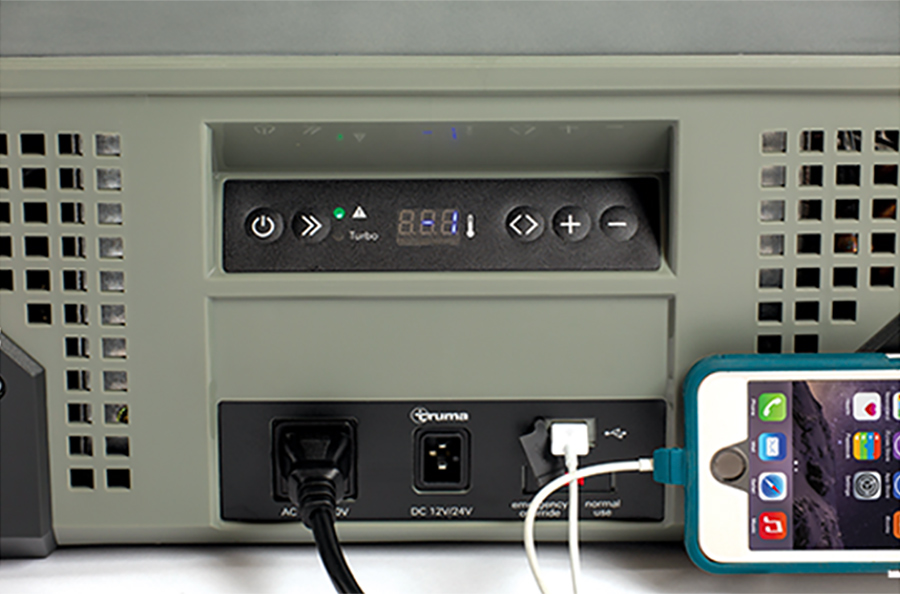
That last segment shouldn’t be ignored. While we tend to focus more on the built-in appliances in RVs, portable units like the Truma Cooler not only allow them to be utilized by the wave of smaller “adventure” travel trailers, they also lend themselves well to use in other environments. These smaller portables also feature technology to a greater degree than their traditional-sized counterparts. The Truma Cooler, for example, can be powered by either 12-volt DC or 120-volt AC — drawing just 0.5- to 1.1 amps per hour, depending upon the size of the unit — and boasts intuitive digital display with set-point/actual temperature and “fast turbo” cooling, individually adjustable temperature zones on dual-zone models, internal LED lighting, Bluetooth app control and even a USB port for charging devices.
Among 12-volt DC refrigerators designed to be integrated into to RV cabinetry, the “sweet spot” seems to be the 8- to 10-cubic-foot size, a landscape populated by all four full-size refrigerator manufacturers. Not coincidentally, these dimensions fit the appliance needs of the largest segments of towable and motorized manufacturers.
At present, only WAY builds a 12-volt DC unit that rivals larger residential-style 120-volt AC refrigerators in size and capacity. As a consequence, its 17-cubic-foot model is finding its way onto fifth wheels and Class A motorhomes — particularly on RVs intended for extended off-grid camping excursions. For example, Alliance RV calls itself “The masters of 12-volt” and claims to offer more 12-volt DC systems in its Valor toy hauler than similar rigs on the market. Between standard equipment and options, virtually everything on the Valor — from the fuel tank pump to the power recliners, slideouts, furnace and, yes, its 17-cubic-foot Everchill refrigerator — can be powered by batteries fed by 640 watts of solar panels. Still, that begs the question: Why opt for a 12-volt DC refrigerator when current RV power sources (using inverters and converters) and gas-absorption models get the job done — even when boondocking?

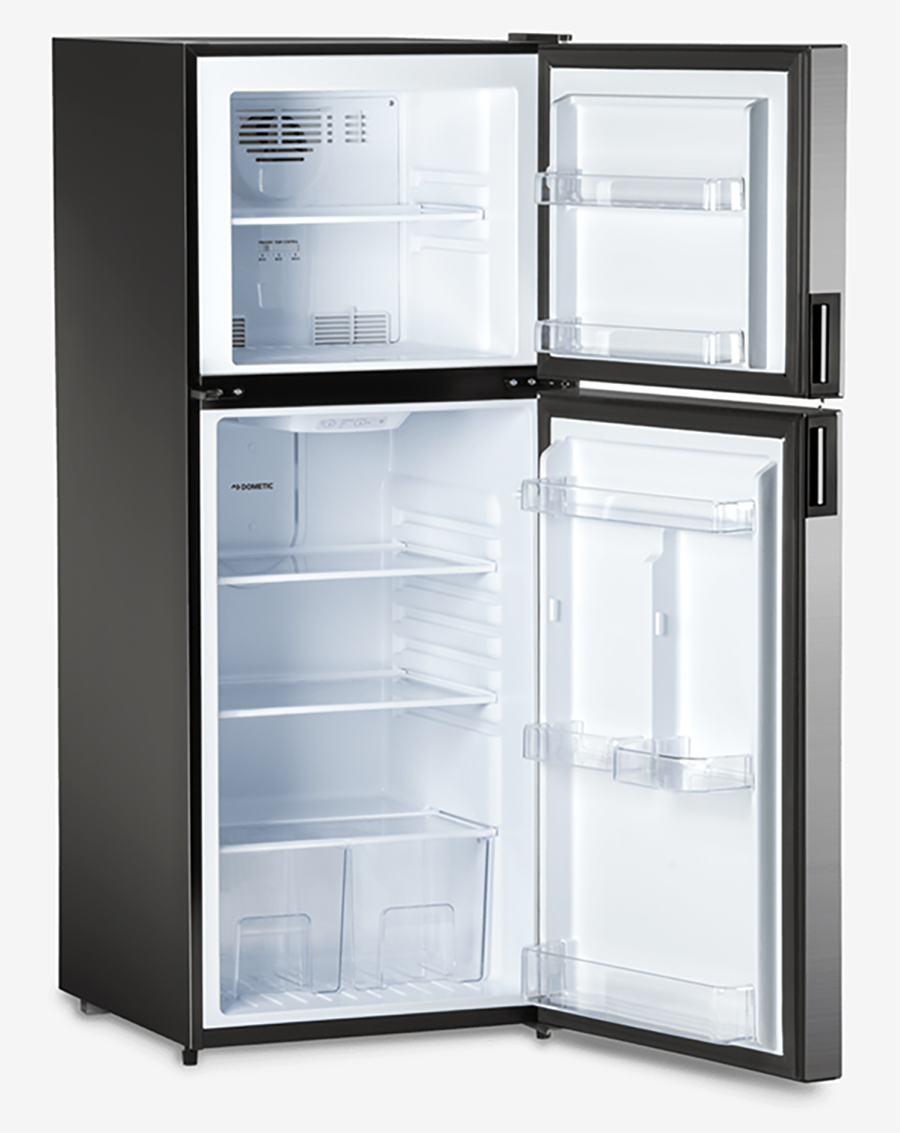

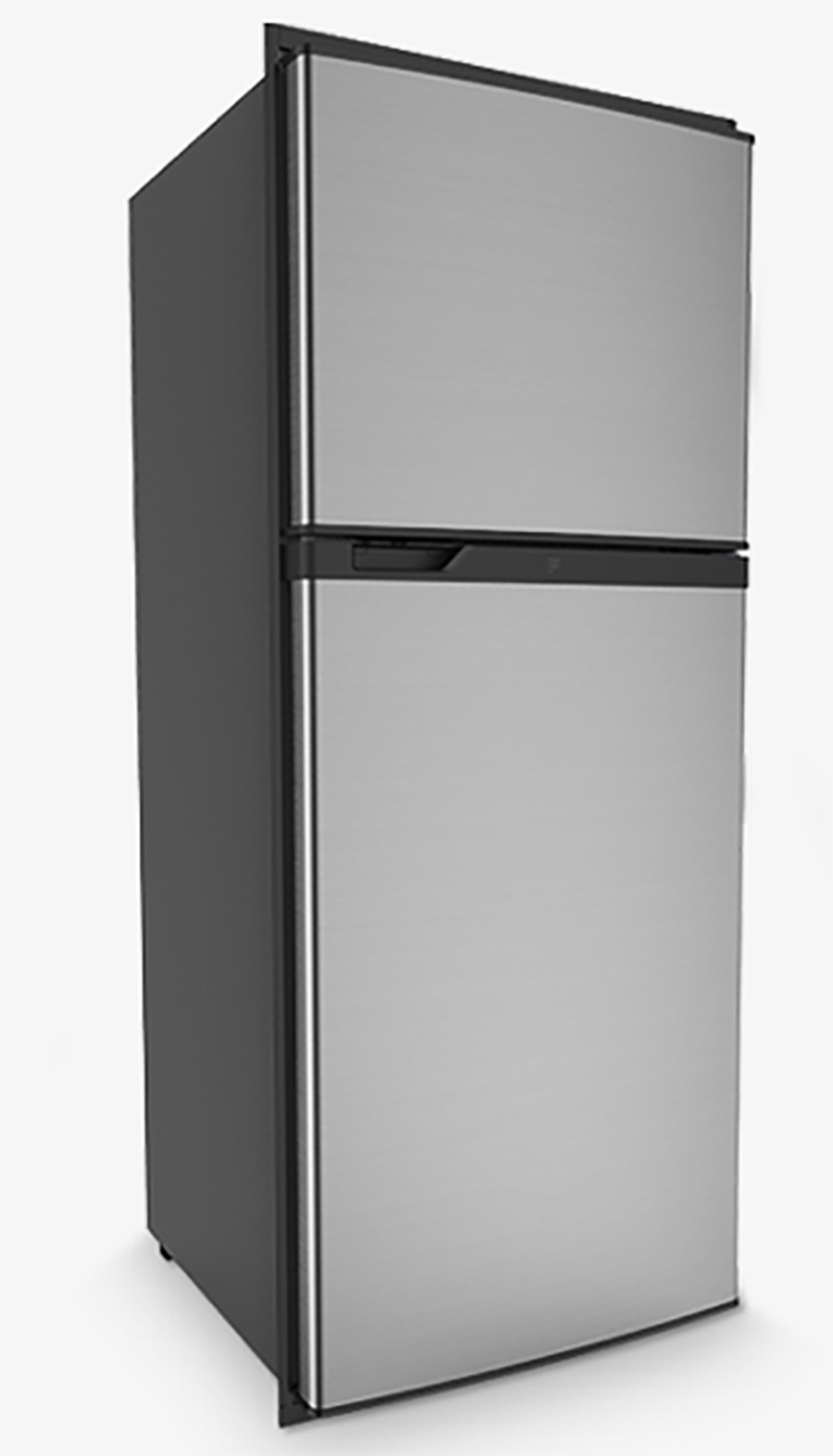
Aside from the cost differential between a replacement gas-absorption unit and a similarly sized 12-volt refrigerator — a matchup that the 12-volt unit will win every time — there’s also the question of capacity. Without the need for a gas-absorption unit’s bulky rear coils and the full metal jacket that typically envelops a residential refrigerator, manufacturers are able to create larger interior dimensions within the same external dimensions as a smaller gas unit.
“What you don’t have is an absorption cooling unit that takes up so much room on the backside,” Thetford/Norcold Product Manager Eric Klein told the RV trade journal RV Pro. “Your refrigerator may be the same width and height, but it’s deeper, so you can fit more contents on your shelves.” As Klein explained, the design differences often mean a 10-cubic-foot model, for example, can fit within the enclosure previously home to an 8-cubic-foot absorption unit.
There are other benefits, as well. Compressor refrigerators aren’t susceptible to the same limitations as gas-absorption units, which can malfunction if the RV isn’t level, and aren’t nearly as heavy. Plus, said Greer, they are easier to work on.
“When a typical three-way (12-volt DC, 120-volt AC and propane) gas-absorption unit stops working, it can be tough to troubleshoot,” he said. “It could be 12-volt power, it could be AC power, it could be propane issues — you’re dealing with three different power-supply sources, so determining the fault takes time. We’ve built self-diagnostics into our circuit board; you can test it and it will tell you what to check.”
All other benefits aside, it still oftentimes comes down to the power draw — especially when you’re camping without hookups.
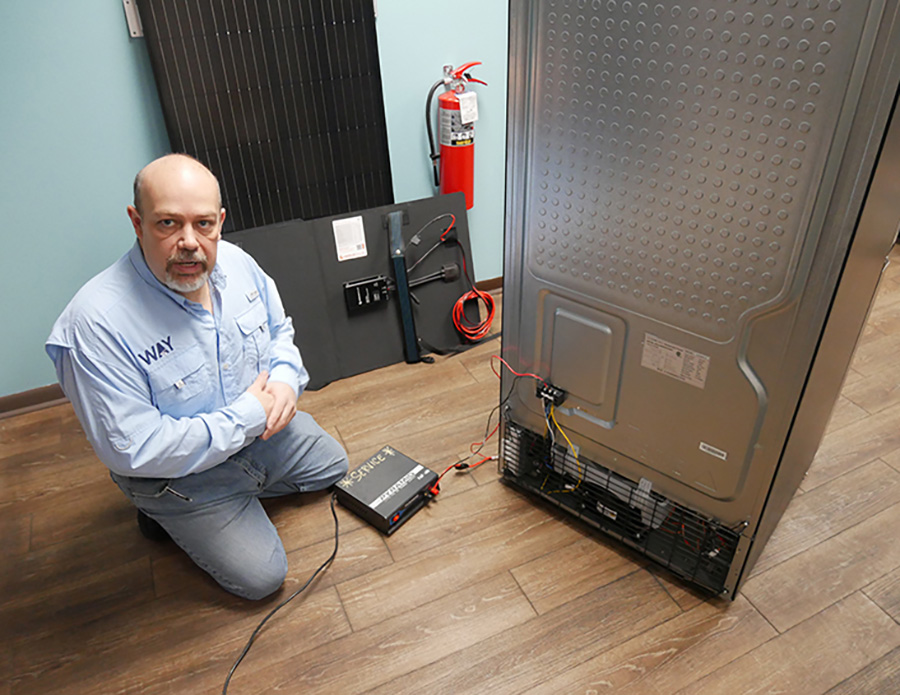

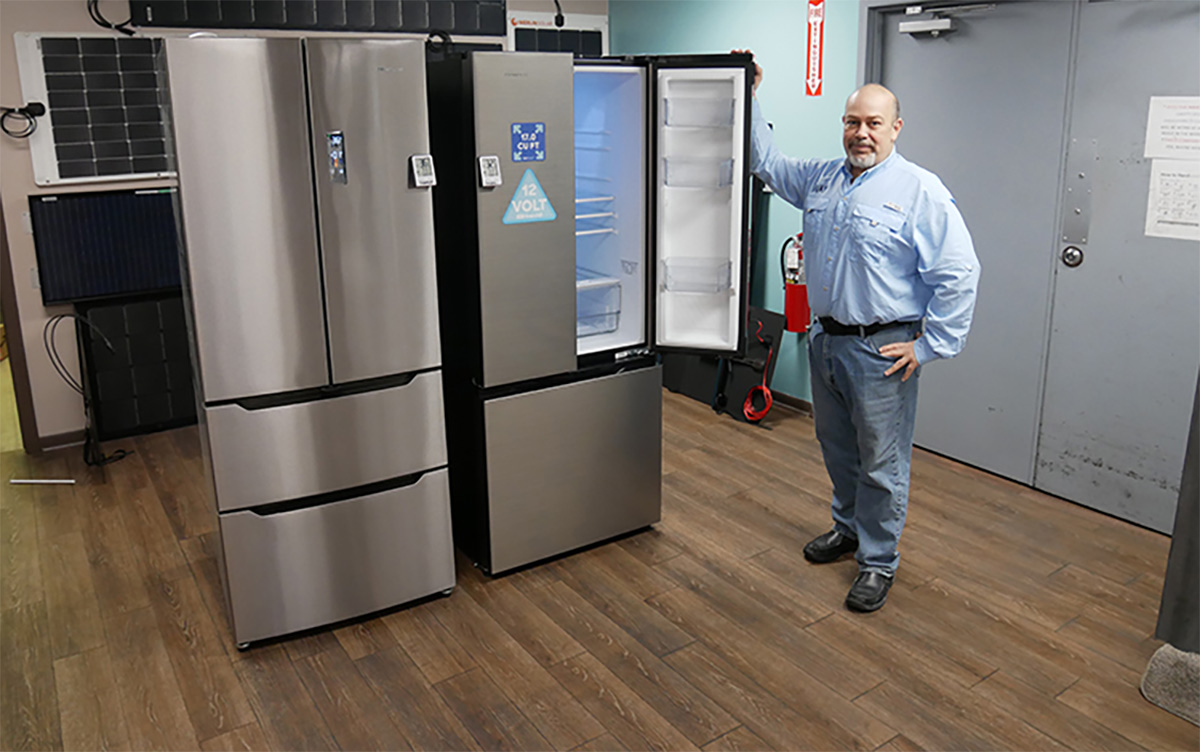
To hammer home the performance of its 12-volt refrigerators, WAY’s Elkhart headquarters includes a showroom for the products the company distributes, including its proprietary brands like Everchill. There, a 17-cubic-foot Everchill 12-volt DC refrigerator/freezer (hooked up to a power converter) is set up alongside a comparably sized Hisense 120-volt AC residential-style unit. Temperature monitors on the front doors of each reveal what’s going on inside each. In a 71-degree showroom environment, the Hisense is running at a steady 36 degrees inside. The Everchill? 32 degrees.
We caught up with Greer recently at WAY’s Elkhart, Indiana, headquarters for a discussion of 12-volt DC refrigeration.
RVE: Chris, is there a limit to the size to a refrigerator that can be cooled by 12-volt DC technology?
Chris Greer: Yes, there has to be a limit always to everything, but we have had really good success with our 17 (cubic-foot model). In fact, we will shortly be introducing a new 18-cubic-foot, 12-volt refrigerator. So, I would say that we have not reached the limit yet, but it’s getting to a point to where it’s a balancing act between compressor and cooling size and power consumption. I think at some point we will reach that limit, where people just don’t want to have that size of current draw on a 12-volt compressor. But we’ve had great success, and R600 freon — I think nearly everyone manufacturing in the cooling side of the world, from air conditioners to refrigerators, has changed over to R600 — it is a more efficient cooling agent, so that actually helped all of our products, including larger-cubic-foot refrigerators.
RVE: How difficult is it to swap out an absorption refrigerator for a 12-volt unit?
Greer: So long as it’s approximately the same size cabinet, it’s extremely easy. You remove the absorption refrigerator and plug the gas line, obviously, so you don’t have any leaks. Then, depending on what size 12-volt wiring is in that cabinet, install the new unit. Sometimes the wiring can be used, while at other times it needs to be bumped up a bit in wire gauge. That’s really it, so long as the cabinet doesn’t require any modifications. We have several units that fit into the same size cabinets that some of the smaller absorption units do. But even when you are swapping units with the same exterior dimensions, you actually get more storage space out of a 12-volt refrigerator than you ever did out of the gas absorption refrigerator because the manufacturer can use all of the space — you don’t need to dedicate any of it to the coil in the back of an absorption refrigerator.
RVE: Speaking of wiring, what changes might be needed to equip an RV for a 12-volt DC fridge?
Greer: The big thing is distance from the battery or power center to wherever the refrigerator’s located. We have a pretty simple chart and follows closely with the RV Industry Association (RVIA) recommendations for wire gauge to current draw and we suggest 10-gauge wire up to 20 feet of wire run. But, again, I’d say please follow the RVIA suggested wire gauge code.
RVE: Is there a comparably sized 12-volt DC refrigerator available for every size of absorption refrigerator?
Greer: I’d say yes. For example, we offer 12-volt refrigerators from 1.7 cubic feet all the way up to now 17 and, shortly, 18 cubic feet of storage space. If we don’t have one that fits a buyer’s needs I would be highly shocked.
RVE: What do you recommend people do about the outside vents if they switch from absorption to 12-volt?
Greer: Leave them, they won’t hurt anything. As a matter of fact, I have an older unit that I put a 12-volt in that previously had an absorption refrigerator. I left the vents. There’s no need to plug them or close them off. They aren’t needed for the 12-volt unit, but it’s a lot of work to try and fill those holes that are cut into the sidewall and the roof.
Greer: It depends. If the refrigerator has been sitting unused at ambient temperature, it will draw 6 to 7 amps to cool down. One of the nice things about 12-volt DC refrigerators is they cool down quickly; our refrigerators will cool down in 45 minutes to an hour, depending on food load. After it gets to the temperature the customer has set it to, standby mode is going to be much closer to 1 1/2 to 2 amps of current draw (per hour). That number is effected by food load, how many times the kids open and close the refrigerator door and things of that nature, but we’ve worked very hard to try and make it very efficient. It doesn’t take a long period of drawdown time to get it cold and keep it cold.
RVE: What do you recommend for a battery bank and solar/renewable charging system?
Greer: If you are going to use it in a boondocking type of situation, our standard suggestion for is that you run two group 27 batteries and a minimum of 120-watt solar panel. That will essentially keep the refrigerator running indefinitely.
RVE: What’s the expected lifecycle of a 12-volt DC refrigerator?
Greer: We obviously offer a standard warranty on WAY units, but many, many units in the field are now approaching five and six years old with no issues at all. I really think of it like a house refrigerator. I’m not sure what a residential refrigerator lifecycle expectation is, but I’ve always expected my house refrigerator to last 10 years or so.
RVE: How do 12-volt DC refrigerators compare, cost-wise, to their gas-absorption refrigerator counterparts?
Greer: Traditionally they are much lower in cost than a gas absorption unit. I think gas absorption units are $1,500 to $2,000 in the aftermarket — our 12-volt refrigerators are nowhere near that. Once you get into some of the smaller-size 12-volts units like the 1.7-cubic-foot or 3.2-cubic-foot ‘mini-refrigerators’ the manufacturers are competing with 110-volt-powered units. In that market, 12-volt units will be a little bit more costly just because of some of the technology needed for the 12-volt, but it’s not a huge difference. But with our larger 12-volt refrigerators, we can go head-to-head cost-wise with a gas-absorption refrigerator all day long. We feel like it’s a very good value and it fits the RV lifestyle.