

nyone who has gone shopping for a car, bought groceries or eaten at a restaurant in the past few years has come to grips with a runup in costs not seen stateside in 40 years.
That holds true for RVs, as well.
Building units to meet specific price points is a juggling act for RV manufacturers in the best of times — and no one would characterize the past few seasons in quite those terms. Granted, the pandemic-fueled resurgence in the RV lifestyle pushed shipments and registrations to record highs, but even then, shortages of parts and appliances created by closed manufacturing facilities overseas — coupled with huge jumps in shipping charges — began to impact RV prices.
And then, of course, record consumer-price inflation reared its ugly head, followed by a near tripling of interest rates as the federal government worked to corral these rising costs. None of these factors could be controlled by the RV industry, but their after-effects are on display on dealer lots. Depending upon who you talk to, the total cost to consumers of towable RVs, for example, have increased in price anywhere from 25% to 40% or more just since 2020, forcing manufacturers to reevaluate what they offered — or didn’t offer — especially in the price sensitive entry-level arena.
“We faced a few less challenges when we started because of how we were sourcing and what we were sourcing,” said Bontrager. “A lot of the components we used to design our first Overland series RVs weren’t broadly used. The independent suspension we co-designed with CURT was brand new to the market, we imported windows from Europe which weren’t widely used stateside, we went to more of a composite build because there was such a struggle getting lauan to the states. We got really creative.”
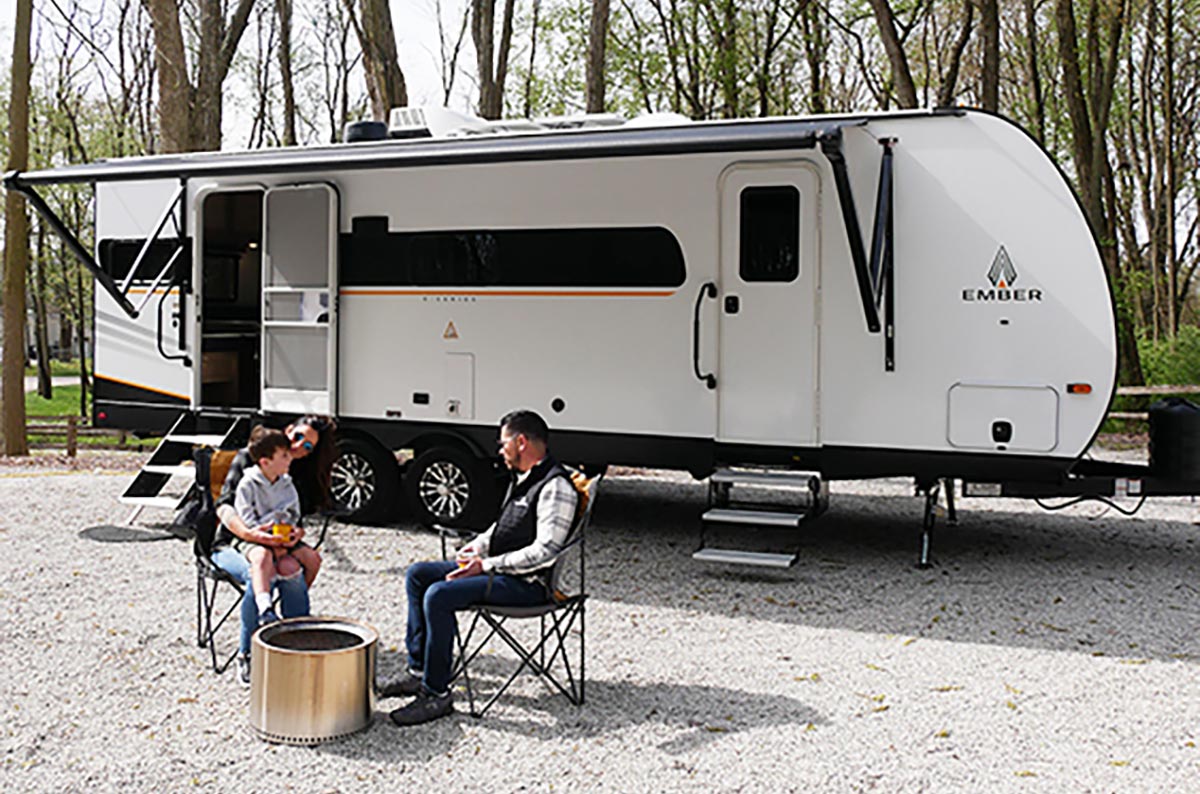
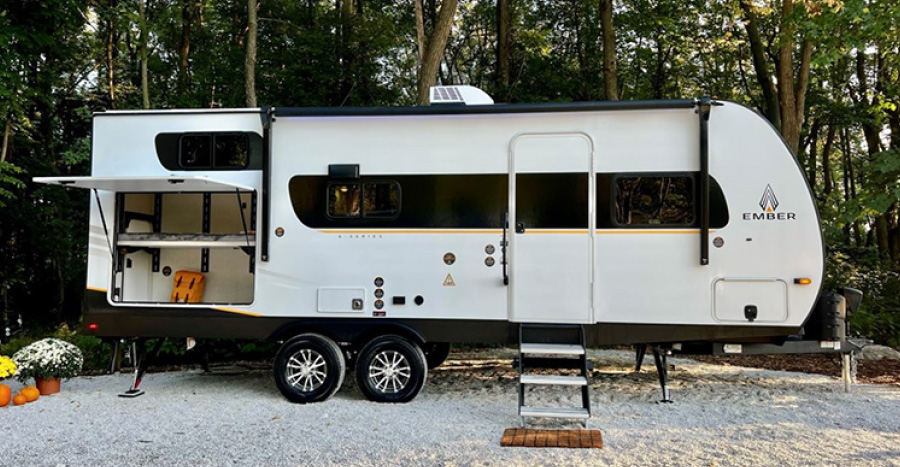
That said, the company has had to deal with rising costs associated with producing its Overland Series and Touring Edition travel trailers. Like certain other towable manufacturers RV Enthusiast contacted, Ember’s response to higher tariffs was the establishment of an entirely new line designed to appeal to more price-conscious buyers. Introduced in February, its new E-Series — the “E” stands for having the “essentials” needed for comfortable camping — is Ember RV’s first foray into a lower-priced line.
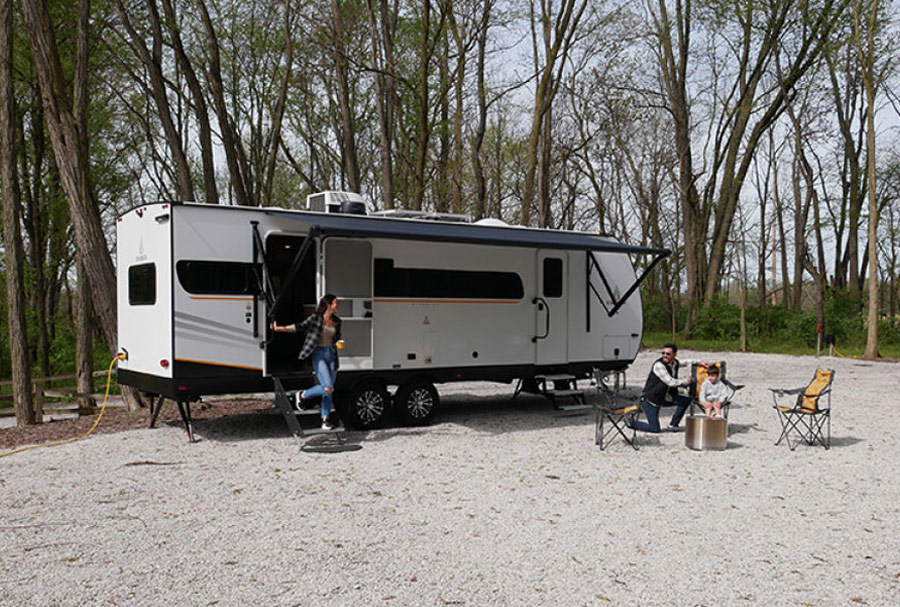
Currently available in five single-slideout floorplans, the E Series baselines beginning at $41,781 — more than $14,000 less than the company’s lowest-priced Overland unit.
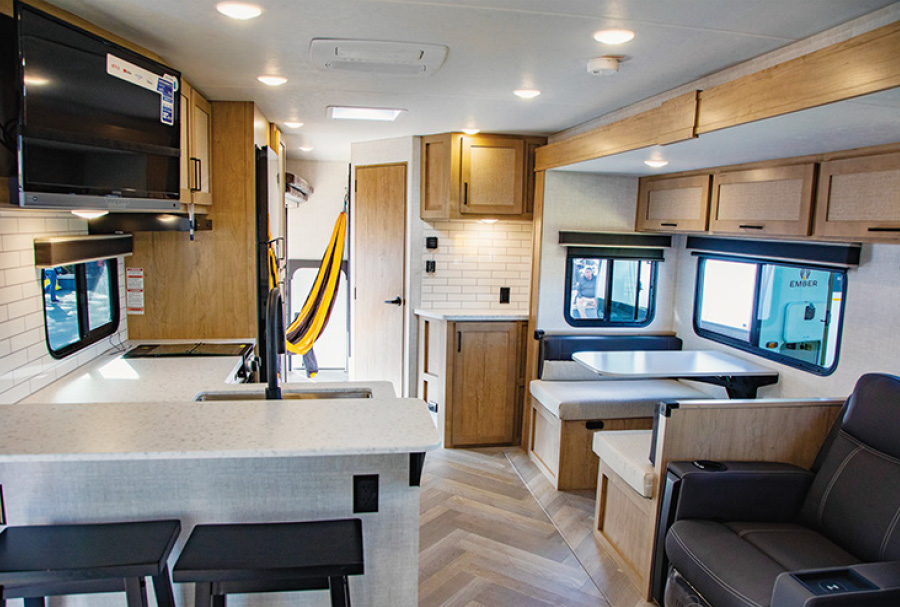
“We did have to make some concessions during design,” Bontrager pointed out. “For example, our E-Series doesn’t feature our caravan-style windows due to their higher cost and has more wood and less composite materials in its structure. We also went with a leaf-spring suspension with 15-inch Goodyear tires versus the CURT IS suspension and 16-inch Goodyears — but generally speaking, when someone looks inside an E-Series, when they touch it, they don’t notice some of these things because we delivered on the same level of fit and finish that our products have become known for.”
Neither are we talking about shrinking the unit’s footprint to reduce its cost. The E-Series is available in five single-slideout, tandem-axle floorplans from 27 feet, 1 inch to 31 feet, 7 inches and dry weight of 5,155 to 6,120 pounds. All feature 82-inch ceiling heights and Ember RV’s “Smart RV” system to control the slideout room, awning and lighting. Among them:
- 22ETS: A 27-foot, 1-inch family travel trailer (5,395 pounds dry) with a forward queen-size bed and rear bunk system offering multiple singe/double bunk configurations as well as a rear bike/kayak door and Ember RV’s new Embertrack, a repositional bunk/storage system.
- 22MLQ: A 27-foot, 1-inch “couples coach” with front sleeping and mid-unit living quarters, this 5,155-pound (dry) trailer shares the streetside slideout with theater seating and galley appliances; the curbside dinette looks out over the campsite.
- 24RLD: Built around a rear living area floorplan, this 28-foot, 7-inch, 5,580-pound (dry) trailer separates the main quarters from the front sleeping quarters with a full-width bath and is one of two E-Series units offering door access to either end of the unit.
- 25RUD: The second dual-door-access trailer, this 30-foot, 1-inch, 5,635-pound (dry) trailer is similar to the 24RLD, but features a U-shaped dinette along the rear wall; the streetside slideout is home to theater seating, a 12-volt refrigerator and pantry.
- 26ETS: Another rear bunk/forward bedroom suite model featuring Embertrack, the 6,120-pound (dry), 31-foot-7-inch 26ETS is built to sleep 5-8 persons; the mid-living area coach offers both the dinette and theater seating in the streetside slideout opposite the galley.
And, while the E-Series embraces the essentials needed for camping, Bontrager noted that the new line also features “a few extras” to make them stand out, including accessories like an air fryer as well as an 18,000-Btu rooftop “Whisper Quiet” A/C unit. An optional solar package (with two 200-watt rooftop solar panels, 2,000-watt pure sine wave inverter and MPPT controller) also is available, as is a wireless side/rear camera observation system.
“That particular air-conditioner is new to the market, and we love the fact that it is 18,000-Btu versus 15,000,” Bontrager said. “And, since we’re building “relatively” smaller units, they aren’t ducted on our E-Series except for one duct in a key location like a bathroom or bedroom. The 18,000-Btu unit provides amazing air-conditioning capability — and it’s extremely quiet. So it has a lot of benefits for the customer, which we really like.”
Offering an air fryer is likewise new to the market.
“It’s actually a convection microwave with air fryer capability, so you get all three possibilities in one appliance, which is fantastic — not only for usability, but saving space,” Bontrager said.
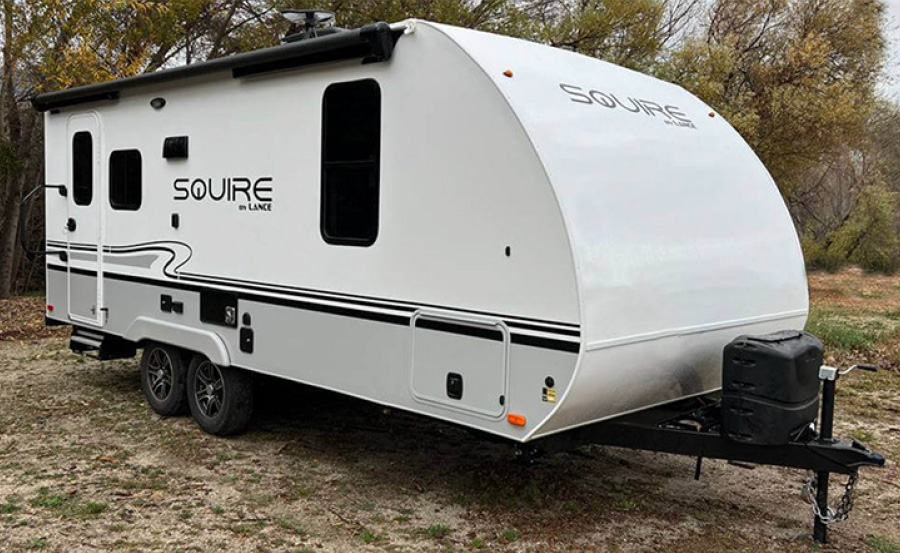
“Lance has always positioned itself as a premium brand in the trailer market ever since we entered it 15 years ago,” said Marketing Manager Jim Waters. “We’ve had conversations for a while about expanding our line, doing what we used to do with truck campers when we had the Squire (entry-level), Max (mid-level) and Legend (premium level). We decided now was the time to move forward with the product.”
The Squire, said Waters, still carries Lance’s construction “DNA” — from its dual Azdel walls and CNC-cut and pressure pinch-bonded floors, sidewalls and ceilings to its no-truss roof — while equipped at a trim level “that is more approachable from a price standpoint.”
The first Squire, the 19-foot, 2-inch SQ19, debuted at September’s Elkhart RV Open House. The SQ19 floorplan is a copy of the company’s single-slideout Model 1985 travel trailer, though it comes in substantially lighter (4,380 pounds dry, compared to 4,950). The weight reduction, noted Waters, was achieved by evaluating virtually everything inside and out — the SQ19 features different doors, windows, air-conditioner, furnace, cabinets and more. A larger model, the SQ26, is already on the drawing boards and is, said Waters, a new floorplan to Lance with a large streetside slideout housing both a dinette and theater seating. Future floorplans, he added, will be a combination of new layouts and popular floorplans from existing Lance units.

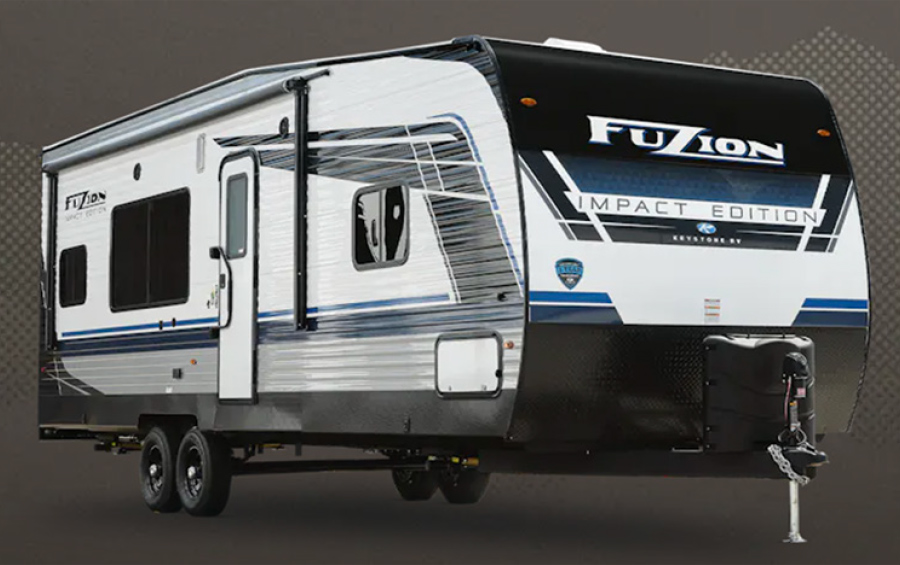
“What was traditionally a $19,900 unit all of a sudden cost $27,900 or $28,900. Our brands just grew beyond the typical price points driving the market at retail,” he said. “We needed to work hard to design floorplans in such a way that we could get back down into those high-volume price points for our dealers with something the customer wants to own.”
The new model extensions actually give Hideout and Springdale three unique market segments. Each starts with compact, single-axle models that, said Rank, retail for less than $20,000. Between them and the fully featured full-size units are the new Hideout Sport and Springdale Classic dual-axle travel trailers — limited floorplans that are “generally a bit more price-sensitive that we looked at carefully to take out weight and cost and lower the price.” Changes include a move away from solid-surface countertops, less elaborate furnishings, slightly smaller windows and, in some instances, smaller cabinetry.
“We had to look at every nut and bolt and feature and determine whether it made sense to eliminate it or massage it a bit to drive the price out,” Rank said, adding that the two new model extensions will start around $24,000 MSRP and go to about $32,000. Comparatively, retail prices for the full-featured counterparts begin in the high $20,000s and top out at about $40,000.
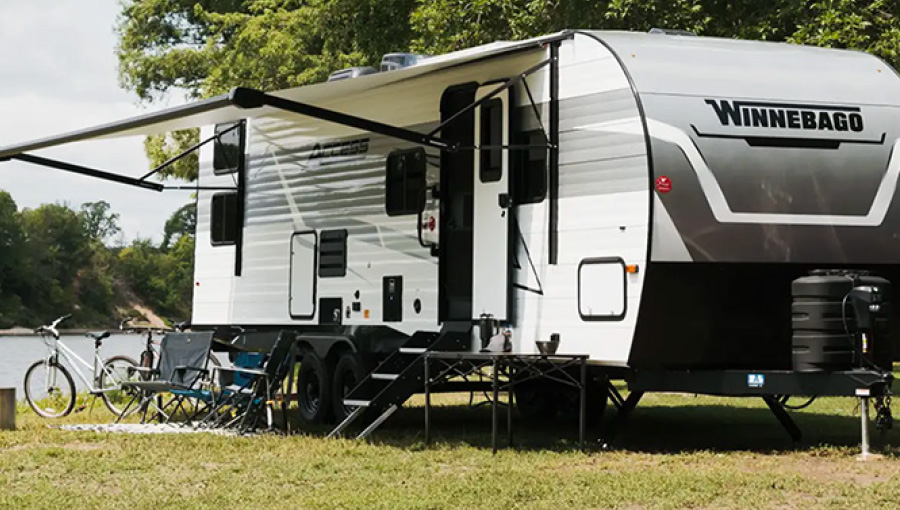

Access also is built with the full slate of what Winnebago refers to as “red thread” features, including a 200-watt solar panel, 30-amp charge controller, tire pressure monitoring system, independent electric stabilizer jacks, two-inch accessory hitch receiver, 12-volt tank pad heaters and Wi-fi prep.
The gestation period for the laminated M-Series, said Smith, was substantially shorter, going from concept to finished unit in about a year’s time. Two floorplans are available, with lengths of 25 feet, 8 inches to 26 feet, 7 inches; MSRPs start at $27,860. Both twin-axle models carry 6,000-pound GVWRs and, with the exception of the two-inch receiver and power stabilization jacks, is outfitted with the same read thread features as the Access.
“Our whole idea with the Access was that we can put an entry-level product out in the market that isn’t completely de-contented,” said Smith. “It has creature comforts that we think consumers at that price point still want, and we could still hit key price points that are attractive to them without sacrificing interior build quality, features or the overall look of the unit.”
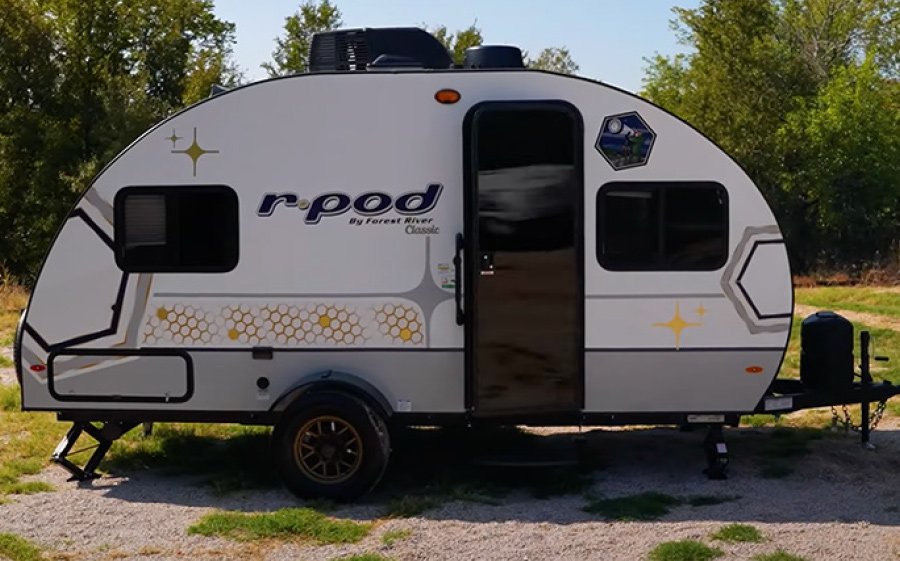
Like most existing brands, the R•Pod had gotten comfortable over the years, Holdread noted, adding features and weight. Major changes to the Classic edition included eliminating the front window and power A-frame tongue jack, along with a switch back to a leaf-spring suspension — which had the side benefit of lowering the trailer’s center of gravity. Taken together, the changes resulted in shedding substantial cost: MSRPs for the Classic, said Holdread, begin in the $30,000s, while a traditional R•Pod — now known as R•Pod Ultra Lite — is in the $40,000 range.
The Classic also helps the brand return to its lightweight roots. Five floorplans are currently offered, from the 1,789-pound (dry), 15-foot-long RP-107C to the 3,447-pound, 20-foot-long RP-180C.
“We’ve never been focused completely on trying to capture that entry-level price point,” said Holdread. “And that’s not what we’re trying to do here. Obviously, we’re trying to put a more affordable, appealing product out there to that first-time buyer, but we’re focused on trying to give our customers what they want. That doesn’t always mean just taking content out of a product. It means making the product a better fit.”