

Powering Off-Road —
and Off-Grid — Adventures
t’s one of the great conundrums of the RV industry: As manufacturers continue to ship motorized and towable units to dealers at a record pace, ever-greater numbers of RV owners vie for a finite number of campsites where they can enjoy them.
Rather than being perceived as a brake on RV sales, however, the scarcity of campsites — especially on popular holiday dates and weekends — has given wings to an RV lifestyle nearly as old as the industry itself: off-grid and off-road camping.
“It’s something that a lot of us in the industry have been concerned about for a handful of years — how do we create a product that the consumer doesn’t have to use in a campground?” said Cody Schade, product manager for Forest River Inc.’s No Boundaries and IBEX “adventure trailer” lines. “Having those conversations is what led us to develop No Boundaries, and now we’re adapting some of its traits to other (Forest River) products. I think you’re going to see this topic take on greater significance.”
Indeed, if there was ever a trend evident in new model year RVs, it is more and more OEMs are developing units designed to go off road and/or off the grid. Why the “and/or”? While there is plenty of overlap, it’s not just semantics: off-grid and off-road are actually two distinct elements.

It’s rare, but an RVer can be off the grid without being off-road. Member-based organizations such as Harvest Hosts are pairing RVers up with private landowners whose properties — wineries, golf courses, breweries, etc. — aren’t necessarily the wilderness, but they also typically don’t have a 30- or 50-amp pedestal nearby.
“I think we’re still as an industry working to define the differences between ‘off-road’ and ‘off-grid’,” said Schade. “An off-road RV needs the same systems to survive that an ‘off-grid’ unit does — along with enhanced clearance and more aggressive tires to negotiate uneven terrain as well as an underbelly enclosure to keep out dust and debris. So, there is a difference between the two, but right now we tend to use the terms interchangeably.”
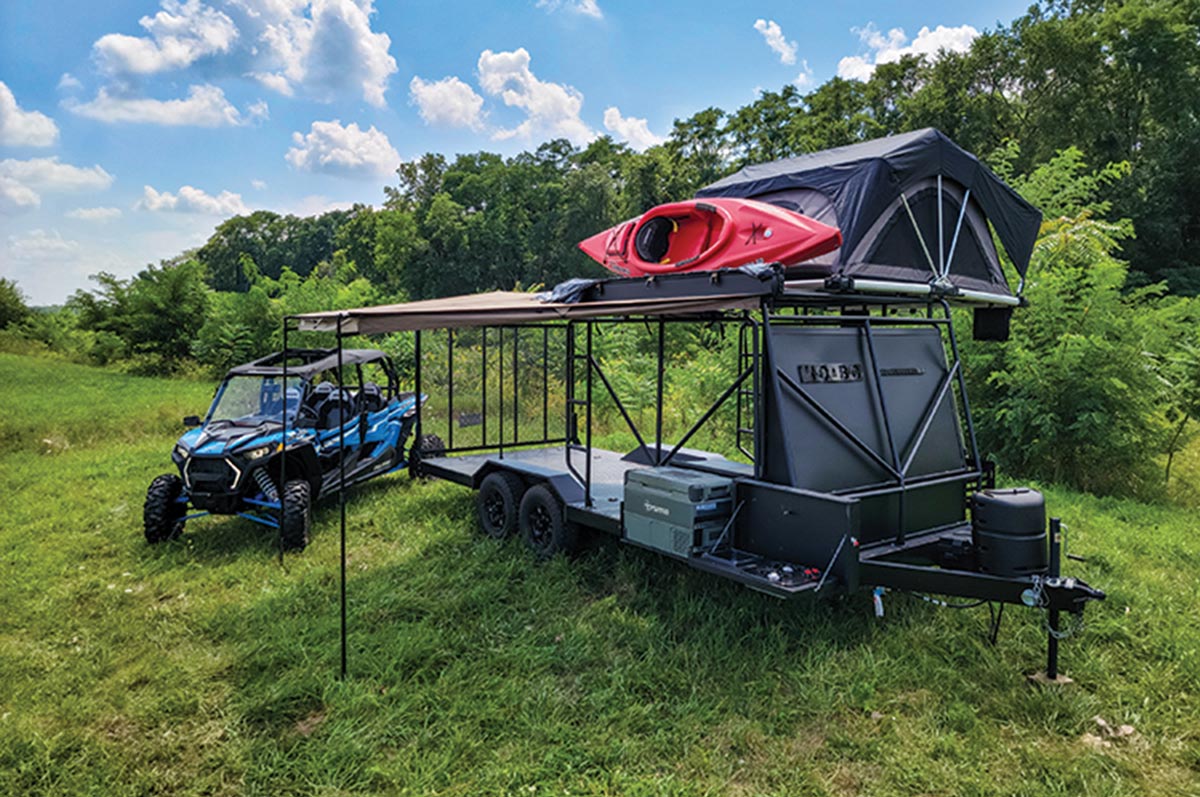
A case in point might very well be No Boundaries’ 10.8, introduced last year. Essentially an open-framed unit with a rooftop tent, 40-gallon freshwater capacity, flexible solar panels, outdoor kitchen and Goal ZeroYeti 1500X Portable Power Station, the 10.8 is expressly designed to carry motorized toys — up to and including a four-seat Polaris RZR ATV. To the consumer, it appears for all the world as if it was designed for off-road use. And it most assuredly can be — but Schade sees it as an off-grid platform.
Meanwhile, the IBEX, launched in 2020, carries similar equipment — but also sports all-terrain tires, increased ground clearance and heated and enclosed underbelly. Call it “off-road” capable.
See what we mean?
Power Storage a Strict Necessity
Absent adoption of a more generic, all-encompassing classification such as “adventure RV,” the most telling difference may simply be size: No matter how stout the tow vehicle, you can only pull or drive so much weight across uneven terrain or deep powder-covered ground.
Meanwhile, the biggest inroads to off-grid performance are being underwritten by manufacturers of more expensive fifth-wheels that can absorb the quest for new technology before it “trickles down” to more affordable units. And that usually revolves around solar power — a trend certain to pick up steam now that the California Air Resources Board has voted to ban the sale of portable gas-powered generators effective 2028. (Like it or not, the Golden State tends to set the trends, especially when it comes to taking a strong stand against air pollution; its standards for low-emission vehicle (LEV) criteria, pollutant and greenhouse gas emission (GHG) regulations and zero-emission vehicle (ZEV) regulations have been adopted by 14 other states.)
Keystone RV Co., for instance, initially made its Super SolarFlex off-grid package available a few years back on Montana, Raptor and Fuzion models. At the time, it was a $20,000 upcharge and included four 250-watt solar panels for a combined 1,000 watts of solar collection. As of the 2022 model year, the Goshen, Ind.-based subsidiary of THOR Industries Inc. announced all its brands will come factory-equipped with one of four SolarFlex packages. They range from 200 to 1,200 watts of power, with increasingly advanced support components — and increasingly high tariffs.

And, let’s face it: anything the manufacturers can do, you can probably do better — or, at the very least, find a reputable company to create what you need. With manufacturers well aware of what current owners are doing to their rigs, aftermarket trends oftentimes fuel many of the design innovations found at the OEM level. We at RV Enthusiast are big believers in solar and have, in fact, run various articles on assembling capable solar systems in the past. And, just last month, we ran an extensive look at DC-to-AC inverters needed to amplify the 12-volt direct-current (DC) charge the house batteries provide into the needed 120-volt alternating-current needed to power most systems in an RV beyond the lights, slideout rooms and maybe the refrigerator (see “Sine Language,” RV Enthusiast March 2023).
We thought it appropriate, then, to take a look at batteries this time around, because all the sun’s energy in the world won’t do you much good if you can’t store it until you need it. And any discussion of 12-volt batteries for RV use is by default really a discussion of lithium-iron phosphate (LiFePO4) battery systems. (Related discussions on battery monitors, managers and chargers will be shelved to a future date.)
“As we start talking about bigger battery banks (for powering off-grid excursions), lithium makes a lot more sense than lead-acid or AGM (absorbed glass mat) batteries,” said Kyle Cameron, product and engineering manager for Dometic’s Go Power! mobile power solutions division. “Lithium batteries are much lighter weight, will last longer and you can store more energy in them.”
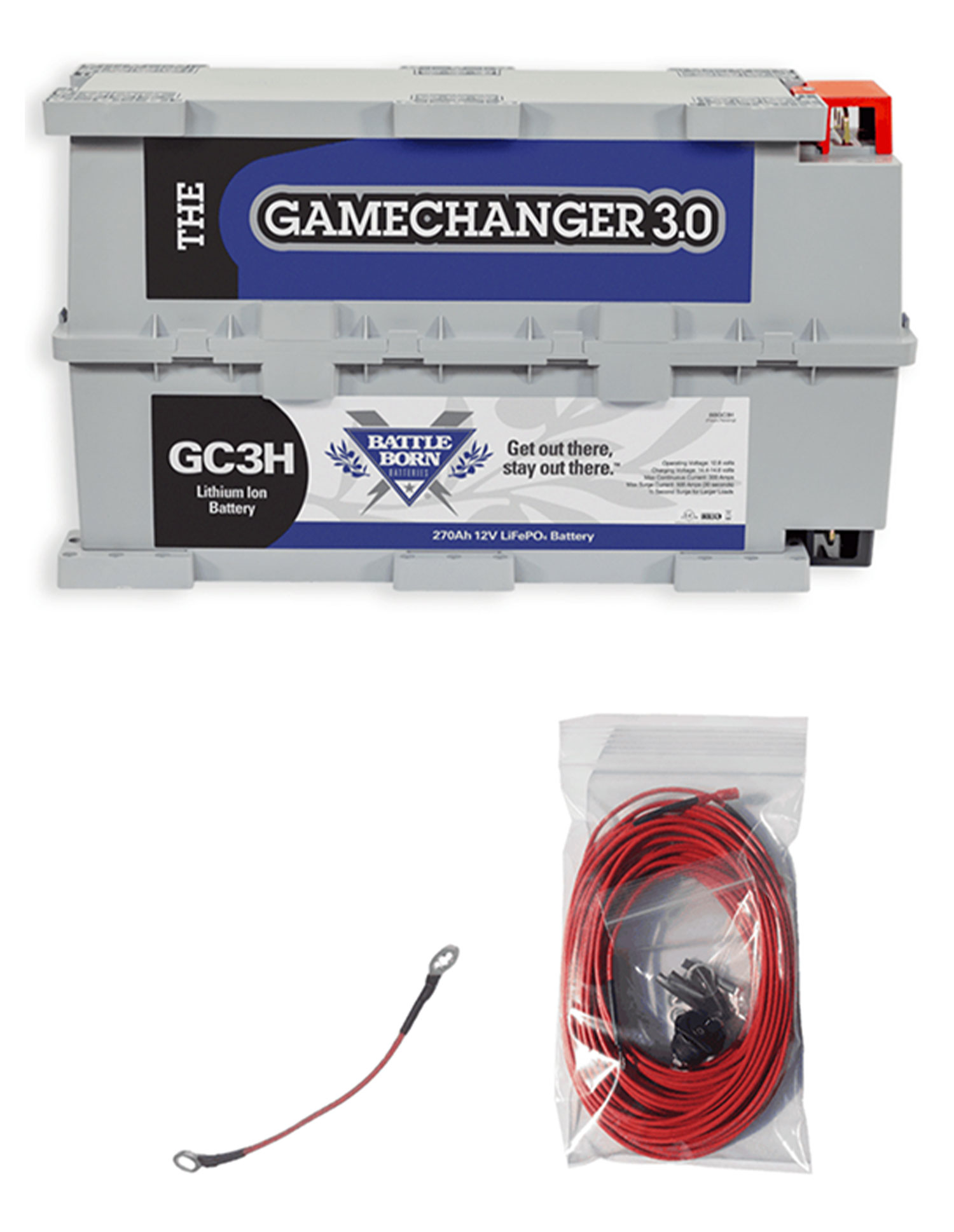
Battle Born offers many of its lithium-ion batteries — including the 270 amp-hour Gamechanger GC3 — separately or with a heated battery kit. The GC3 is built with a unique battery case and shape that can be placed anywhere, while the GC3H (“H” for heated) uses proprietary, low-draw technology to keep the battery warm in low temperature conditions. The heated kit includes the battery, heat battery kit and heat battery jumper wires.
While AGM is a step up from sealed lead-acid batteries — the main difference is the addition of a thin glass mat “separator” that absorbs the electrolyte to prevent possible spilling of the electrolyte should you inadvertently knock the battery on its side — neither should ever be discharged past 50% of its capacity (expressed in amp-hours). The same can be said of gel batteries, which suspend the electrolyte in a gel paste inside the battery case.
“Acid batteries really like being at 100% charge all the time,” said Cameron. “The more time they spend at less than 100%, the less life you’ll get out of them. For example, if you only discharge an AGM battery to 50% capacity and then charge it all the way up again, you might get 1,100 cycles out of it. But if you frequently discharge it all the way, you might only get 200 or 300 cycles before it needs to be replaced.
“With a lithium battery, it doesn’t mind if it’s not at 100% — you could have it sitting at 50%, for example, and it won’t significantly affect its lifespan. Even completely discharging a lithium battery won’t damage it.”
At Dragonfly Energy, company Co-Founder and CEO Denis Phares and Wade Seaburg, director of business development and outside sales, told RV Enthusiast the fact that the growth of their company — known for its Battle Born brand of lithium-ion phosphate batteries — coincides with the greater adoption of lithium batteries is not a coincidence.
“We like to think that we had a lot to do with spreading the word, and educating folks on not just how to replace your lead-acid batteries with our lithium batteries, but how to experience the full benefits of the power you can get to power your microwave, your hair dryer and even your air-conditioner,” Phares said.

This 850-watt solar system installation featuring five 100 amp-hour Battle Born batteries, is representative of the high-end solar systems custom-built by AM Solar. Photo by Chris Hemer.
Phares added the sky’s the limit for lithium battery technology.
“We feel the entire movement to being able to live off-grid — and living off solar panels, for example — is something that’s going to become far more prevalent beyond the RV business,” he said.
Of course, lithium batteries are not completely devoid of drawbacks — chief among them its sensitivity to low temperatures. That’s why many people who utilize a lithium battery bank in the winter employ an eternal battery blanket (heater). They also usually require a different charger. However, battery manufacturers are well aware of this and are taking steps to mitigate issues.
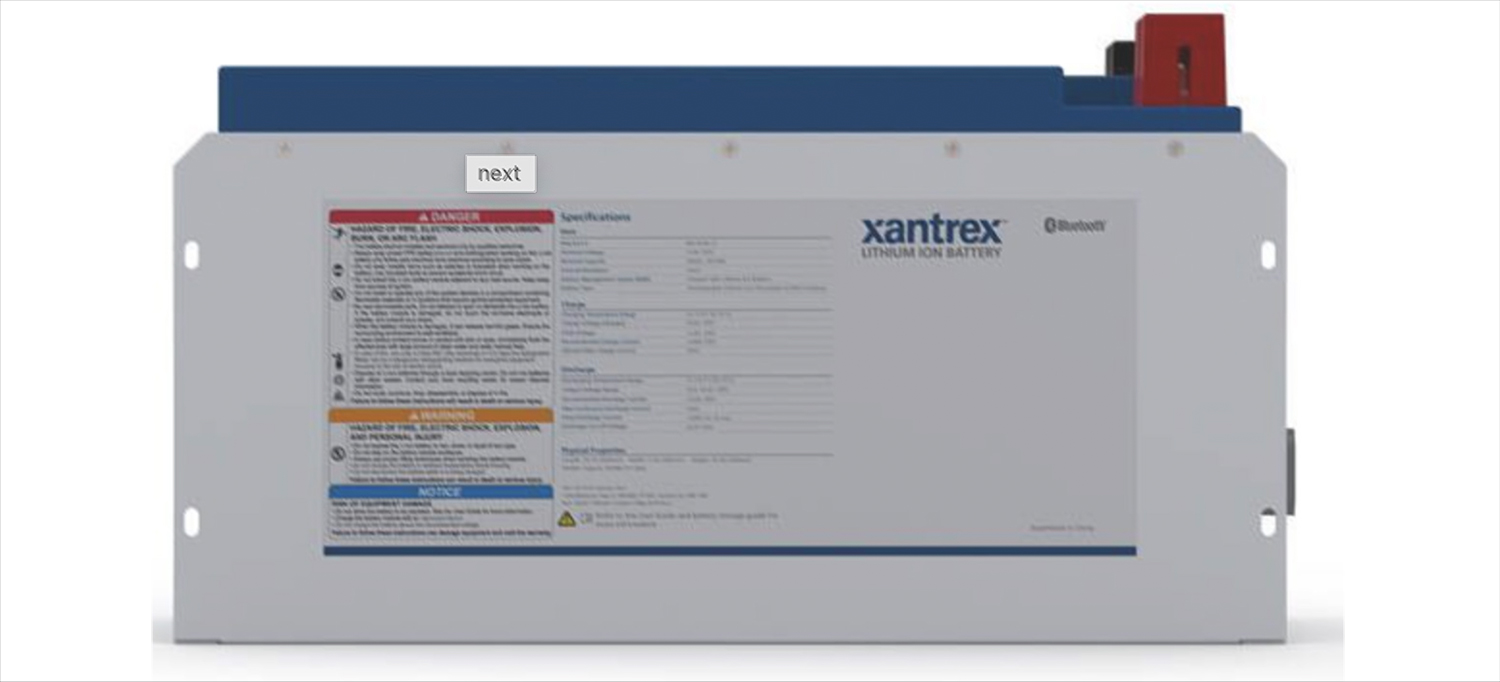
For example, Go Power! currently offers a 100 amp-hour lithium-iron phosphate battery with an internal battery management system (BMS) and heat management; the BMS continually measures temperature and protects the battery from becoming unsafe or damaged. Meanwhile, the company will shortly be releasing an “advanced” version with a host of additional upgrades — including a built-in heater for year-round performance. Compared to its 100 amp-hour solar battery, the 100 amp-hour Advanced also will feature larger cells (50 amp-hour versus 25 amp-hour) that mean less connections between cells to further reduce internal resistance, staggered terminals for ease of wiring in series or parallel, is RVC-compatible for higher-end RVs utilizing the Control Area Network bus to allow house and chassis components to communicate, and is Bluetooth-enabled so owners can monitor the battery status remotely. Cameron also let it be known that a 300-amp-hour Advanced battery also is in the works.
- If you want to run an air-conditioner, you will get about one hour of runtime on a 15,000-Btu A/C running on “high” per every 200Ah of lithium battery capacity. You will also need at least a 3,000-watt inverter and an EasyStart Kit.
- Roughly every 100 watts of solar will produce about 25Ah (or 300Wh) of charge per day.
- A minimum of 500 watts is recommended for any system with a residential refrigerator.
- With lithium batteries, there is no “solar panel to battery” ratio. This only applies to lead-acid batteries, because it is necessary to top these off at least once a week; lithium batteries do not need to be topped off. If using lead-acid batteries, the ratio is 1 watt solar for every 0.5-2Ah of battery.
There is, truth be told, another drawback to lithium-iron batteries: cost. A quality 12-volt lead-acid battery can be had for about $150, while an AGM battery will easily double that. Buy a lithium battery and you might not get change back from $1,000.

However, as PowerTech Advanced Energy Storage Systems outlined on its website, any discussion of a lithium battery’s cost must also include its lifespan — which is about six times that of its lead-acid counterpart — and discharge rate. Even taking into consideration a lead-acid AGM battery’s 50% discharge rate — and, hence, using a 50 amp-hour lithium battery as a comparison — PowerTech noted that the AGM battery would be good for 500 cycles compared to 3,000 cycles for the lithium-ion.
Factoring in everything from battery cost and transportation to installation cost, PowerTech assigned a cost of about 42 cents (0.42 euros) per cycle to the AGM unit and about 17 cents (0.15 euros) for the lithium battery. Even removing the transportation and installation costs — not usually factors for most RVers — the lithium battery still is a more worthwhile investment.
Depending upon your lifestyle requirements, however, that initial outlay can be substantial. As AM Solar President Garrett Towne explained, “Before, it was more a matter of ‘let’s keep our batteries healthy.’ Solar systems were a lot more basic — and, because of that, more popular with smaller RVs. Now, the technology exists to take a 40-foot fifth-wheel off the grid for a week. When I first started, the biggest jobs we’d ever do cost about $20,000. Now, we’re doing $20,000 jobs regularly — and have even had some that were more than $50,000.”

As this callout highlighting the various features engineered into the new Go Power! Advanced lithium-ion battery demonstrates, modern technology has transformed 12-volt batteries into power stations that do a lot more than simply provide a ready source of electric current. This is yet another argument in favor of lithium.
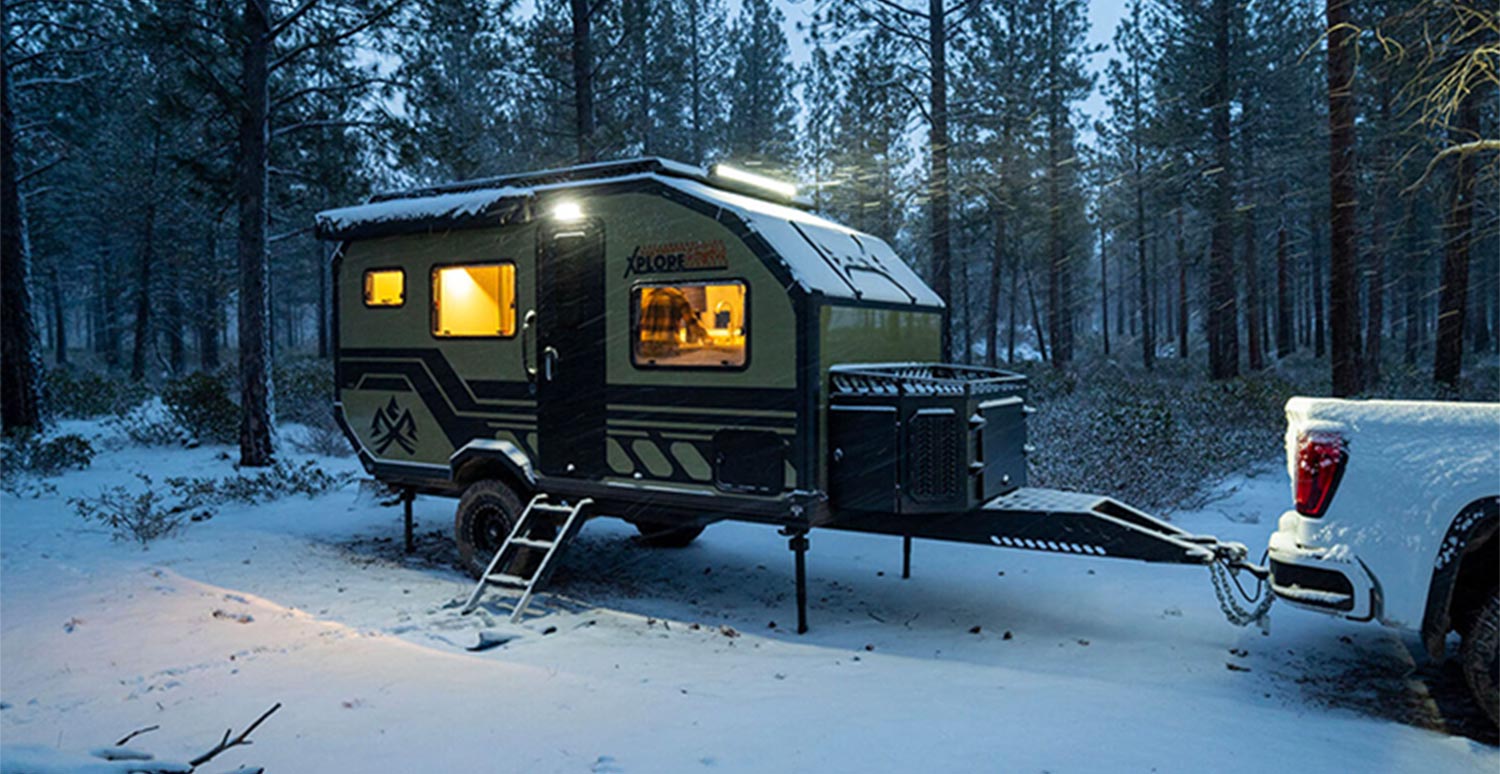
High-end factory installed systems also carry a hefty pricetag. The rugged 2023 Imperial Outdoors XploreRV X145 four-season overland trailer seen at the beginning of this article boasts a battery system using Go Power! and Expion360 components, including a three-battery package (1,080 amp-hours total) and 740-watt solar roof panel kit — which added $17,000 to the trailer’s bottom line.
For most RVers, however, such systems are well out of the norm. However, while “starter systems” that include a 110- or 120-watt panel and an inverter are fast becoming the standard with factory-installed solar, such setups really only work well to keep the battery topped off for a weekend while offsetting 12-volt DC loads such as lights, fans, water pumps and slideout motors. Many solar suppliers recommend a slightly more robust package to truly enjoy life off the grid.
“I would say the bare minimum needed to just run basic RV operations would be 200 watts of solar and 200 amp-hours of battery, with a charger to keep the charge up,” said Cameron. “But if you want to power other accessories — your refrigerator, microwave, along with other AC-powered components at times — you probably want to double that. Using lithium batteries. If you only have AGM batteries, though, you’d have to double it again, because you can really only use half of their capacity.”
And you’ll also have all that weight to contend with.