

ater has been the nemesis of recreational vehicles almost from the moment the first RVs were produced more than 100 years ago. Actually, the problem isn’t water by and of itself, but the fact that the average RV today has dozens of openings cut into its outer skin. Some are as small as screw holes to cinch down rooftop vents, satellite TV antennas and the like, while others are major cutouts for doors and windows — and every one of them presents a possible incursion site for water to leak into the RV if they aren’t properly maintained and repaired.
Of course, once water does manage to find its way inside, bad things tend to happen. Most RVs continue to be built with wood internals, from framing to floors — and wood has a tendency to attract water like a magnet attracts iron filings. Over the long term, this creates wood rot as fungi attack the wood and cause the fibers to degrade. Most wood craftsmen will tell you that four conditions need to be present for this to occur: wood, oxygen, warmth and, of course, moisture. Obviously, all exist in a typical RV environment. It’s a simple problem with complex solutions, because while you can reseal incursion points, once the water is inside the only real recourse is to replace the substrate.

There are several companies that provide composite panels to the RV industry, among them Azdel. While each has its own proprietary manufacturing processes, they each are intended to replace lauan, a type of imported plywood that’s generally thinner and easier to bend, in the manufacturing process. The benefits of an RV builder opting to use composites is twofold: they are lighter weight and are not susceptible to the same problems — including wood rot and mold — that tend to shorten the lifecycle of lauan.
By far the most extensively used composite in the RV industry is Azdel. Originally a division of General Electric, Azdel was founded to provide the automotive industry with moldable thermoplastic materials. The auto industry, in fact, continues to be the largest consumer of Azdel products, where the composite is used for everything from headliners to door panels.
“It is a lightweight material that replaced shiny cottons and wood particle board, which had a tendency to absorb moisture and, ultimately, warp and develop mold,” said Joe Dumeah, new business development manager for Azdel. “It’s a very stable product that can handle temperature changes — hot or cold — without affecting the material performance.”

A blend of glass fibers and polypropylene, Azdel is used behind the FRP (fiberglass-reinforced plastic) exterior walls to give added stiffness and help with thermal expansion. There, it also helps guard against delamination.
“The reason a lauan board delaminates is either enough glue wasn’t applied to it or there’s an internal delamination going on unseen inside the board,” Dumeah said. “Also, our substrate is identical to the thermal expansion of FRP, wheareas lauan is not; as FRP grows, wood will shrink and as wood grows, FRP will shrink. So that puts a lot of stress on the glue, which can also cause delamination. We take all that stress off by expanding and contracting at the same rate as the unit.”
In addition to RV sidewalls, Azdel also is used by gel manufacturers and in RV interiors — including ceilings, floors and laminated sidewalls. And, while it does save weight — a typical 4-foot by 8-foot sheet of Azdel weights just 6 pounds, half the weight of lauan – Dumeah said another benefit of using the product is in lower warranty claims for the manufacturer and consumer.
“The biggest point is the warranty on the backside that we help eliminate,” he added. “I’m not saying we (Azdel) are perfect, but if we ever have a failure in the field, we generally will cover that wall and replace it.” That doesn’t mean, Dumeah added, that Azdel’s warranty is open-ended, “but if we have a failure, we want to know why it failed. So we want that wall back.”


But leaks don’t just happen outside. As any RV owner knows full well, these mobile homes are built with a mass of interior plumbing fixtures connecting sinks, showers and toilets with holding tanks — and leaks can happen just about anywhere along the lines. Trapped between the floor and sidewalls joints or between the floor substrate and decorative top laminate, the net result can be a soft, sagging floor, delamination and the development of mold.
That’s why composites are used inside an RV, as well. Keystone RV Co., for its part, has made a name for itself beyond the manufacture of some of the industry’s most popular fifth-wheels and travel trailers. The company has partnered with a number of vendors to push the technology envelope, including iN•Command — one of the industry’s first app-based vehicle control systems, created in conjunction with ASA Electronics — and KeyTV. The latter uses patent-pending technology featuring a multisource signal controller with built-in, automatic antenna booster and eliminates the need for splitters, jumpers, many cable connectors and about 50% of coax cable to offer a clean, uninterrupted signal.
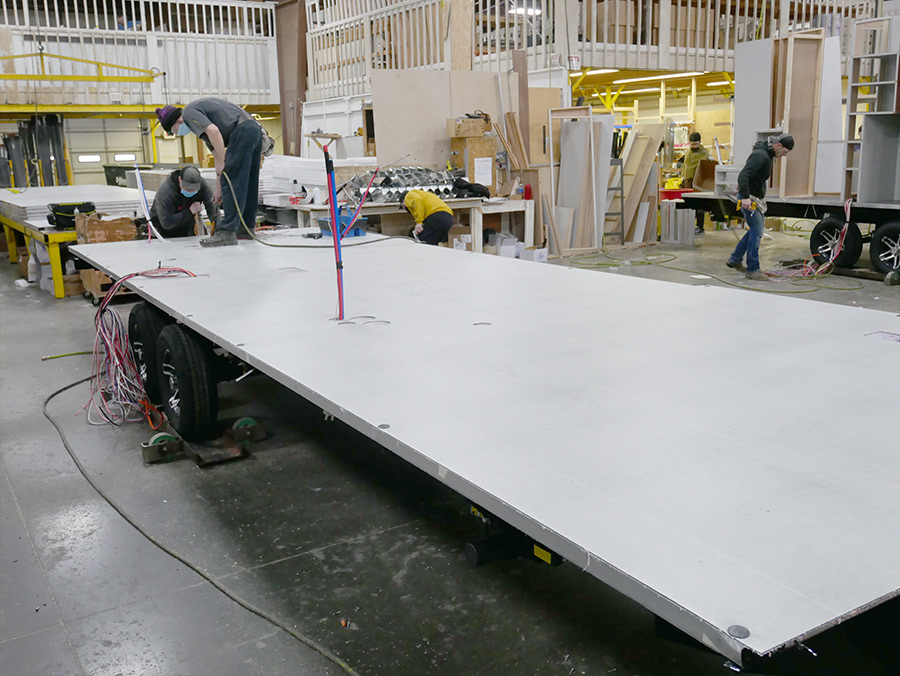
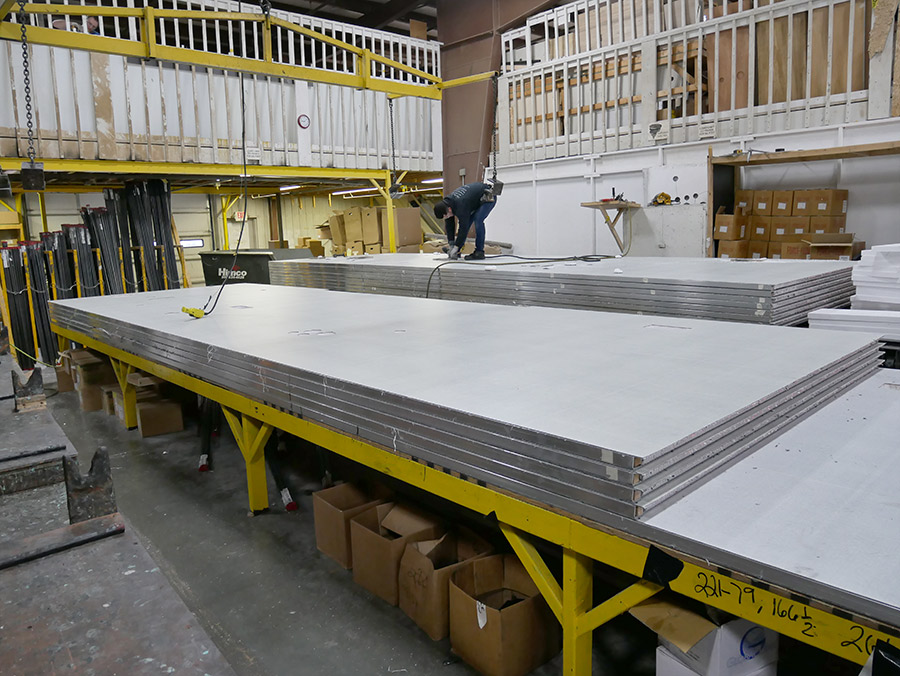
More recently, the subsidiary of Thor Industries introduced its Hyperdeck, a composite floor made of 100% inorganic materials that, said Mark Bullock, senior vice president of engineering for Keystone, is “basically impervious to water,” lighter weight and stronger than the lauan plywood it replaces.

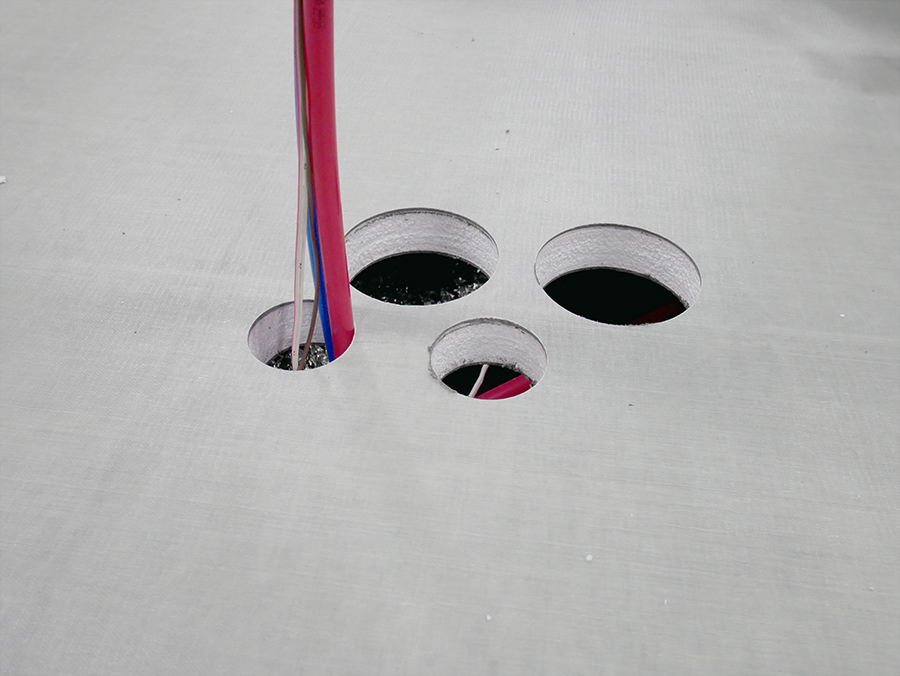
According to Bullock, Hyperdeck is a laminated composite “sandwich” — it’s basically a three-layer product with two outer layers of a hard-shell polypropylene with an inner composite weave of short- and long-strand poly fibers that are stitched together; the entire assembly is then heated and compressed into sheet form.
“It gives us the benefit of being rigid, has very good impact strength, is extremely durable and has, surprisingly, better screw retention for cabinet and wall screws than we had with the wood layers on top of the old laminated floor,” Bullock said.
Even the two exterior polypropylene layers are unique. Topside, Hyperdeck utilizes FX8 floor composite from TekModo that itself offers water resistance, lighter weight and increased strength and durability. On the bottom, the decking uses Symalite, a low-weight reinforced thermoplastic (LWRT), a mixed-glass-and-polymer fleece.
“It’s a common product in the industry,” he added, “and companies (including Keystone) often use it as a panel material. But what we’ve done is apply it as a lower bottom layer to our floor along with a protective film that’s been added to the material to withstand rain, road debris —anything the tires might be throwing out.” The bottom film essentially replaces the traditional (and sometimes messy-appearing) Darko underbelly protection.

“Once we narrowed our search down to a couple of likely candidates, we went into a second round of really intensive testing,” Bullock said. “We did the typical ‘impact test’ for glue retention, then performed a lot of deflection testing for the product’s elasticity.” Then, after determining how much bending strength the material had, Keystone engineers took the same 8-foot sample, mounted it to a simulated RV frame and positioned it in one of the company’s plants so hundreds of employees had to walk over it every day. The sample was then remounted to the test fixture for additional “bending moment” testing — where engineers found it still deflected the same amount, depending on the weight added to it, as it had beforehand.
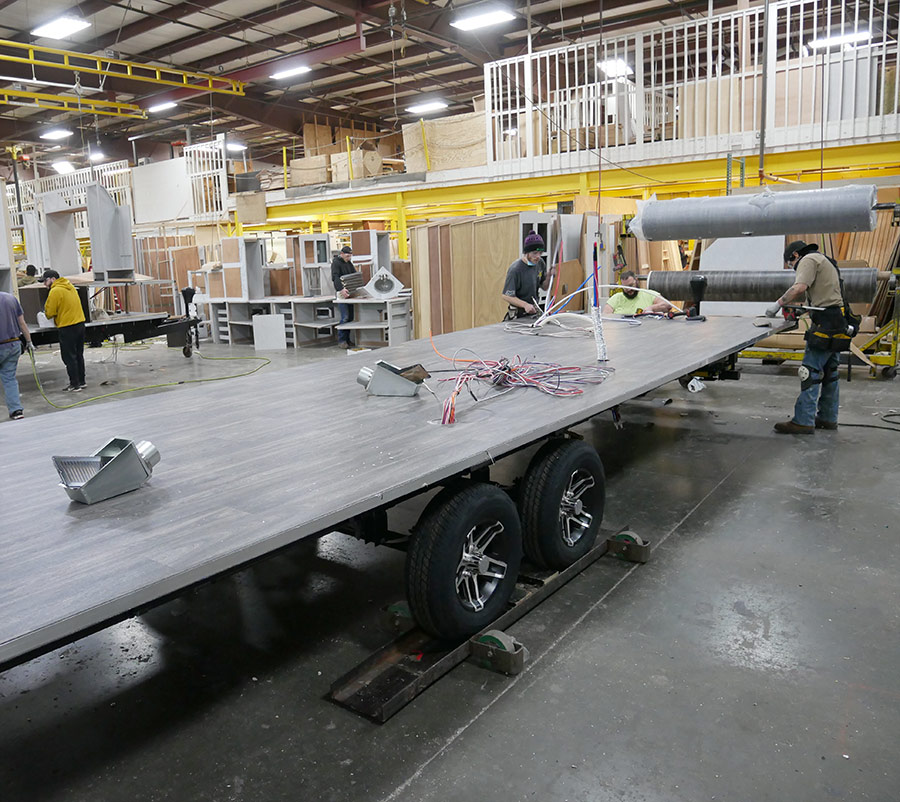
Hyperdeck is intended to be utilized on all Keystone models that use a laminated floor and are more weight-conscious, a lineup that includes Bullet, Passport, Premier, Outback, Cougar Half-Ton and Laredo SuperLite brands.
“We did some calculations, and the Hyperdeck saved about 70 pounds on our shortest lightweight unit,” Bullock pointed out. “In our longest product in that segment, we saved about 110 pounds over what we had used before — and it’s a stronger product.”
It is, and one might expect, also a more expensive product — but Keystone didn’t pass along the cost to consumers. “We just wanted to give customers some peace of mind,” said Bullock. “There are no issues with it: if they spill something or, if a leak occurs somewhere, they aren’t going to have a problem down the road.”