


hose of you who are seasoned veterans of camping have likely encountered “hot skin” situations a few times over the years. New RV owners, however, may be surprised and alarmed the first time they touch the side of their RV while standing on the ground and feel a shock. Is this normal? Can it possibly be dangerous? No, it’s definitely not normal. And yes, it can be dangerous under certain conditions and circumstances. But first, let’s get a few definitions out of the way.
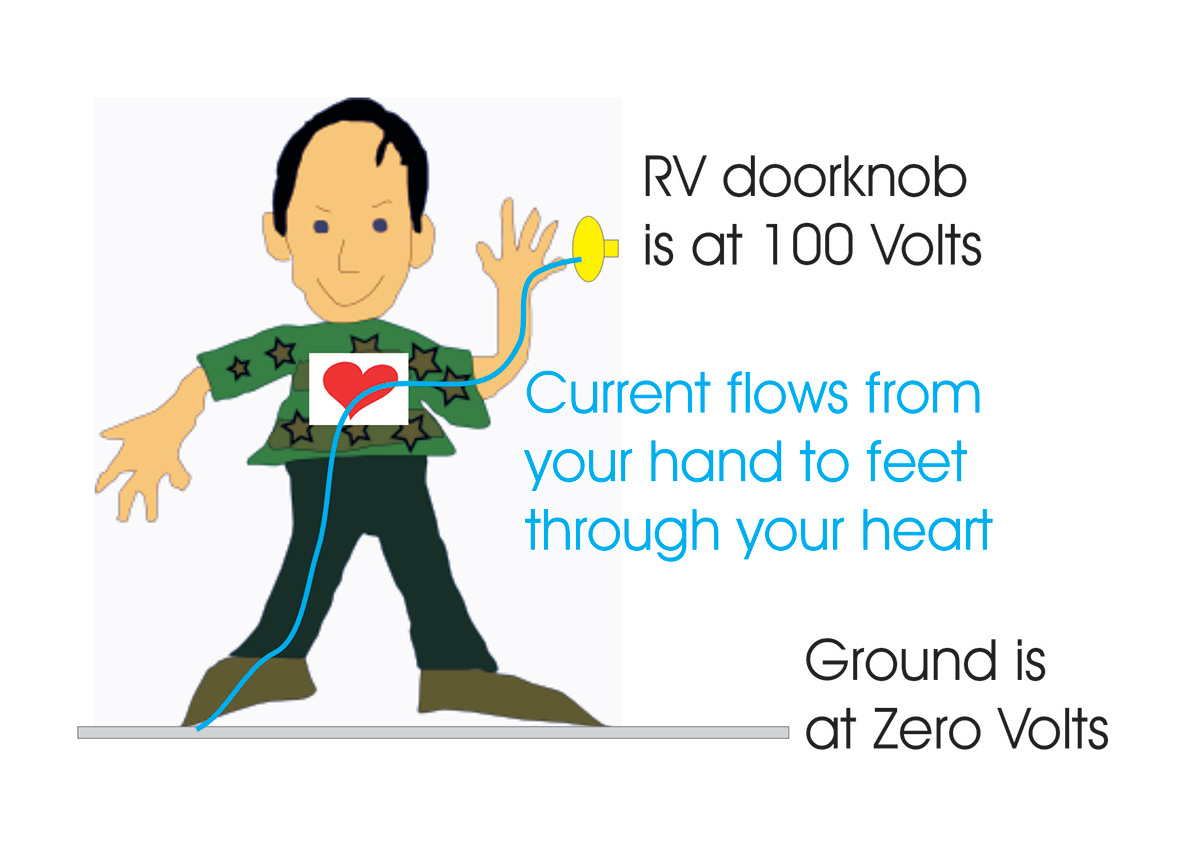
What is “Hot Skin”?
There’s really no formal definition of a hot-skin voltage in the National Electrical Code (NEC). In fact, the phrase “hot skin” is unique to the RV industry. In nearly all other industries and trades it is called a “contact voltage” or “stray voltage.” However, I’ll stick with the term “hot-skin” since that’s what the RV industry has been calling it as far back as the 1960s.
RV hot-skin voltage is defined as, “a significant voltage potential between the chassis/skin of the RV and earth ground.” Understand that there can be normal electrical potential of up to 5 volts between the RV chassis and earth, which is caused by the power company, but that’s not what I’m describing here. I consider a hot-skin condition to be any voltage potential over 10 volts AC between the RV chassis and earth ground, with any voltages around 30 to 40 volts being potentially dangerous depending on the condition of your heart and how long you’re in contact with it. And it’s certainly possible to have up to 120 volts AC on an RV skin/chassis, which can definitely be deadly under certain conditions.
What causes a Hot-skin Voltage?
Glad you asked. There needs to be two conditions for a hot-skin voltage to occur: First is a poor or missing ground connection between your RV and the service panel’s ground-bonding point. That means that your RV and all of its shore power cords, adapters, extensions and whatever it’s plugged into (such as the campground pedestal) need to be properly grounded (specifically called “bonded” by the NEC). If your RV is properly grounded to the campground or home service panel’s bonding point, it should be impossible for your RV to develop more than 5 volts between it and earth ground.
Second, you need a have a source of a ground-fault current, which can turn into a hot-skin voltage since it’s not drained away by the ground wire. Please be aware that a ground rod really doesn’t “ground” an RV (more on that later).
Why is This Dangerous?
If you feel a tingle while touching any part of your RV, there’s likely at least 20 or 30 volts AC of hot-skin voltage on everything metal — not only is the skin of the RV electrically energized on aluminum-sided models, but the RV chassis is energized as well, along with the wheels, trailer hitch, propane tank/cylinders and even your tow vehicle. That’s because virtually everything metal in and on the RV is tied (or bonded) together. If you have 40 volts on the RV skin, you’ll have the exact same 40 volts everywhere else.

The danger comes when a human body gets between earth ground (standing on the damp dirt, lawn or concrete) and touching anything metal on the RV (such as the steps, door handle, metal skin or bumper). Even the lug nuts on the wheels and the wheels themselves can be dangerous if you touch them while they’re energized and you’re standing on the ground.
If you touch any of these energized parts with your hands or other body part while standing on the ground, there’s a fault current that will pass through your body on the way to ground — and right in the middle of your body is your heart. Depending on your age and fortitude, as little as 10 mA (milli-amperes or 0.010 amperes) of current passing through you can put your heart into fibrillation. If this happens and you don’t receive medical attention in a few minutes, you’ll likely die from this hot-skin shock.
Normal or Dangerous Hot-skin Voltage
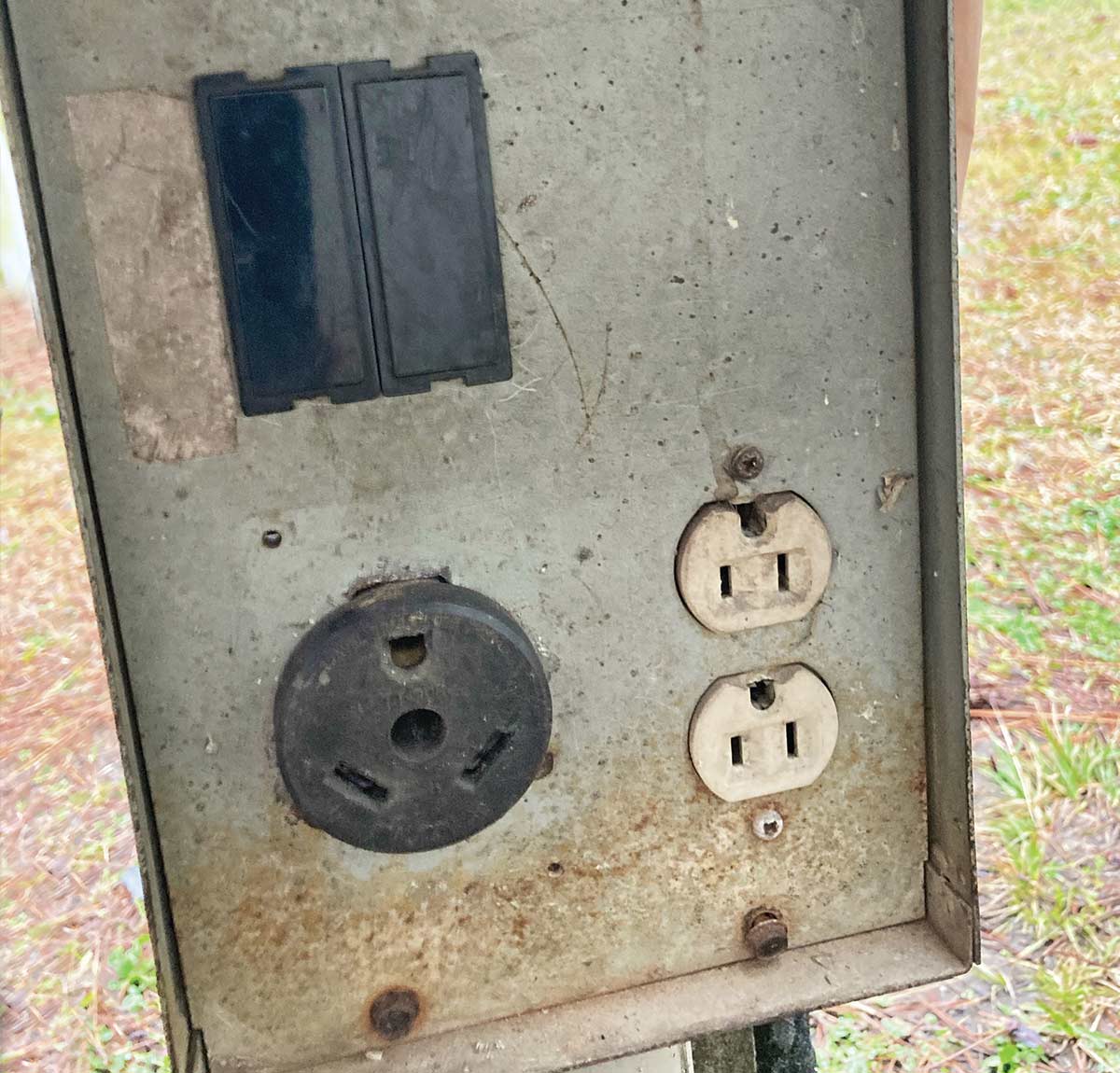
If you measure a small voltage potential between earth ground and the chassis ground of the RV (in the range of 3 to 5 volts), that can be caused by the power company’s unbalanced 3-phase power lines feeding the service panel. This can be annoying but it’s not really dangerous to human life. However, if you’re measuring 30 to 40 volts — with up to 120 volts AC possible between the RV skin/chassis and earth — then there’s definitely a broken or loose connection somewhere in the RV’s electrical grounding system between the RV chassis and the service panel’s ground-bonding point. In many cases, this can be as simple as a missing ground lug on an extension cord or a worn-out pedestal outlet in a campground that’s too corroded to make a good connection. The campground pedestal in the accompanying example was so worn the park operator had to use a bungee cord to keep the surge protector from falling out of the outlet. Note, too, the lack of circuit breakers — another big code violation.

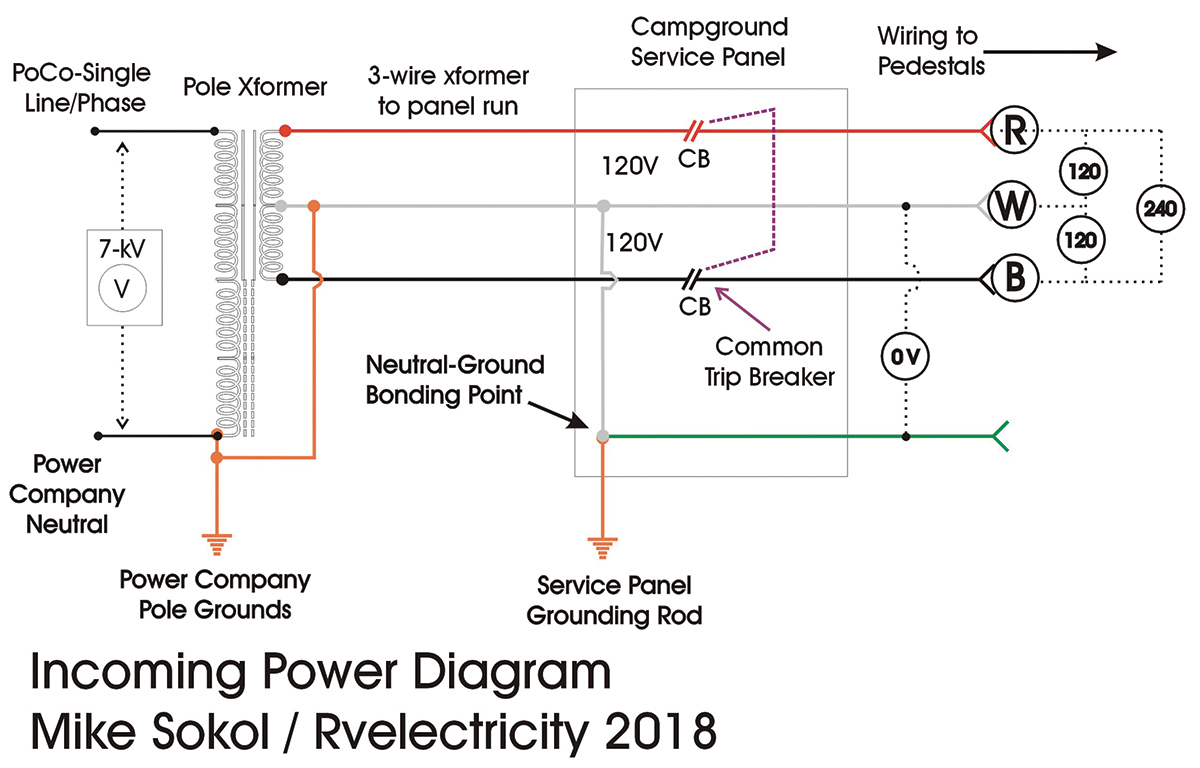
The green or bare-copper ground wire in a shore power connection is so important because it’s the safety ground (technically called the Equipment Grounding Conductor or EGC). Its primary job is to drain away any ground-fault currents to keep them from turning into hot-skin voltages that can shock you. Obviously, any situation with a missing or corroded safety ground connection is always dangerous.

Making the Connection
The EGC conductor extends from the bonding point inside the RV’s power panel, though the shore power cord, dog-bone adapter, campsite pedestal outlet and all the way back to the campground’s service panel. There, it’s “bonded” to the neutral conductor of the transformer from the power company as well as at least one (and possibly two) eight-foot-deep grounding rods.
Ground rods are probably not what you think they are. The job of the grounding rod is not to “ground” the RV. In fact the earth itself is a pretty poor ground, believe it or not. Ground rods are there to direct any lightning strikes deep into the earth before these can take secondary paths through your home or RV wiring. So, a ground rod by itself will not “ground” the RV; that’s the job of the safety ground wire (ECG).

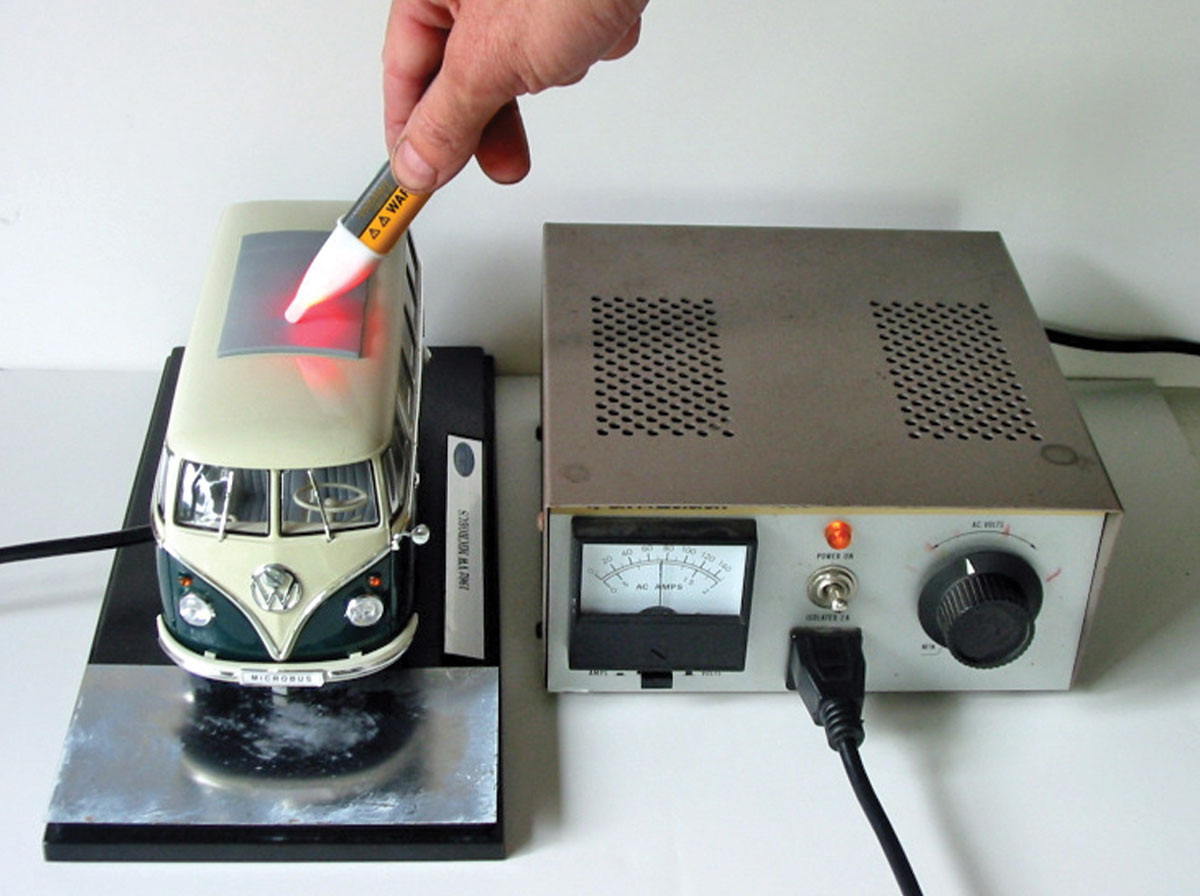
Fault currents come from nearly everything you plug into power. Anything that’s plugged into an electrical outlet will leak at least a little fault current to the chassis. But UL (and other code-making bodies) limit the allowable amount of leakage current to below the threshold of what a person can normally feel, which is typically around 1 mA (milliamps or 0.001 amperes) of current. When the available leakage current gets above 5 mA, that’s what trips a GFCI. But that’s another entire article.
Larger ground-fault currents can also occur in an RV. For the most part, the prime suspects are often the 120-volt AC noise filter capacitors in the RV converter/charger (up to 3 mA), a corroded-through electric water element (up to 2 amperes) or even a dead short circuit between a conductor and the chassis of the RV (up to 20 amperes) which can be caused by something like a screw or nail piercing a wire inside of a wall.
Measuring for Hot-skin Voltage
The “gold standard” method to test for hot-skin voltage is to drive a short ground rod into the damp dirt — a 12-inch-long screwdriver will do — and measure between the metal screwdriver shaft and a bare metal spot on the RV chassis (a lug nut usually qualifies). If you measure up to 5 volts AC with a digital meter, there may not be anything wrong at all — but if you find in excess of 10 volts AC with this measurement, then there’s definitely some kind of failure in the RV’s safety ground connection (the EGC in code language).
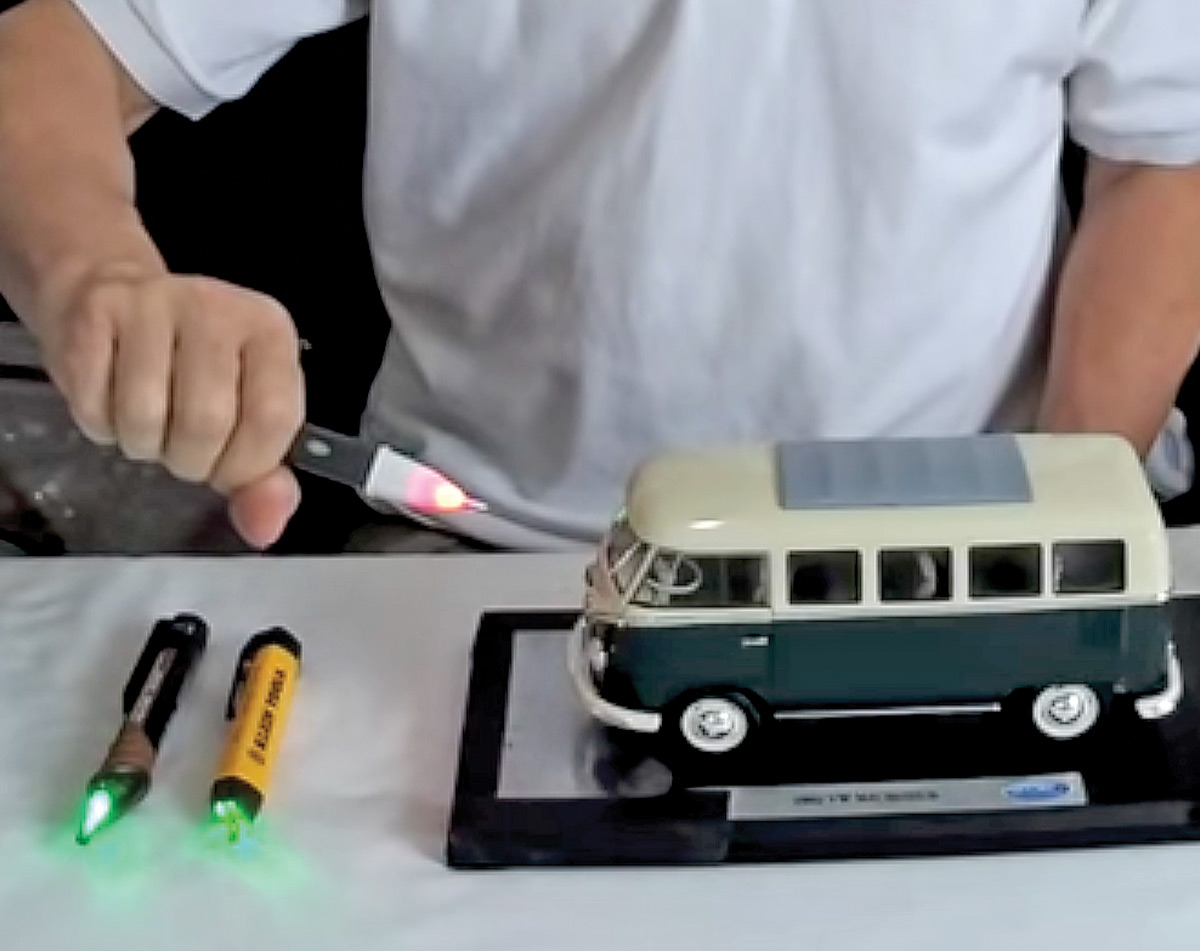
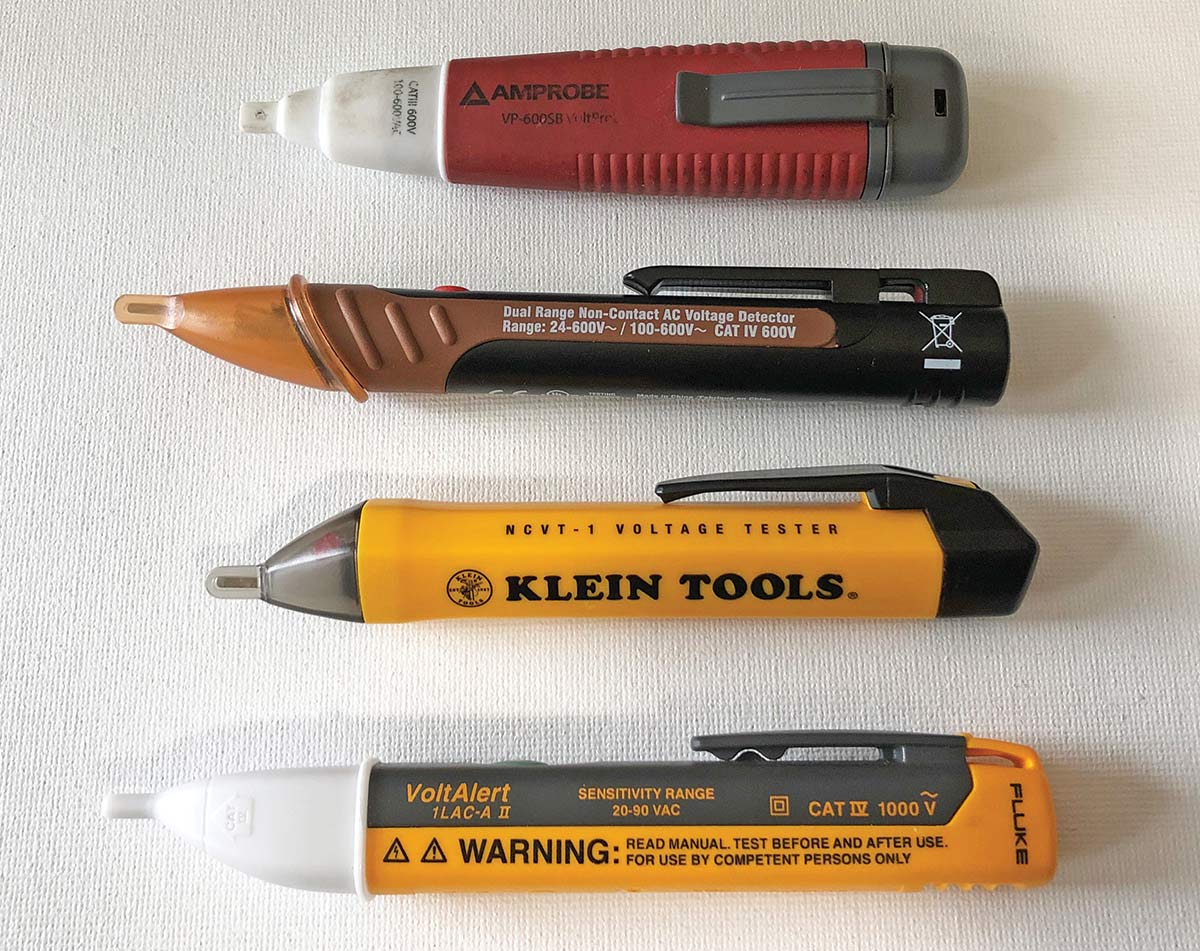
That said, there’s an easier way to test for hot-skin voltage, which I developed and pioneered with the late Gary Bunzer more than 10 years ago — and I’ve found it to still be the quickest and safest way to test for a hot-skin voltage of 30 to 40 volts (where it begins to become really dangerous). A product called a Non-Contact Voltage Tester (NCVT) or Tik-Tester (electrician slang), available from any big-box store, will beep if you get close to an RV skin (or chassis) that’s energized with at least 30 volts. Remember to always check any NCVT on a known-energized electric source like a pedestal outlet first to confirm that it’s actually working and hasn’t failed from a dead battery.
In fact, if your RV has a hot-skin potential of 60 to 80 volts it will typically beep from several inches away — and if your RV has a hot-skin potential of 120 volts AC, it will usually beep from one to two feet away. That should get your attention.
What to Do if You Find a Hot-skin Voltage
Well, don’t leave your RV plugged into power and hope for it to go away. You need to unplug from shore power immediately until you or the campground operator locates the source of the voltage and repairs it.
You may feel a stronger tingle if the dirt is wet — and it may even seem to go away when the dirt dries out — but that usually doesn’t mean that the hot-skin voltage has magically disappeared. What probably has occurred is that you’re now in dry shoes standing on dry ground, so there’s so little current passing through your hand that you can’t even feel it as a shock. But the hot-skin voltage — and the potential fault current causing it — in all likelihood has not gone away. It’s probably just disguised by the dry dirt. The next time it rains, the real danger lurks if anyone touches any metal part of the RV while standing in a puddle outside.
Above all, if you suspect that you are experiencing a hot skin condition, unplug the RV from shore power and either diagnose the issue yourself or arrange for a professional to help you as soon as possible.
In the next issue of RV Enthusiast, Part Two of Hot Skin will demonstrate advanced troubleshooting techniques to find the source of all ground fault currents as well as how to repair them. It also will show how to use an inexpensive line splitter from Italy with a low-amperage (1mA) clamp meter from China to find very small (5 mA)l ground fault currents that can cause GFCI “nuisance-tripping” in campgrounds as well as more elaborate test gear which can confirm that campground pedestal grounds actually meet National Electrical Code standards.
id you know that many, if not most, hot-skin incidents happen when an RV is plugged into an improperly wired or maintained home outlet? If you are plugging your RV in at home, invest in an RV connection box (30AMP / 50AMP / 50/30/20AMP) and have it installed by a licensed electrician.