



o you really need a battery in your RV?
Let’s get this question out of the way first. If you’re plugged into shore power 100% of the time and only rarely move your RV, then there’s nothing forcing you to have a “house” battery at all. That’s because even though most of your RV’s electrical system (such as lighting, furnace control and monitoring systems) is likely powered by 12 volts DC, all modern RVs include something called a “converter.” This component’s job is to provide around 12 to 14 volts DC (direct current) at 40 to 60 amperes of current for general electrical needs.
Of course, this 12-volt DC power doesn’t include heavy appliances such as your convection microwave oven, rooftop air-conditioner or electric water heater, each of which require a dozen or more amps of current at 120 volts AC. But if you’re plugged into shore power (or a generator) the converter takes care of the 12-volt DC requirements of your RV while your power center distributes 30 or 50 amps (two 50-amp legs for 100 amps total) to all your 120-volt AC power hungry appliances. But that’s a different story altogether.

The Candidates
I’m currently experimenting with a number of batteries to determine how long each of them will run an air-conditioner, Instant Pot, RV furnace or CPAP machine. More details on each one can be found further on, but for now I’ll divide them into the following chemistry types:
- Flooded Lead-Acid (FLA) 6-volt
- Flooded Lead-Acid (FLA) 12-volt
- Absorbent Glass Matt (AGM) 12-volt
- Lithium Iron Phosphate (LiFePO4) 12-volt
This article will only cover 12-volt battery systems, so there will be no discussion of high voltage (48-volts DC and above) systems that are becoming popular on some all-electric RVs.

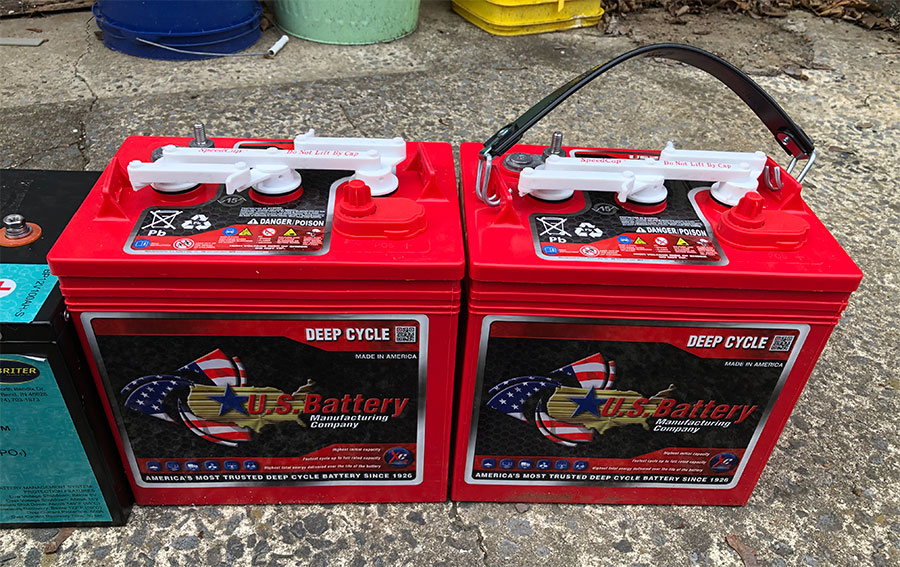
As noted below, flooded lead acid batteries do indeed have liquid electrolyte inside of them (sulfuric acid and water) so they must be shipped and mounted vertically. Insofar as safety, getting sulfuric acid on your clothes quickly rots them away in a matter of hours, while getting it in your eyes can be very painful and possibly lead to blindness, so old clothes and safety goggles are the uniform of the day when working with any flooded-cell battery.

This is a true deep-cycle battery that offers a few advantages over the typical flooded lead acid battery. It requires zero maintenance, which is an advantage in an RV that has its batteries located in an inconvenient location. And, because there’s no actual liquid sloshing around inside, you can mount it on its end if you want. Since this technology can be discharged down as low as 20% SOC (state of charge) you can use about 80% of its rated 100 amp-hours, which works out to 80 amp-hours of usable storage. However, for optimal life expectancy, discharges below 50% should be kept to a minimum. Also, since there’s no significant out-gassing (unless something goes terribly wrong) its venting requirements are much less stringent compared to an old-school flooded-cell battery.


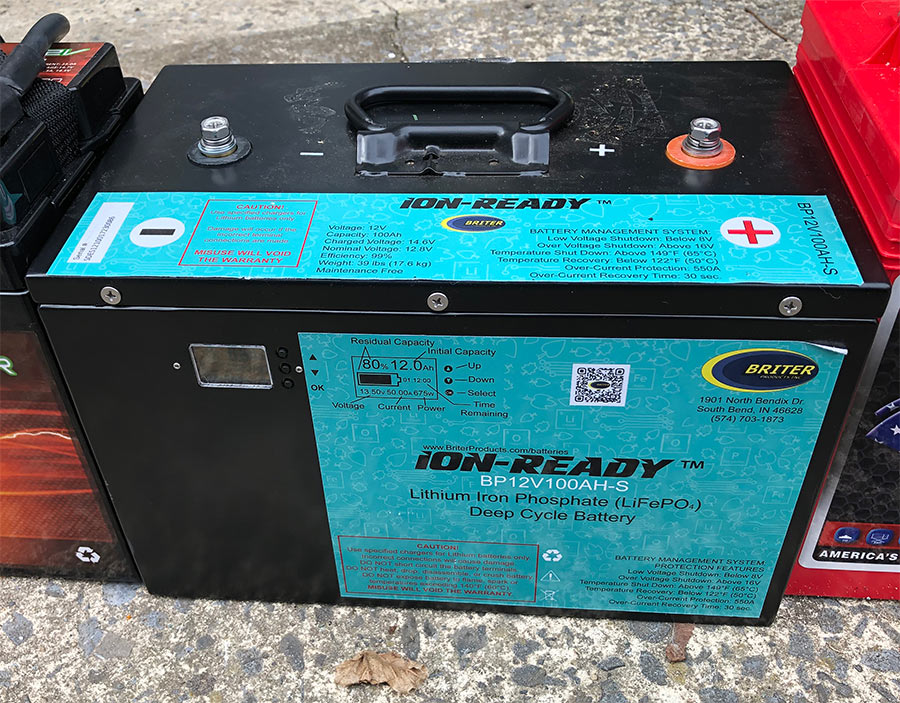
Another benefit of lithium batteries is they can be recharged at a much faster rate than a FLA or AGM battery. In many cases you can recharge it from 0% to 100% SOC in less than 2 hours. That may not be important to you if you can use a smaller charger all night, but if you’re boondocking and want to only run the generator a short amount of time, you may be able to go from 20% to 100% SOC in an hour or so instead of the four to six hours of generator running/charging time for FLA and AGM chemistries. Also, charging via a solar system is more efficient.

The Choice is Yours
What type of battery should you choose to power your 12-volt DC needs? If you’re not planning to keep your RV for six or seven years, then paying $1,500 for a lithium battery doesn’t make economic sense. However, if you’re a serious boondocker who takes his/her batteries to the limit, then it’s a great deal.
AGM batteries are a good middle ground, offering zero maintenance and more usable storage capacity than flooded lead-acid batteries.
So, you pay your money and make a choice for your own RVing lifestyle. With a little care, any of these battery technologies should give you many years of solid service.
In the next issue of RV Enthusiast, part two of Battery Basics will cover charging characteristics of each battery type and how to select the proper converter/charger for each battery chemistry. It also will discuss how much battery capacity is needed to operate things like coffee makers, hair dryers and CPAP machines while boondocking; show a number of solar panel and DC-to-DC charging solutions; and illustrate how to recharge your batteries quickly with a portable generator.
(574) 703-1873
briterproducts.com
U.S. Battery Mfg. Co.
(800) 695-0945
usbattery.com
VMAX USA, LLC
(248) 827-1021
vmaxtanks.com

Chemistry: Flooded Lead Acid (FLA)
Weight per pair: 124 pounds (62 pounds each)
Energy capacity per pair: 232 amp-hours at 12 volts with 0% SOC (State of Charge). 116 amp-hours of available energy at 50% SOC.
Max Charging Rate: Approximately 40 to 50 amperes (20% to 30% of rated amp-hour capacity, depending on the manufacturer)
Minimum SOC: 50%
Lifespan: From 500 to 1,000 charge/discharge cycles
Maintenance: monthly level checks and refill with distilled water
Mounting Orientation: Must be mounted with fill caps on top
Safety: Can outgas sulfuric acid fumes so they must be installed in a vented compartment
Temperature Limitations: None
Cost: $185 ea. /$370 per pair
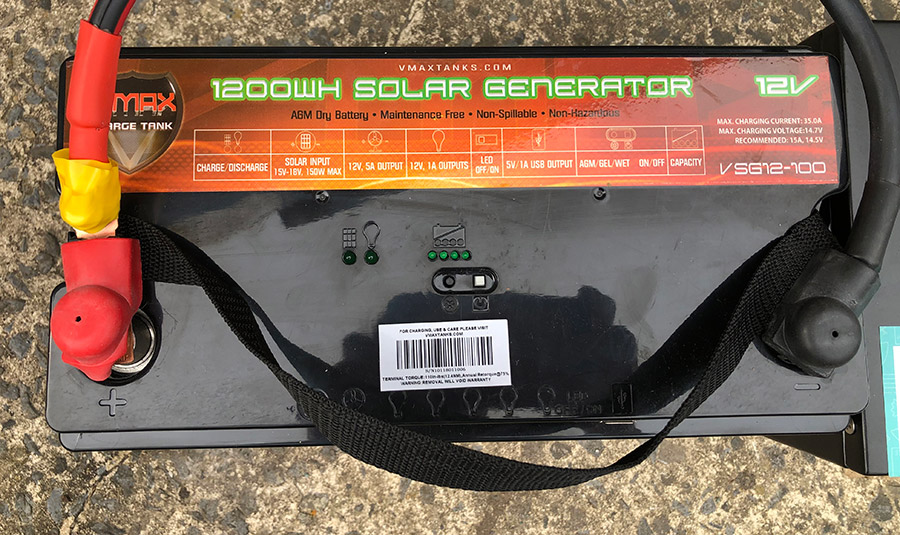
Chemistry: Absorbent Glass Mat (AGM)
Weight: 73 pounds
Energy capacity: 100 amp-hours at 12-volts
Max Charging Rate: 30 amperes (20% to 30% of rated amp-hour capacity, depending on the manufacturer)
Minimum allowable SOC: 20%
Lifespan: 300 to 1500 charge/discharge cycles (depending on depth of discharge and manufacturer)
Maintenance: None
Mounting Orientation: Any
Safety: No outgassing under normal conditions, so can be mounted with limited ventilation requirements.
Temperature Limitations: None
Cost: $290
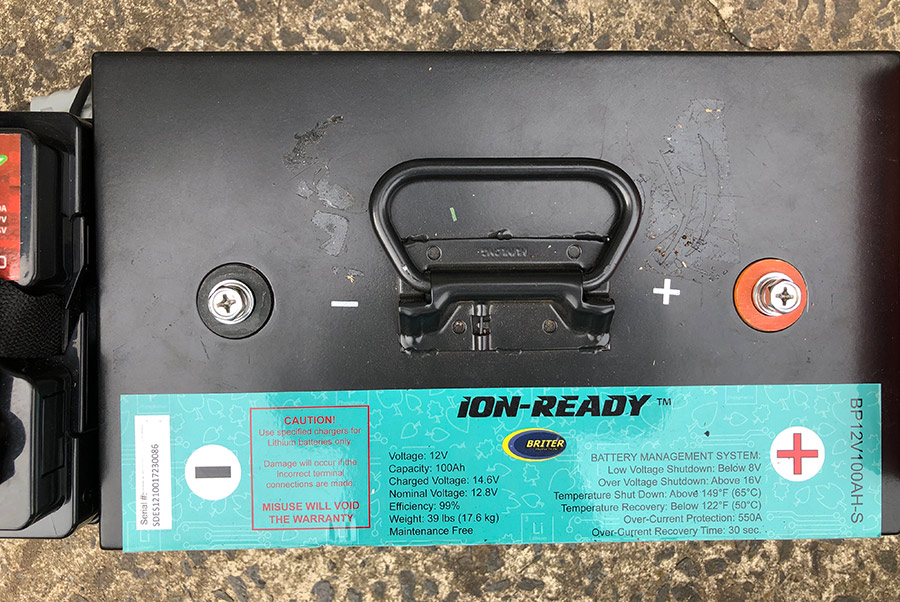
Chemistry: Lithium Iron Phosphate (LiFePO4)
Weight: 41 pounds
Energy capacity: 100 amp-hours at 12-volts
Max Charging Rate: 100 amperes (depending on the manufacturer)
Minimum allowable SOC: 0%
Lifespan: From 1,500 to 5,000 charge/discharge cycles, depending on depth of discharge
Maintenance: None
Mounting Orientation: Any
Safety: No outgassing possible, can be mounted with no ventilation
Temperature Limitations: 32F to 104F during charging, and -4F to 140F during discharge
Cost: $1,500

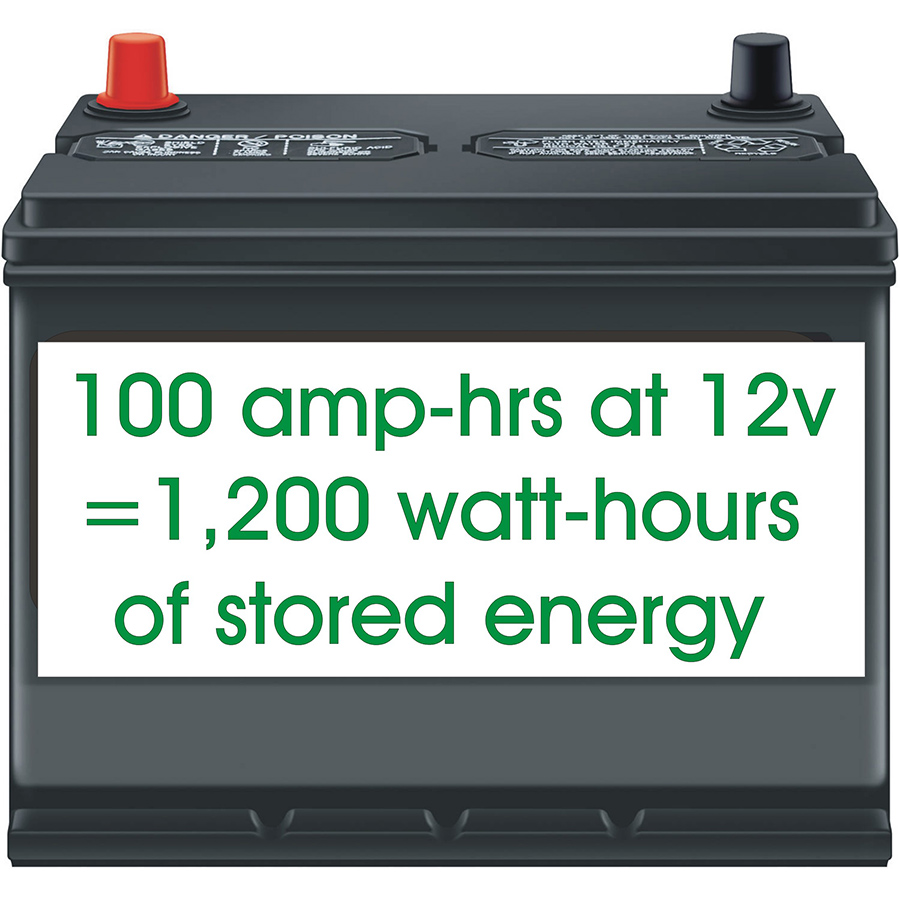
A watt is a unit of power. Let’s say you have a 100-watt light bulb, for example. By definition it draws 100 watts of power from its electrical source. It will also make 100 watts of light and heat energy (mostly heat if it’s an old-school tungsten bulb). Other common things with wattage ratings would be an electric space heater (1,200 watts), a hair dryer (1,800 watts) and a laptop computer (75 watts). A watt-hour is a unit of energy. If your 100-watt light bulb is drawing 100 watts of power for 1 hour, it will use 100 watt-hours of energy. Turn it on for 10 hours and it will draw 10 times that: 1,000 watt-hours of energy (because 100 watts x 10 hours = 1,000 watt-hours), which could also be called 1 kwh (for kilowatt hours).
But what about batteries that are rated in amp-hours of storage? Well, since Ohm’s law tells us that volts x amps = watts, we have to convert the typical 100 amp-hours of storage at 12 volts DC into watt-hours of storage. That’s pretty easy, because we know that volts x amps = watts. So, a 12-volt battery rated for 100 amp-hours of storage can be defined at 1,200 watt-hours of storage. All you have to do is multiply 12 volts x 100 amp-hours to calculate 1,200 watt-hours (12 volts x 100 amp-hours =1,200 watt-hours) of stored energy.
Once you get everything converted to a common energy currency (watt-hours) it’s pretty easy to calculate how long you can run the appliance before you discharge the battery. As an example, let’s suppose you have a CPAP machine that draws 200 watts of power to operate. If you have 1,200 watt-hours of battery storage (100 amp-hours at 12 volts) then you can easily see that 1,200 watt-hours/200 watts = 6 hours. It doesn’t matter if you’re using a 12-volt DCD connection or a 120-volt AC wall plug, because watts is watts. Once you get everything converted into watt-hours of energy, you can simply multiply and divide to estimate the available run time on a battery charge.
If you double the number of batteries you will now have 200 amp-hours of storage at 12 volts, which is 2,400 watt-hours of energy storage. With four 100 amp-hour batteries, you would have 400 amp-hours times 12 volts of storage which equals 4,800 watt-hours of stored energy. Simply put, if you double your battery amp-hour capacity, then you double the time you can run your microwave or hair dryer or Instant Pot.
See how it all works?