
t’s safe to assume that the words “pick-up truck” and “serenity” have rarely been used in the same sentence. After all, trucks were engineered with specific uses in mind — pulling heavy trailers, hauling big payloads and trundling down rutted roads en route to the farm or worksite.
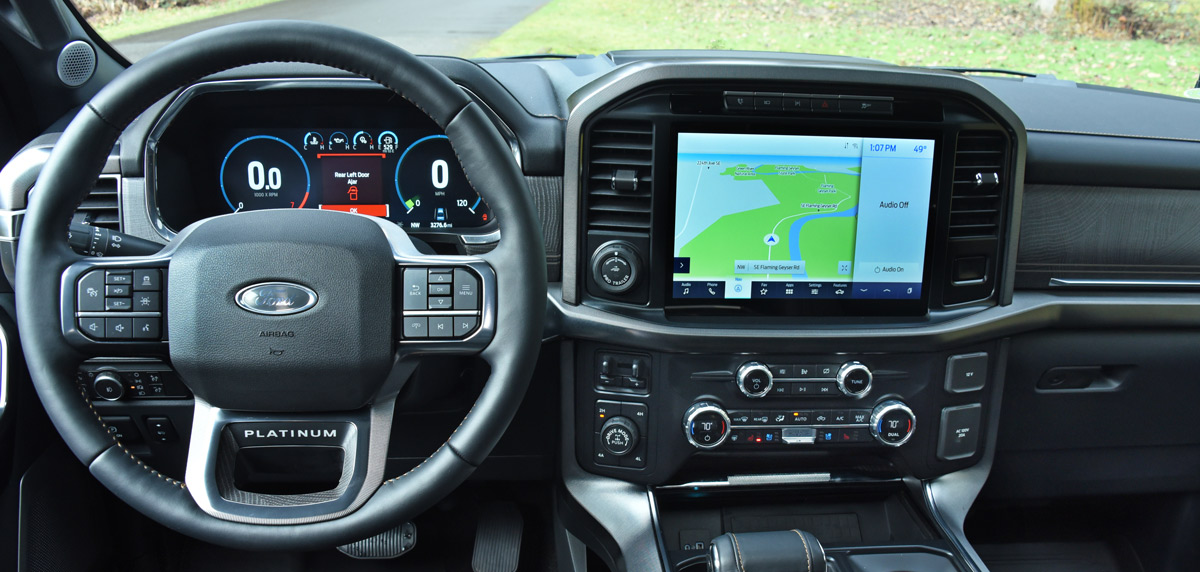
So you can imagine my surprise when I pushed the start button in our test 2021 Ford F-150 PowerBoost hybrid and experienced…nothing.
In a Toyota Prius, for example, the initial absence of an internal combustion engine wouldn’t come as any surprise. But in a truck capable of towing up to 12,700 pounds, it felt surreal. A message on the digital instrument cluster told me the truck was ready to drive, so I eased the Antimatter Blue-toned SuperCrew out of the parking lot. It was more than a quarter mile down the street before its 3.5-liter EcoBoost engine finally came to life. When it did, it was with little fanfare — just a subtle purr, like the dutiful hum of a well-worn sewing machine. There are luxury cars that aren’t this quiet.

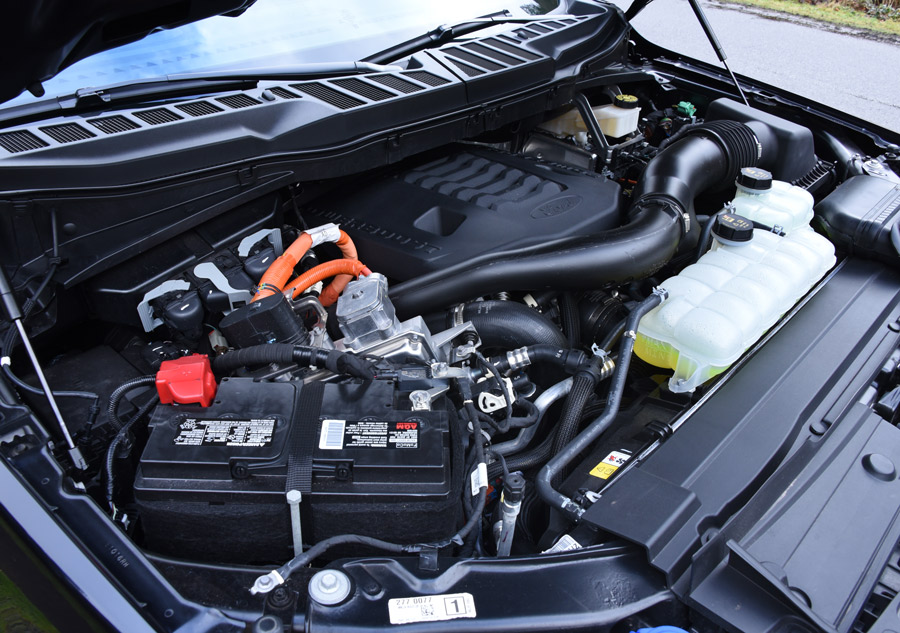
As with other hybrids, the 35kW electric motor is housed inside the transmission and works in tandem with the engine for more power and torque, for a total of 430 bhp and 570 lb-ft of torque compared to 400 bhp and 500 lb-ft of torque for the non-hybrid EcoBoost V-6. A belt-driven starter motor provides smooth transitions between EV Mode and Engine-On mode.
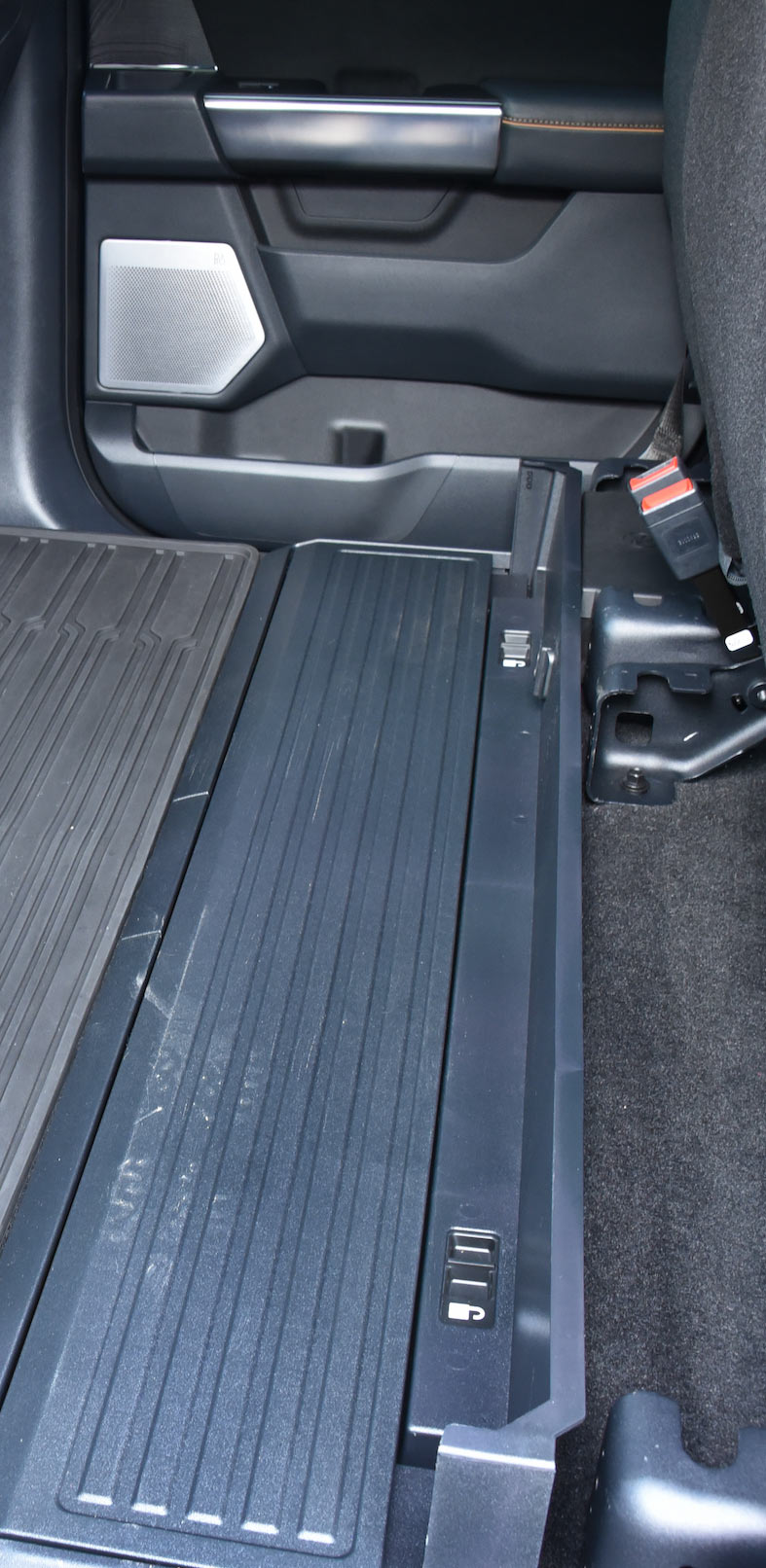
The 1.5kW lithium-ion battery is liquid cooled and engineered to minimize weight while delivering optimum performance, according to Ford. It is mounted with a unique vibration isolation system between the frame rails and below the load floor, so that it does not impact passenger or cargo space.
There is, however, another big reason to want a PowerBoost F-150, especially if you’re an RVer: Pro Power Onboard.
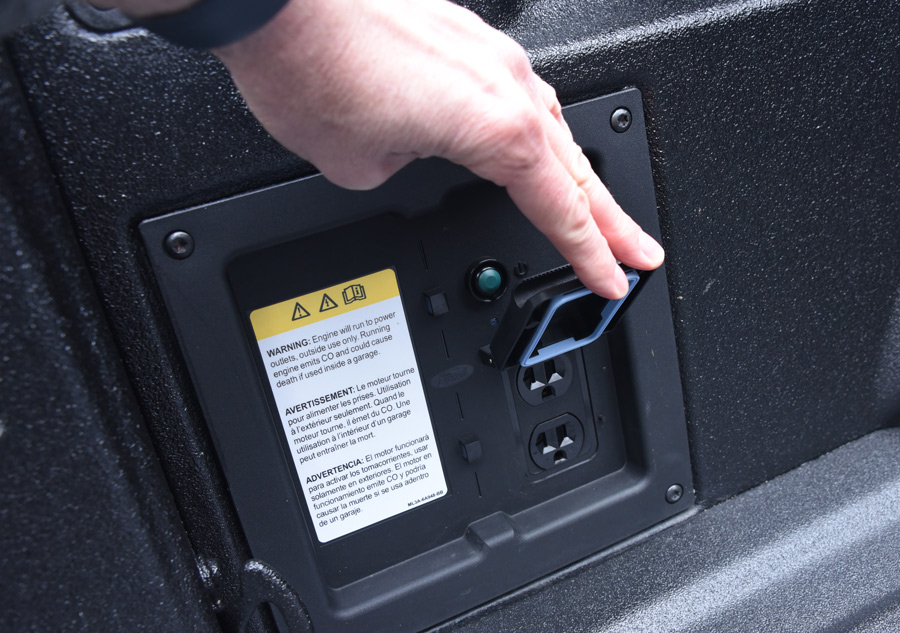
Unless we’re pulling a trailer that’s already equipped with a generator, most of us carry a portable unit capable of powering 120-volt AC appliances when we’re not hooked up to a pedestal at an RV park or campground. With Pro Power Onboard, the PowerBoost F-150 is the generator. A standard 2.4kW inverter converts direct current (DC) from the high-voltage battery to standard alternating current (AC), so you can power up a total of 2,400 watts simultaneously through two 120-volt, 20-amp AC outlets in the driver’s side rear of the bed. Optional is the 7.2kW inverter, which includes four 120-volt 20-amp AC outlets and one 240-volt 30 amp outlet — that’s enough juice to power up your roof air conditioner. Just keep in mind that the power-generating feature of the Pro Power Onboard system requires the engine to be running, so you’ll need to keep a watchful eye on the gas gauge.
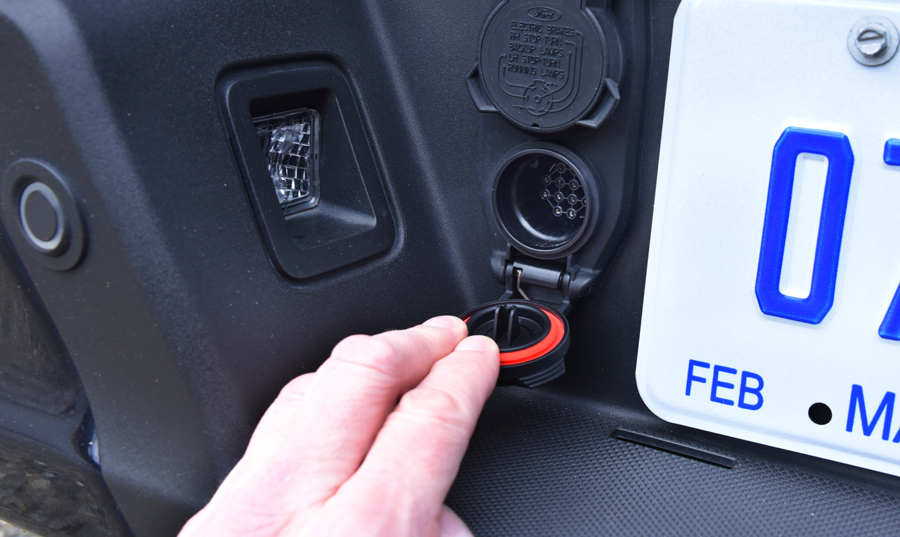
Ford reports that the 2.4kW system has a maximum run time of 85 hours on a full tank, while the 7.2kW system has maximum runtime of 32 hours. Both systems also incorporate 120-volt, 20-amp AC outlets in the cab: one for front-seat passengers, one for rear. We should mention that, if you like the idea of mobile power in your truck but don’t want to ante up for the PowerBoost option, you can get a 2.0kW system with two bed-mounted 120-volt, 20-amp outlets on 2.7-liter EcoBoost, 5.0-liter V-8 and 3.5-liter EcoBoost (non-hybrid) trucks as an optional feature.
On the road, driving solo, there is almost no noise with the F-150 — no wind whistle, and certainly no squeaks or rattles. The engine and hybrid system transfer power to one another so seamlessly, you won’t notice it after a while. But when you mash the accelerator pedal, a completely different personality emerges: The truck lunges forward with urgency and continues pulling until you’ve arrived at Jail Speed. On a highway on ramp, we floored it around 50 mph and were at, um, 85 mph by the time we merged. This F-150 isn’t just fast for a pick-up — it’s fast, period. For anything. We have no doubt it will tow within its rated capacity without effort, and it’s capable of returning fuel economy figures you’d normally associate with a passenger car when driving solo.
That’s progress.